


Cleaning incense burners in preparation for Tet (Lunar New Year). Photo: DUY KHOI
In terms of meaning, the customs and rituals of the Lunar New Year are seen as expressions of the life of agricultural communities, because the spring festival is a time to celebrate the harvest, and at the same time to offer thanks to heaven, earth, and ancestors, and to pray for a bountiful new farming season. In terms of meaning, the Lunar New Year is the first day of the new year ("nguyen" means first, and "dan" means morning, so "nguyen dan" means the first morning of the first month of the new year). Therefore, folk belief holds that the Lunar New Year is the most important day of the year, especially the first day, counted from the moment of the New Year's Eve.
In fact, ever since the day the Kitchen God is sent to heaven, the 23rd day of the 12th lunar month has been considered Tet (Vietnamese New Year) by the people, which is why it's called the 23rd day of Tet. This name makes sense, as it marks the first step in the family's rituals to welcome the new year: worshipping the Kitchen God. And from the 23rd day of Tet onwards, people have the custom of visiting their ancestors' graves to weed, clear bushes, and decorate them, a practice known as grave sweeping.
Accompanying this traditional tomb sweeping custom is the Nghia Trung Ceremony before Tet. According to custom, on a certain day, usually after the ceremony of sending the Kitchen God to heaven, the communities together go to weed, cut trees, and build up all the tombs without descendants to worship them, located here and there in their village boundaries, and pool money and prepare offerings for the communal ceremony... This is a communal ceremony of a certain scale with solemn rituals. In general, the maintenance of ancestral tombs before Tet is a custom of filial piety; the maintenance of tombs without descendants to worship them on this occasion is an act of showing compassion towards the unfortunate in the community before proceeding with the ceremony of welcoming their grandparents and ancestors on the afternoon of the last day of the year (1).
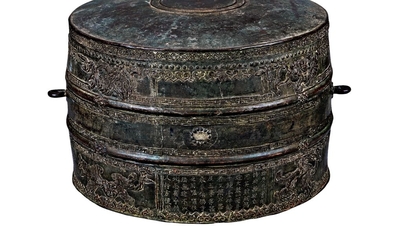
Having finished the external tasks, people began to think about the internal ones: sweeping and cleaning the house, washing mosquito nets, blankets, and curtains; wiping everything clean, with the most important being the incense burner. The incense burner had to be polished until it shone. During the year, if there were no weddings in the house, the incense burner on the altar would only be taken down and cleaned during Tet. Then they would cut bamboo to erect the New Year's pole, according to folk belief, to ward off bad luck and pray for peace in the new year. Another indispensable task during Tet in the old Southern region was the custom of pasting couplets. Couplets were pasted in many places in the house, made of red paper, with content wishing for good fortune in the spring. These couplets were pasted in bright red throughout the house, on wooden pillars, and had to be on the ancestral altar, along with vases, fruits, the bronze incense burner, and a pair of candlesticks, forming a very solemn set on the ancestral altar.
Besides couplets, people also decorate their houses with Tet paintings. Usually, it's a set of four paintings - depicting the four seasons of spring, summer, autumn, and winter, on paper or silk fabric. Besides the four paintings, people also print four auspicious paintings: plum, orchid, chrysanthemum, bamboo; or four people: fisherman, woodcutter, farmer, shepherd. Later, there were more paintings associated with folk tales, stories, and plays close to the life of the people of this land such as: Pham Cong Cuc Hoa, Luc Van Tien, Thoai Khanh Chau Tuan...(2)
Once the house is cleaned, people begin rearranging household items, discarding unusable things, wiping down tables, chairs, and wardrobes, checking the rice bin to see if it's full—if it's half-empty, they buy more to fill it up. Abundance is essential for prosperity during Tet (Lunar New Year). Then they turn to cleaning the altars of the God of Wealth and the Earth God…
Around the 24th to 25th of the twelfth lunar month, people in the Mekong Delta begin draining their ponds to catch fish. They select some of the best fish to keep, and sell the rest at the market. Indispensable dishes for Tet (Lunar New Year) in the Mekong Delta are braised pork and bitter melon soup. Braised pork is usually served with pickled onions, pickled mustard greens, pickled cabbage, and unripe bananas… while bitter melon soup stuffed with meat is believed by locals to symbolize the passing of hardship and the arrival of good fortune in the new year.
Regarding sweets and preserves, besides common varieties like coconut jam, ginger jam, pumpkin jam, candied bananas, sesame candy, watermelon seeds, etc., there are two types of cakes that are always present: banh tet (sticky rice cake) and banh trang (rice paper). Banh tet comes in many varieties such as: beans, meat, fat, etc., and banh trang can be used for grilling or for wrapping vermicelli. Fruits are mostly homegrown, but the two most popular are tangerines and watermelons.

Wrapping banh tet (Vietnamese sticky rice cake) for Tet. Photo: DUY KHOI
On the afternoon of the 30th (or 29th if it's a short year) of the twelfth lunar month, families perform rituals to welcome their ancestors home for Tet (Lunar New Year). This ceremony not only honors ancestors but also the land and spirits of the deceased. Simultaneously, they perform a ceremony to welcome the Kitchen God home for Tet. New Year's Eve is the most sacred moment, marking the handover between heaven and earth, the transition of the old year's rulers to the new year's rulers. At exactly midnight, families lay out offerings to heaven and earth, giving thanks, bidding farewell to the old year and welcoming the new, dispelling bad luck and embracing good fortune for the new year. The atmosphere of New Year's Eve is both sacred and joyful, creating a warm and welcoming feeling for people celebrating the new year.
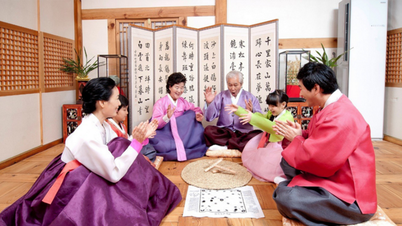
On the morning of the first day of the Lunar New Year, everyone wakes up early. Adults prepare offerings for the New Year's ceremony, while children eagerly look forward to wearing new clothes and visiting relatives. Besides offering sacrifices to ancestors, family members also exchange New Year's greetings. Children and grandchildren wish their grandparents good fortune, especially good health; while older generations give lucky money to their children and grandchildren, along with wishes for successful business and academic achievements. On the second or third day of the Lunar New Year, relatives often visit each other, exchange New Year's greetings, and strengthen family bonds.
It can be said that Tet (Lunar New Year) is also a matter of family tradition. Families have the opportunity to gather and reunite after days of working far apart. The family atmosphere is warmer as they share meals and tea together. Children and grandchildren have the chance to express their gratitude to their grandparents and parents. Siblings care for and love each other more. And even more importantly, it's a time for reunion and filial piety towards ancestors, manifested at the ancestral altar. Children and grandchildren offer the fruits of their labor to their ancestors, showing their remembrance of their roots and gratitude to their ancestors for creating the good life they have today. Along with this, they pray for a prosperous, peaceful, and safe life for their family…
During the Lunar New Year holidays, people also go on outings, visit acquaintances, friends, teachers, colleagues, and business partners... Therefore, the Lunar New Year also helps to strengthen community spirit, close relationships in society, and solidarity within villages.
In short, Lunar New Year is an expression of the relationship between humans and nature in the spirit of agricultural culture, with family and village in the spirit of national community, and with sacred and noble beliefs in spiritual life.
TRAN KIEU QUANG
(1) Huynh Ngoc Trang (2018), "Discussion on Tet", Ho Chi Minh City Culture and Arts Publishing House, pp. 59-60.
(2) Vuong Dang (2014), "Southern Customs", Culture and Information Publishing House, p.105.
Source: https://baocantho.com.vn/phong-tuc-ngay-tet-a197551.html
![[Image] "Journey of Hope" promotes the organ and tissue donation movement in Vietnam.](https://vphoto.vietnam.vn/thumb/1200x675/vietnam/resource/IMAGE/2026/05/20/1779294400833_1-8910-jpg.webp)
![[Photo] General Secretary and President To Lam works with the Party Committee of the Ministry of Health on the work of Vietnamese traditional medicine.](https://vphoto.vietnam.vn/thumb/1200x675/vietnam/resource/IMAGE/2026/05/20/1779294323718_a1-bnd-2978-3319-jpg.webp)














![[Photo] National Assembly Chairman Tran Thanh Man working with the Standing Committee of the National Assembly's Delegation Affairs Committee.](https://vphoto.vietnam.vn/thumb/1200x675/vietnam/resource/IMAGE/2026/05/20/1779294340023_ndo_br_1-1691-jpg.webp)



































Comment (0)