

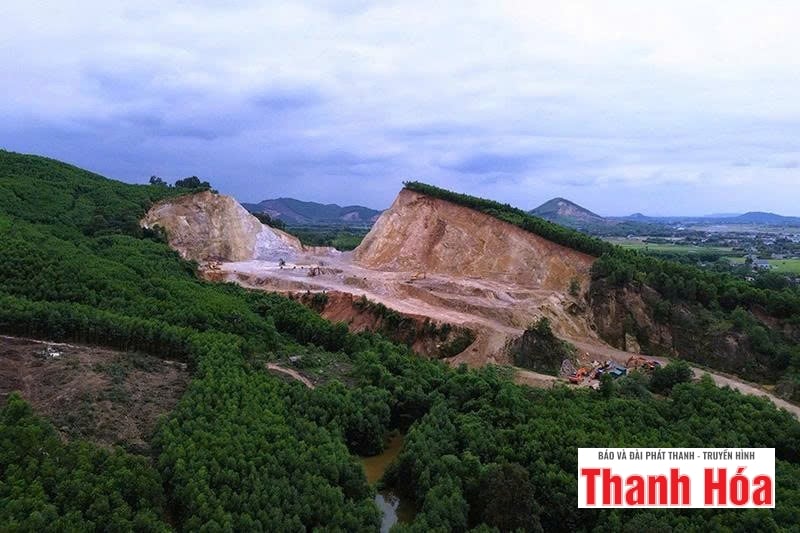
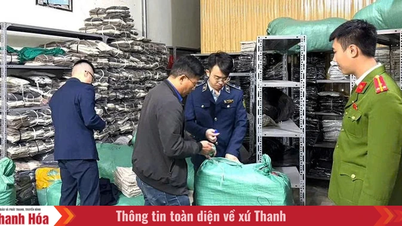
The quarry for leveling materials and weathered laterite, operated by ALMA Civil Construction and Transportation Engineering Joint Stock Company, has numerous violations related to mineral exploitation activities in Tuong Son commune (Nong Cong district).
According to Report No. 48-BC/DU, dated June 13, 2025, from the Party Committee of the People's Committee of Thanh Hoa province, from 2010 to the present, Thanh Hoa province has carried out four revisions and adjustments to the planning for exploration and exploitation of mineral resources used as common construction materials. In particular, after the implementation of the 2017 Planning Law, the province reviewed and included 557 mines in the mineral resource utilization plan for the period 2021-2030, with a vision to 2045.
Despite the large number of planned mines, only 304 mines have been licensed for exploitation by May 2025. Of these, 214 mines are licensed for ordinary construction materials, covering a total area of approximately 1,057 hectares, with a total exploitable reserve of approximately 187 million m3 and an exploitation capacity of approximately 12 million m3/year; 62 mines are licensed for soil, covering a total area of approximately 393 hectares, with a total exploitable reserve of approximately 93 million m3 and an exploitation capacity of approximately 18.53 million m3/year; and 28 mines are licensed for sand, covering a total area of approximately 299 hectares, with a total exploitable reserve of approximately 9.4 million m3 and an exploitation capacity of approximately 0.784 m3/year. Meanwhile, the demand for construction materials for projects in the area in 2025 is very high, requiring approximately 33.27 million m3 of fill soil. Construction sand: 5.49 million m3; construction stone: 8.43 million m3... Inspection of mining activities in the area shows that the licensed reserves only meet about 50-70% of the demand.
Looking at the figures, it's clear that while the number of approved mines is enormous, the actual exploitation and supply of construction materials show a significant discrepancy. This indicates a lack of synchronization between the planning vision on paper and the actual implementation and management capabilities. Many mines included in the plan are not feasible due to unsuitable mining conditions, lack of transportation routes, and local consensus. Post-licensing inspections and audits are also a major "gap." Many licensed businesses have not yet commenced operations or have not operated at the committed capacity; improper mining practices and non-compliance with environmental and occupational safety regulations remain common. Furthermore, the auctioning of mineral exploitation rights is slow, with lengthy procedures, sometimes taking from 4 months to over a year. Some cases involve violations of the law during illegal mining or exploitation of policy loopholes for personal gain, leading to resource depletion, environmental pollution, and disruption of local security and order.
Based on the above situation, from 2023 to the present, the Standing Committee of the Provincial People's Committee has issued a series of directives such as Notices No. 08, 41, 102; Official Letters No. 8291, 7805... requesting relevant departments and localities to urgently review and supplement the planning, inspect mine conditions, and accelerate the auction of mining rights... However, many localities such as Nong Cong, Trieu Son, Ngoc Lac, Ba Thuoc... reported proposing the addition of 17 earth and stone mines, but after inspection, none of them met the conditions for inclusion in the planning (due to cultural planning conflicts or being located in prohibited areas). Some other localities such as Dong Son, Nga Son, Bim Son town... reported not proposing the addition of mines to the planning, without clearly stating the reason, or stating that there was no longer any land area for planning or no need. Nine districts lacked the necessary documents for review and assessment: Nhu Thanh, Nhu Xuan, Vinh Loc, Hau Loc, Ha Trung, Cam Thuy, Muong Lat, Yen Dinh, and Lang Chanh. This clearly reflects a lack of proactiveness and lax management by the district level in mineral resource planning.
The imbalance between supply and demand leads to a shortage of construction materials, driving up prices. This not only directly affects the progress and costs of public investment projects but also negatively impacts residential construction activities, hindering the province's development. One of the biggest paradoxes today is that although the planned reserves are large, they are not being converted into licensed reserves for exploitation. The reason cited is that the survey and planning process, integrated with cultural, defense, and forestry plans, has eliminated many potential mining areas. Many mines are planned but are located in restricted areas or have not been thoroughly reviewed for inclusion in the revised plan.
Given the scarcity of construction materials, which directly impacts the progress of key projects, it is time to shift the mindset in mineral resource management from document-based to development-driven; from passive licensing to proactive forecasting, planning, and auctioning in concentrated mining areas; and from a fragmented and overlapping mechanism to a unified coordination mechanism with clear responsibilities and sufficiently strong sanctions. All issued plans need to be reviewed, assessing their feasibility, effectiveness, and suitability to development needs. Simultaneously, management and supervision should be strengthened, applying modern technologies in monitoring mining operations, such as satellite positioning and surveillance cameras, to tightly control production, reserves, and mining activities. Violations should be dealt with severely. Furthermore, the exploitation of resources for recovery and deep processing, utilizing industrial waste, and producing new construction materials should be encouraged. This not only reduces pressure on natural resources but also opens up a sustainable development path for the construction materials industry.
At the same time, the entire mineral resource management process needs to be transparent; information on planning, licensing, reserves, and production output should be publicly available and easily accessible. This will not only help people and businesses grasp information in a timely manner but also serve as an effective tool to prevent corruption and negative practices.
It is time for mineral resource management to adopt a fresh, flexible, and decisive approach. It shouldn't just stop at zoning and licensing; it must encompass comprehensive management from planning, exploration, extraction, utilization, processing, and environmental protection. This requires policy synchronization, transparency in processes, and the highest level of political determination to transform mineral potential into a real driving force for sustainable development.
Text and photos: Minh Hieu
Source: https://baothanhhoa.vn/quan-ly-khoang-san-nhung-van-de-dat-ra-253336.htm



![[Image] Bridges and roads connecting the eastern part of Ho Chi Minh City](https://vphoto.vietnam.vn/thumb/1200x675/vietnam/resource/IMAGE/2026/04/16/1776328595108_ndo_br_bh-vt5-jpg.webp)












































































Comment (0)