

The opening ceremony of the exhibition space showcasing traditional longhouses and reenacting the "Housewarming Ceremony (Đĭ dôk sang mrâo)" of the Ê Đê people took place at 8:00 AM on November 17th, at the Ê Đê Longhouse Space, within the grounds of the Đắk Lắk Museum.
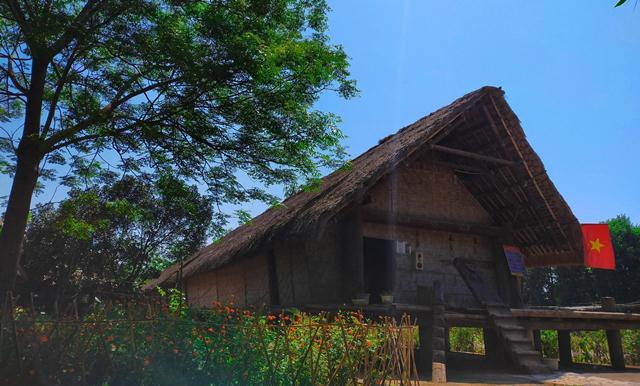
Ede longhouse (illustrative image)
The Ede longhouse - a unique traditional cultural feature of the Ede people.
For the Ede people, the longhouse is not only a family residence but also reflects the family's lifestyle and wealth within the community. The unique features of the longhouse are also expressed through the design of the stairs, floor pillars, and the layout of the living space.
In Dak Lak province, the Ede are one of the two indigenous ethnic groups that have lived there for a long time, divided into many different local groups. The Ede people live under a matriarchal system with many generations in one house. In an Ede family, the head of the household is the woman, who controls all family activities. Children bear their mother's surname, and sons do not inherit. Men reside in their wives' homes. With a matriarchal system, a large family in a longhouse usually has three groups: women who bear their mother's surname, men who bear their mother's surname, and men who do not bear their mother's surname.
The Ede house has unique characteristics unlike the houses of other ethnic groups in the Central Highlands. It is a long stilt house, also known as a longhouse, providing living space for dozens of people. Typically, the longhouse is built 1.5-2 meters above the ground, with the upper part for living and the lower part for raising livestock: pigs, chickens, buffaloes, cows, etc. The longhouse architecture has three parts: a courtyard, a guest area, and living quarters. In the traditional longhouse structure, the staircase is considered the pride of the family and community. The staircase is made of solid wood, beveled and connected from the ground to the floor, and all the steps are odd numbers, which is considered ideal by the Ede people. On the staircase, several motifs are carved: a pair of mother's breasts symbolizing the matriarchal system of the Ede people; around the breasts are images of a pair of doves, the moon, stars, or animals such as turtles and lizards symbolizing polytheism.
The Ede longhouse is not only a family residence but also reflects the family's lifestyle and wealth within the community. The unique features of the longhouse are also evident in its layout. The house is divided into two parts: the half near the main entrance (called Gah) is where guests are received, where the extended family gathers, and where community activities take place. This is also where valuable and sacred items of the Ede people are often displayed, such as drums and gongs, the main kitchen, guest chairs, host chairs, the long bench (Kpan), wine jars, and animal horns. The Kpan bench is also a familiar item to the Ede people; its special feature is that it is carved from a single, continuous tree trunk, with the legs and seat joined together, slightly curved at both ends, and some Kpan benches are 15-20 meters long. The Kpan bench is usually used by artisans to sit and play gongs and drums during family or community festivals and celebrations. The other half (called the Ok) is the communal kitchen and living quarters for married couples, running along both sides of the central walkway. The left side is divided into several small living spaces. The right side is a corridor for movement, with the kitchen located at the far end...
In a longhouse, the first room from the back courtyard is the mistress's room. This room contains the kitchen and the water reservoir for the entire house, and all activities within the house are decided by the mistress. When the mistress dies or becomes old and frail, the "mistress's position" is passed to the youngest daughter. If the youngest daughter marries while her mother is still alive, her family lives next to the mistress's room.
For the Ede people, the longhouse is not only a distinctive symbol of the matriarchal extended family, but also a place that preserves cultural and spiritual values in their lives. It also fosters close bonds and mutual support among family members. Therefore, the unique cultural features of this highland region are being preserved and maintained by generations of Ede people to this day.
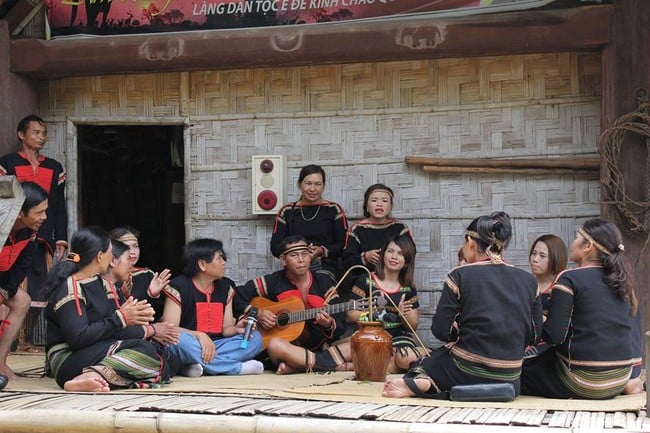
The Ede people with their unique cultural practices (illustrative photo)
Housewarming Ceremony
The housewarming ceremony, or Đĭ dôk sang mrâo, is an important and sacred ritual in the cultural and spiritual life of the Ede people, aimed at praying to the spirits for blessings for a cool and sturdy house, good health for the homeowner, and prosperity in business. This ceremony vividly reflects the traditional cultural identity and close-knit community spirit of the Ede people in the Central Highlands.
The ceremony is an occasion for the homeowner to thank the gods for their protection during the house-building process and to pray for their continued protection from evil spirits and illness. It is also an opportunity for relatives and villagers to come together to celebrate, congratulate the homeowner, and strengthen community solidarity. The ritual marks the official ownership and residence of the new house, a significant family asset (according to the matriarchal system, the longhouse belongs to women and is extended when a daughter marries).
The housewarming ceremony is usually held after the completion of the traditional longhouse and often takes place during the "year-long feasting season" (after the harvest). The main rituals include: preparing offerings, which, depending on the family's circumstances, may include chickens, pigs, or buffaloes and cows, along with other items such as rice wine, betel nuts, rice, and candles. Next, the master of ceremonies (usually the homeowner or a respected shaman) performs the prayers: The prayers invite the gods (house god, earth god, river god, mountain god, etc.) to witness, accept the offerings, and bestow blessings upon the family.
During the ceremony, the master of ceremonies performs rituals at important locations in the house, such as the main pillar and the hearth, to ask permission and inform the spirits of the arrival of the new house and the family. Some ceremonies may include the exchange of bracelets (bronze bracelets) symbolizing the bond and harmony among family members or clans. After the ceremony, everyone gathers to eat, drink, dance, play gongs and drums, and sing throughout the night. This is a lively celebration, expressing the joy and sharing of the entire community with the family who has moved into a new home.
The housewarming ceremony is not just a personal event, but a shared cultural event for the entire village, contributing to the preservation and promotion of the unique cultural identity of the Ede people.
Source: https://bvhttdl.gov.vn/quang-ba-gioi-thieu-van-hoa-truyen-thong-cua-dan-toc-e-de-20251115154443909.htm
![[Photo] General Secretary and President To Lam meets with National Assembly delegates from ethnic minorities.](https://vphoto.vietnam.vn/thumb/1200x675/vietnam/resource/IMAGE/2026/04/20/1776696701056_a1-bnd-8331-3342-jpg.webp)
![[Image] National Assembly discusses the implementation of the socio-economic development plan.](https://vphoto.vietnam.vn/thumb/1200x675/vietnam/resource/IMAGE/2026/04/20/1776696707422_ndo_br_img-20260420-185419-jpg.webp)








![[Photo] Election atmosphere at polling station No. 7, Xuan Dinh ward, Hanoi city](https://vphoto.vietnam.vn/thumb/402x226/vietnam/resource/IMAGE/2026/03/15/1773543204075_img5935-1773539854991135573309-154-0-1707-2484-crop-17735409472061858573395.jpeg)






































Comment (0)