The arduous journey of "massaging" coconuts to find their sweet nectar.
Amidst the mangrove forests along the Kinh River (Tinh Khe commune, Quang Ngai province), the sight of Nguyen Thuong (35 years old) daily carrying a rubber mallet to tap on each coconut bunch has piqued the curiosity of many. Many believe he is pursuing a far-fetched idea, dedicating so much time and money to a plant traditionally only used for its leaves and fruit.
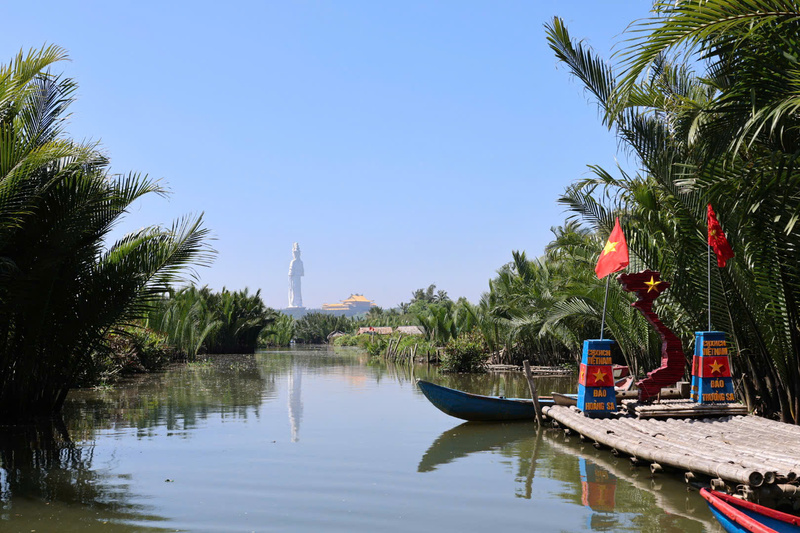
The mangrove forests along the Kinh River (Tinh Khe commune, Quang Ngai province) have opened up a new economic model. Photo: Tue Lam
Few people know that before becoming a pioneer in harvesting coconut nectar in Quang Ngai, Mr. Thuong had a stable job with a high income. After 3 years working in Japan and 5 years working for a foreign company, he accumulated a lot of experience and opportunities for career development.
In 2024, he decided to quit his job to start his own business. However, his initial venture didn't yield the desired results, forcing him to return to work for a Japanese company in the VSIP Quang Ngai Industrial Park. Nevertheless, the desire to create his own product from the potential of his hometown continued to motivate this young man.
Sharing with a reporter from the Industry and Trade Newspaper, Mr. Thuong said that the idea of exploiting nipa palm sap came to him while rowing a boat on the Kinh River. Looking at the lush green nipa palm trees stretching along the riverbank, he recalled his time working in Japan, where products made from nipa palm sap from Thailand were positively received by consumers.
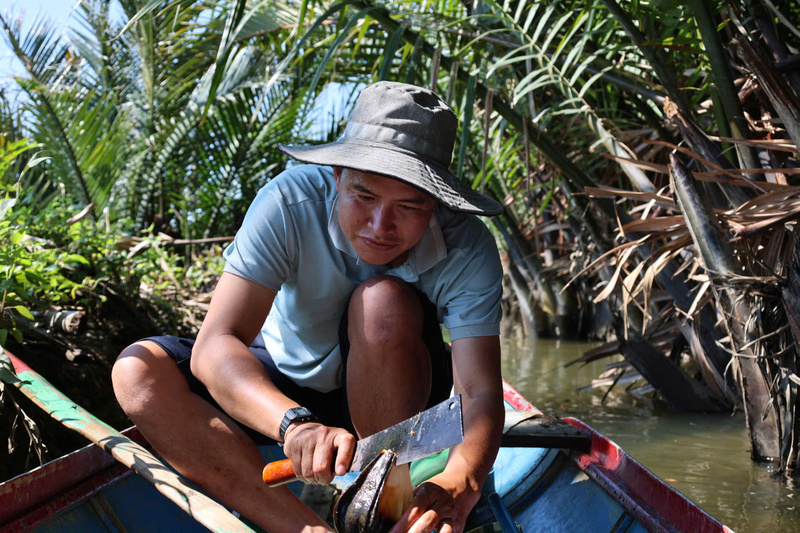
When the coconut stem reaches the desired ripeness and color, the coconut bunch is cut off to begin harvesting the sap. Photo: Tue Lam
"My hometown has dozens of hectares of nipa palm trees, but people mainly only harvest the leaves and fruit. I wonder why this valuable source of nectar hasn't been exploited," Thuong shared.
With that thought in mind, he began his journey to learn the techniques for extracting coconut nectar. Initial experiments were unsuccessful, yielding very little nectar that quickly stopped producing after only one or two days. Undeterred, he continued researching domestic and international literature to find a solution.
After months of research, Mr. Thuong learned about a method of stimulating coconut trees to secrete nectar by "massaging" the trunk. This also marked the beginning of his diligent research.
Sweetness comes from never giving up.



According to Mr. Thuong, achieving the results he has today is the culmination of tireless effort. During the day, he works at the company, and in the evenings and on his days off, he is out in the mangrove forest. With a rubber mallet in hand, he patiently taps each coconut trunk, observing the changes in the tree and meticulously recording the results after each experiment.
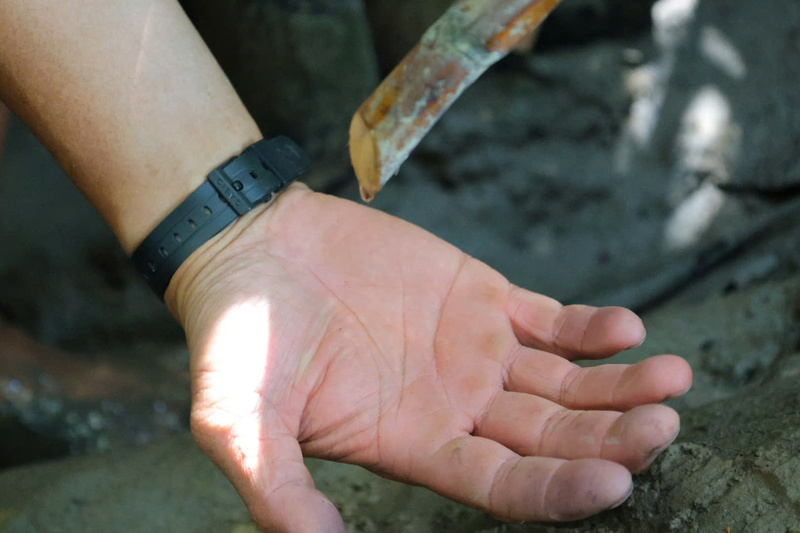
Drops of sap from the stem of the coconut palm. Photo: Tuệ Lâm
"There were times when I worked alone in the coconut forest, and many people didn't understand and thought I was doing something strange. But thanks to the encouragement of my family, especially my wife, I remained determined to pursue my goal," Thuong recounted.
To support his research, he boldly leased a coconut grove from local residents. After nearly two years of experimentation, his investment had reached over 500 million VND. In return, he gradually perfected an efficient process for extracting coconut nectar.
According to Mr. Thuong, when the coconut bunch is about three months old, harvesters must use a rubber mallet to tap along the stem about 100 times a day, while gently shaking the bunch to stimulate the tree to secrete sap. This process is carried out continuously for about a month.
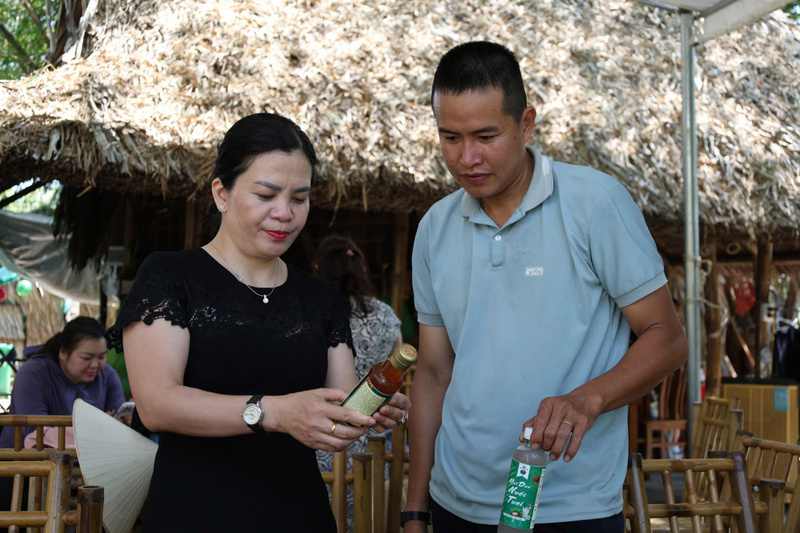
Products made from coconut nectar are popular with consumers. Photo: Tue Lam
When the coconut stalk reaches the desired ripeness and color, the coconut bunch is cut off to begin harvesting the sap. Thanks to this process, the tree's ability to secrete sap is significantly extended.
"Without treatment, the trees only secrete nectar for one or two days. But after the 'massage' process, each tree can yield 0.5 - 0.7 liters of nectar per day, continuously for about a month," Mr. Thuong said.
Currently, harvesting the honey starts around 2 AM to ensure the best quality. On average, he harvests about 30 liters of fresh honey per day. After filtering and pasteurizing, the honey is sold as a beverage or further concentrated into commercial coconut honey.
According to calculations, producing one liter of concentrated coconut syrup requires approximately 8 liters of fresh coconut sap. The product is currently sold for around 500,000 VND per liter, generating significant revenue and opening up new economic prospects from the coconut palm.
Not content with just production, Mr. Thuong is also aiming to develop ecotourism associated with the mangrove forest. Currently, he has leased about 5 hectares of mangrove forest and partnered with a local cooperative to build an experiential model for tourists.

Besides harvesting coconut sap, Mr. Thuong also aims to develop ecotourism associated with the mangrove forest. Photo: Tue Lam



Here, visitors can directly observe the process of "massaging" the coconut palms, learn how to harvest the sap, and enjoy fresh coconut sap right in the forest. The uniqueness of this model is gradually attracting many tourists to come and experience it.
Commenting on this model, Mr. Nguyen Quoc Vuong, Chairman of the People's Committee of Tinh Khe commune, said that this is a new direction that has initially brought positive economic results.
"This is a way to enhance the value of the nipa palm, create more unique local products, and at the same time contribute to tourism development and increase income for the people," Mr. Vuong commented.
From seemingly simple taps amidst the mangrove forests along the Kinh River, Nguyen Thuong has gradually transformed his entrepreneurial idea into reality. His model not only opens up opportunities to enhance the value of this native plant but also contributes to creating a new tourism product for the coastal region of Quang Ngai.
Source: https://congthuong.vn/quang-ngai-massage-cho-dua-nuoc-lay-mat-460515.html