

General Secretary To Lam, President Luong Cuong, Prime Minister Pham Minh Chinh , Standing Member of the Party Central Committee Tran Cam Tu, and other delegates attended the closing session.
A massive volume of laws and resolutions
At the session, the National Assembly considered, discussed, and voted to pass 51 laws and 39 resolutions, including 8 normative legal resolutions. National Assembly Chairman Tran Thanh Man stated that this represents a very large volume of legislation, accounting for nearly 30% of the total number of laws and normative resolutions enacted during the entire term. The laws and resolutions passed both promptly meet practical requirements and create a legal framework for the new period.

National Assembly Chairman Tran Thanh Man delivered the closing remarks at the session.
PHOTO: GIA HAN
Along with legislative and supervisory work, the National Assembly considered and decided on many strategic issues of great importance. In particular, this session thoroughly and comprehensively reviewed the work of the 2021-2026 term of the state apparatus; considered and decided on personnel matters in accordance with regulations. At the same time, it meticulously discussed the draft documents to be submitted to the 14th National Congress of the Party, contributing intellect, dedication, and ideas for the country's development towards the goal of becoming a developing country with modern industry and high middle income by 2030, when the Party celebrates its 100th anniversary; and becoming a developed country with high income by 2045, the 100th anniversary of the nation's founding.
Looking back over the past five years, the Speaker of the National Assembly expressed his pleasure that the National Assembly had overcome countless difficulties and challenges from the Covid-19 pandemic, the complex and unpredictable developments in the region and the world, and natural disasters such as storms and floods, thereby achieving many very important results, including unprecedented breakthroughs.
According to the Speaker of the National Assembly, the 15th National Assembly term amended and supplemented several articles of the Constitution; proactively reformed its thinking in lawmaking, actively and promptly institutionalized the Party's policies into law; promoted the application of digital technology, digital transformation, and artificial intelligence; and for the first time, successfully organized two forums on law and supervision. The National Assembly also enacted many important laws, creating a foundation for the country to enter a new era of development.
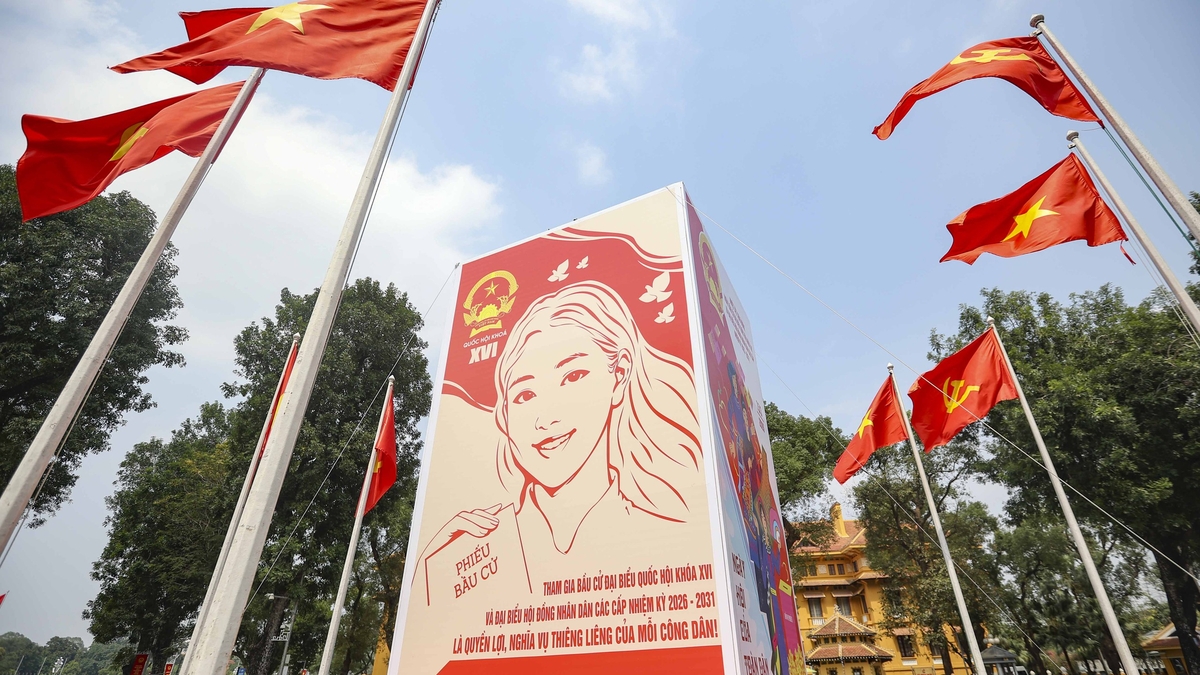
Immediately following this session, the entire political system will continue to strive to achieve outstanding results to celebrate the 14th National Congress of the Party; to celebrate the 11th National Emulation Congress; to meticulously prepare for the election of deputies to the 16th National Assembly and deputies to People's Councils at all levels for the 2026-2031 term; and to commemorate the 80th anniversary of the first general election to elect the Vietnamese National Assembly. The Chairman of the National Assembly requested that, in the immediate future, the National Election Council, the Standing Committee of the National Assembly, the Government, the Central Committee of the Vietnam Fatherland Front, and relevant agencies proactively and closely coordinate to promptly implement the plan according to the issued schedule; thoroughly review the legal framework, processes, and procedures to ensure the election strictly adheres to the law, is democratic, transparent, and disciplined. At the same time, the National Assembly requested the Government, ministries, sectors, and localities to urgently and comprehensively implement the laws and resolutions passed by the National Assembly, determined to successfully achieve the growth target and the goals and tasks of socio-economic development, ensuring national defense, security, and foreign affairs for the period 2026-2030; and to better care for the lives of the people, especially in areas severely affected by natural disasters, storms, and floods.
"The tasks and demands of the country in the new development stage require the entire Party, the entire people, and the entire army to highly promote the spirit of patriotism, the aspiration for development, the strength of the people, and the great national unity; to strongly innovate thinking; and to implement strategic decisions synchronously and effectively. The National Assembly, its agencies, and its deputies must strive, make greater efforts, and be more determined, daring to speak, daring to act, and daring to take responsibility for the people and the country, making an important contribution to our country entering a new era - an era of national progress, for a strong, prosperous, civilized, and happy Vietnam," emphasized National Assembly Chairman Tran Thanh Man.
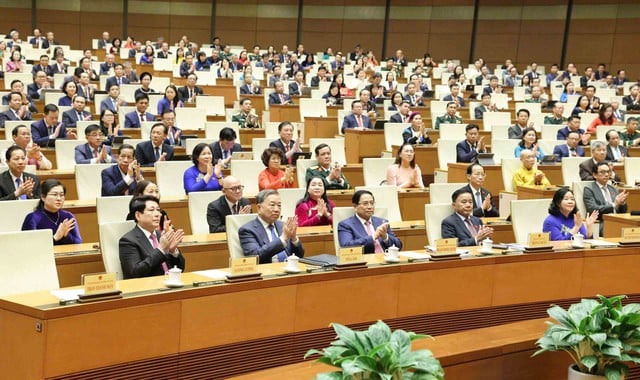
General Secretary To Lam, President Luong Cuong, Prime Minister Pham Minh Chinh, Standing Member of the Party Central Committee Tran Cam Tu, and Chairwoman of the Vietnam Fatherland Front Central Committee Bui Thi Minh Hoai at the closing session.
PHOTO: GIA HAN
Unlocking land resources
One of the most notable highlights of the 10th session was the adoption of laws and resolutions to remove major bottlenecks in land resources, as well as to create additional special mechanisms to enable the growth poles of Hanoi, Ho Chi Minh City, and Da Nang to achieve breakthrough development.
With a majority of delegates voting in favor, the National Assembly approved a Resolution stipulating several mechanisms and policies to address difficulties and obstacles in the implementation of the Land Law, effective from January 1, 2026. According to Minister of Agriculture and Environment Tran Duc Thang, the resolution adds three cases of land acquisition for socio-economic development in the national and public interest: Firstly, projects within free trade zones and international financial centers. Secondly, creating land funds to pay for projects under build-transfer (BT) contracts, and to lease land for continued production and business activities for organizations currently using land that the state acquires.
Thirdly, in cases where land is used for a project through an agreement on land use rights that has expired, but more than 75% of the land area and more than 75% of the land users have been agreed upon, the Provincial People's Council shall consider and approve the revocation of the remaining land area to allocate or lease it to the investor. Specifically for the third case, compensation, support, and resettlement for the remaining land area of less than 25% will be applied as in cases of state land reclamation as stipulated in the Land Law.
The resolution also stipulates that land use fees include: land area; land price according to the land price table and land price adjustment coefficient; infrastructure construction costs determined according to the provisions of the law on construction… The land price according to the land price table and the land price adjustment coefficient will also be used as the basis for calculating compensation when the state reclaims land.
Land price tables are developed based on land type, area, and location. For areas with digital cadastral maps and land price databases, land price tables are developed for each individual land parcel. The Provincial People's Council decides on the land price table, publishes it, and applies it from January 1, 2026; it may be amended or supplemented as needed. The land price adjustment coefficient is the percentage increase or decrease in land prices for each land type corresponding to the area and location specified in the land price table.
An unprecedented breakthrough for the development of Ho Chi Minh City.
Yesterday morning, the National Assembly voted to approve a series of unprecedented special mechanisms and policies for the development of Ho Chi Minh City. A key element in the Resolution amending and supplementing Resolution 98 is the list of priority projects and policies to attract strategic investors.
In addition, the Resolution supplements regulations on the establishment and operation of the Ho Chi Minh City Free Trade Zone, piloting outstanding and groundbreaking special mechanisms and policies to attract investment, finance, trade, services and high-quality human resources, promote exports, industry, research and development (R&D) activities...
Regarding land policy for the Free Trade Zone, except for commercial housing construction investment projects, the Chairman of the People's Committee of Ho Chi Minh City is authorized to allocate and lease land without auctioning land use rights or bidding to select investors to implement projects using land for investment projects within the Free Trade Zone as stipulated in this resolution.
In its report on the feedback and explanations, the Government stated that free trade zones are a new model, creating a breakthrough in promoting and attracting investment through a one-stop mechanism, with conditions ready for investment activities. Therefore, applying special investment procedures for projects is necessary to reduce implementation time. At the same time, this procedure should also be allowed to be applied to specialized areas in the city such as industrial parks, export processing zones, high-tech zones, concentrated digital technology zones, and functional zones within economic zones.
According to the government, allowing the implementation of these procedures is a strong commitment from the state to investors, creating a competitive advantage compared to the region and internationally. In addition, allowing the application of this policy will create more appeal to attract investors to the Vietnam International Financial Center located in Ho Chi Minh City...
38 industries and professions are exempt from business licensing requirements.
Earlier that day, the National Assembly voted to pass the amended Investment Law, officially reviewing and cutting 38 conditional investment and business sectors. The list of conditional business sectors will be applied from July 1, 2026.
According to Minister of Finance Nguyen Van Thang, based on the proposed cuts, reductions, and amendments to conditional investment and business sectors as mentioned above, the Government will instruct ministries and agencies to urgently study management methods according to regulations and standards for the sectors proposed for reduction or amendment.
The goal is to shift strongly from pre-inspection to post-inspection, from licensing to registration or notification, and towards management primarily based on regulations and standards, with important and necessary contents requiring state management and regulation.
Special mechanisms for large projects in Hanoi.
The National Assembly also passed a Resolution piloting a number of specific mechanisms and policies to implement large and important projects in Hanoi. In addition to land acquisition cases under Article 79 of the Land Law, the Hanoi People's Council is authorized to decide on specific land acquisition cases for the implementation of socio-economic development projects for national and public benefit. Furthermore, it can determine the criteria, compensation levels, support, and resettlement when land is acquired, up to a maximum of twice the prescribed rate.
The resolution also stipulates that the Hanoi People's Committee has the authority to decide on measures for urban renovation, upgrading, and reconstruction according to the plan. One of these is the decision on coercive measures in cases where the investor has obtained the consent of over 75% of homeowners and land users, equivalent to at least 75% of the area to be renovated, upgraded, or reconstructed, regarding the planning, compensation, support, and resettlement plan.
Source: https://thanhnien.vn/quoc-hoi-be-mac-ky-hop-lich-su-185251211210946897.htm







































































Comment (0)