A person who defies stereotypes.
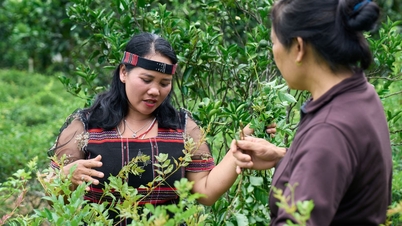
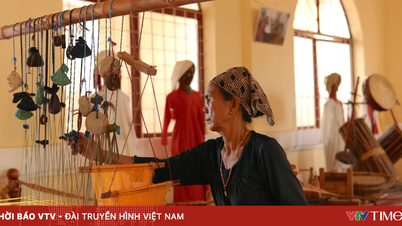
Ms. Vang Thi Mai has the typical appearance of a Hmong woman, with deep wrinkles around her eyes and calloused hands from years spent working with flax and looms. Sitting by her loom, the 64-year-old woman moves the shuttle, her feet nimbly following a familiar rhythm. Behind this simple image lies the resolute, determined gaze of a woman who has spent nearly 30 years defying age-old prejudices on the rocky plateau.
 |
| Artisan Vàng Thị Mai has always been deeply committed to the traditional linen weaving craft. |
For the Hmong people, skill in growing flax and weaving is not only a labor skill but also a measure of a girl's virtue before she goes to her husband's home. Like other Hmong girls, Ms. Mai was taught how to spin flax and weave cloth from a very young age; by the age of 14, she could weave beautiful fabrics for herself to make clothes. Each piece of brocade created is the culmination of diligence, dedication, and skillful hands, containing cultural values passed down from generation to generation.
In the 1990s, with the increasing availability of industrial fabrics, the linen weaving craft gradually declined. Young women lost interest in the loom, and the sounds of needlework became increasingly rare in households. Witnessing this, Ms. Mai was deeply concerned about how to preserve the traditional craft while creating livelihoods to help Mong women improve their lives. In 2001, with the support of Lung Tam commune, she established the Lung Tam Linen Weaving Cooperative, which at that time had 10 members and a meager capital of only 13 million VND.
However, preserving the craft has never been easy. Ms. Mai faced not only the challenges of capital and product distribution, but also deeply ingrained prejudices. She recalled: “In the early days, many women were prevented from joining the cooperative by their husbands, and some were even beaten. Some openly opposed flax cultivation, arguing that women should only be confined to housework. But I believed that when women have jobs and income, they will have more of a voice. Therefore, I persevered, going to each family to campaign and persuade them.”
Thanks to her persistence, their initial opposition turned into respect, and they became willing to share household chores so their wives could participate in cooperatives, attend trade fairs, or promote products. Women who were once confined to the kitchen now had a voice in the family and confidently asserted their self-worth.
Not only has she contributed to changing women's lives, but Ms. Mai is also a pioneer in breaking down gender stereotypes. According to tradition, when someone in the family dies, Hmong women are not allowed to approach or attend the funeral. However, when her husband passed away, she directly participated in bidding farewell to her life partner. This action was met with much opposition, but for her, women have every right to control their own lives and destinies.
Weaving dreams in the Hmong village
Preserving the craft is only the beginning; finding a new market is the decisive factor in success or failure. Ms. Mai understood that relying solely on local demand would make it difficult for even the most beautiful linen fabrics to provide a sustainable livelihood. Acting on this thought, the Hmong woman packed her bags and crossed the Quan Ba Sky Gate to Hanoi , bringing her linen products to introduce to customers. After a journey filled with uncertainty, joy came when the first orders were signed. Customers particularly loved Lung Tam linen products because of their natural, environmentally friendly material and exquisite patterns.
 |
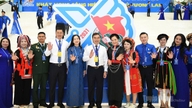
| Artisan Vang Thi Mai (second from the right) participated in the "When Women Take Control" competition organized by Vietnam Television in 2023. |
The market continued to expand when Ms. Mai had the opportunity to meet designer Minh Hanh at the Hue Ao Dai Festival in 2012. From that meeting, Lung Tam brocade gradually moved beyond the confines of the craft village to appear in contemporary fashion collections. This connection also led her to approach and invite European experts to the cooperative, where they lived, ate, and worked alongside the members to learn about the entire traditional linen weaving process.
Recalling the milestone of bringing Lung Tam brocade to the world , Ms. Mai shared that it was an opportunity she had never imagined. Orders from France, Sweden, Italy, and many other European countries poured in. Along with the joy came unprecedented challenges for a highland cooperative. From export procedures and product origin certificates to international quality standards. Undeterred, I worked and learned simultaneously, gradually meeting the stringent requirements of the market.
The products of the Lung Tam Linen Weaving Cooperative are not only available in many provinces and cities nationwide but are also exported to over 20 countries, mainly in the European market. To date, the cooperative has grown to 250 members, with an average income of 2.5 million VND per person per month. In addition, they have created 150 different products, with production organized into groups and stages, each group guided and supervised by experienced artisans. To support community tourism development, the cooperative maintains a production workshop and demonstrates traditional linen weaving processes for tourists to visit and experience.
Not only does she preserve the craft with passion, but Ms. Mai also approaches the market in a very unique way. She carefully records feedback on the design and quality of each customer who buys products from the cooperative. These notebooks, growing thicker over the years, have become a special "data repository" for the cooperative. Monthly, the members meet to discuss and listen to feedback in order to adjust designs and improve quality.
Vang Thi Mai's persistent efforts in preserving the linen weaving craft and creating livelihoods for women in the highlands have earned her numerous prestigious awards and titles. She was awarded the KOVA Prize, honoring exemplary figures in social life, and was bestowed the title of Folk Artisan. Notably, in 2017, she was selected by Forbes Vietnam magazine as one of the 50 most influential women in Vietnam for her pioneering role in bringing traditional Mong linen products to both domestic and international markets.
Ms. Mai said that if you want to see the most radiant faces of highland women, look to the loom. There, they reveal the beauty of diligence, skill, and the happiness of being masters of their own hands and lives. For her, the greatest pride lies not in titles or markets conquered, but in seeing more and more ethnic minority women confidently taking control of their own lives. From the simple flax threads of the rocky plateau, she will continue to extend the dream of a prosperous and happy life for the Hmong people.
Pham Hoan
Source: https://baotuyenquang.com.vn/phong-su/202606/quy-ba-vai-lanh-09934d5/
![[Image] Ho Chi Minh City: Ma Lang area, Chicken-Rice Market about to change its appearance](https://vphoto.vietnam.vn/thumb/1200x675/vietnam/resource/IMAGE/2026/06/25/1782377698627_ndo_br_m1-jpg.webp)

![[Photo] General Secretary and President To Lam receives Palestinian Ambassador Saadi Salama](https://vphoto.vietnam.vn/thumb/1200x675/vietnam/resource/IMAGE/2026/06/25/1782365384740_a1-bnd-9423-8322-jpg.webp)


![[Image] Schools organize meetings and introduce teaching models to students admitted to grade 10.](https://vphoto.vietnam.vn/thumb/1200x675/vietnam/resource/IMAGE/2026/06/25/1782368077271_ndo_br_z7970052192242-1ec8daeb77a6eed1a4e9f58c564ddd3e-jpg.webp)