

Disseminate information to the people.
On November 26th, in Dong Ninh Hoa ward, soldiers from the Ninh Phuoc Border Guard Post, along with local residents, focused on addressing the aftermath of the floods while proactively implementing measures to respond to Typhoon No. 15. From early morning, the soldiers went to coastal areas, aquaculture farms, and open beaches to inform residents about the typhoon situation, guide them in reinforcing their homes, gathering fishing gear, and moving boats to safe shelters. The unit used portable loudspeakers and the local broadcasting system, distributed over 500 leaflets warning of risks, and directly met with nearly 300 households to disseminate information on response measures in case the typhoon made landfall.
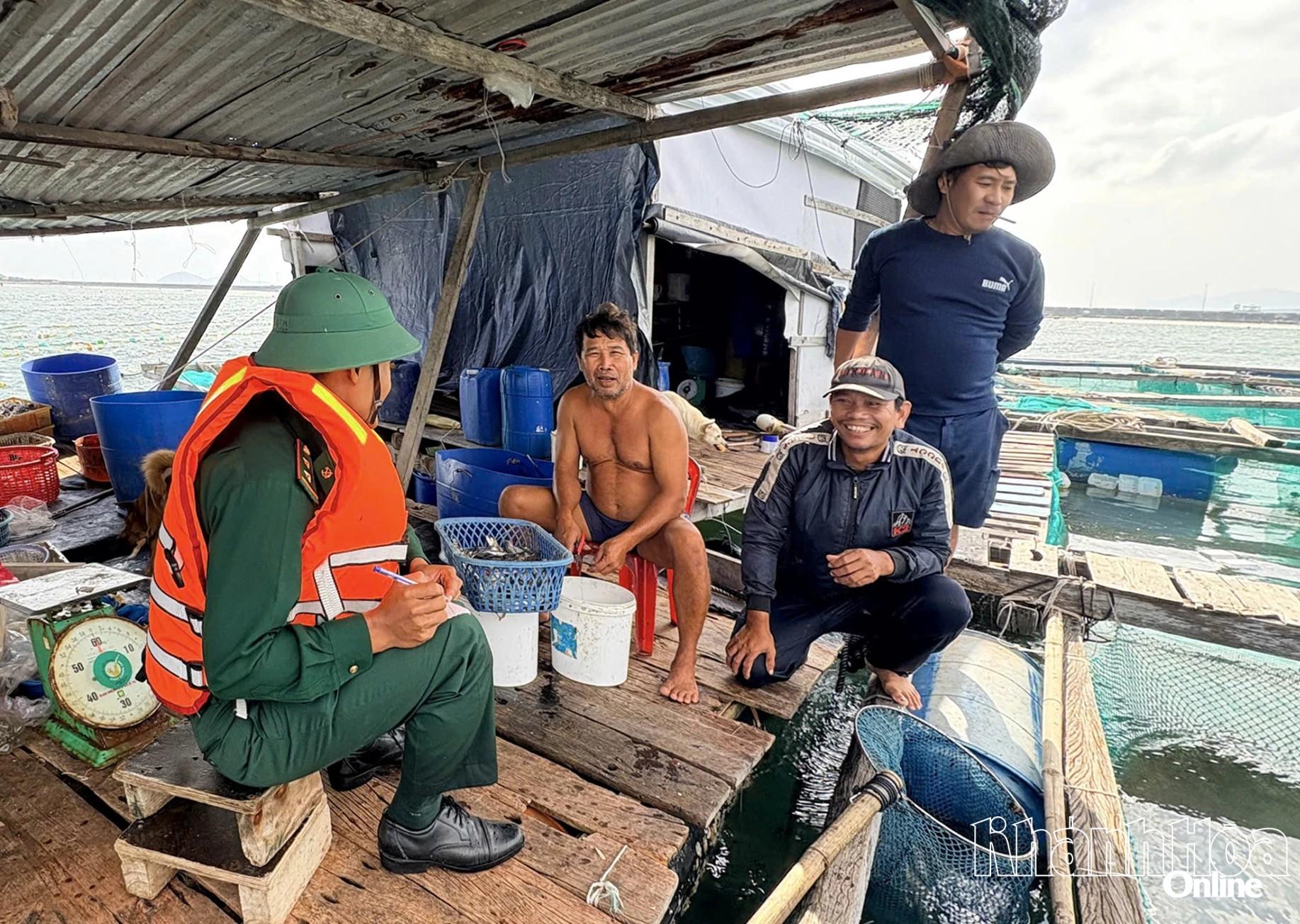 |
| Officers from the Ninh Phuoc Border Guard Station are disseminating information and urging aquaculture farmers in Dong Ninh Hoa ward to move ashore to avoid the storm. |
In addition, the Ninh Phuoc Border Guard Station has coordinated with local authorities to review and inspect vulnerable areas, households living in temporary housing, and areas at risk of landslides; prepared rescue and relief equipment; and organized a strict duty roster in accordance with the "four on-the-spot" principle. "We consider the task of disseminating information and mobilizing people to proactively prevent and mitigate storm damage as a key priority. The unit maintains officers stationed in the area 24/7, ready to assist people in relocating when needed," said Lieutenant Colonel Bui Van Thinh, Political Officer of the Ninh Phuoc Border Guard Station.
Along with accelerating efforts to mitigate the consequences of the floods, the Provincial People's Committee issued a directive on proactively preventing, combating, and responding to Typhoon No. 15. Simultaneously, a meeting was held to implement response measures; decisively directing departments, agencies, units, and localities to focus on supporting the people in proactively responding to the typhoon; regularly updating information on the natural disaster situation and forecast and warning bulletins on mass media, websites, and social networks, promptly warning the community and local authorities throughout the province.
Proactive response
Currently, 64 reservoirs throughout the province hold 563.87 million m³ of water, reaching 75% of their designed capacity. Several large reservoirs such as Suoi Dau, Da Ban, Song Cai, Song Cho 1, etc., are operating to regulate water levels (with flow rates ranging from 3 to 142 m³ /s) to ensure sufficient capacity for flood control. Reservoir management units are monitoring weather developments and proactively calculating and implementing water level reductions to manage floodwaters effectively, ensuring water storage for production, structural safety, and flood prevention in downstream areas.
Plans for protecting disaster prevention and control structures and key infrastructure have been activated. Detailed plans for evacuating residents in vulnerable areas have been developed. The People's Committees of communes, wards, and special zones have reviewed and updated areas at high risk of deep flooding, landslides, and flash floods, preparing to evacuate and relocate residents from dangerous areas before the storm directly impacts and heavy rains occur, especially in 179 dangerous landslide and flooding hotspots; areas at high risk of landslides (South Nha Trang, North Nha Trang, Nha Trang wards, National Highway 27C, Provincial Road 9, Khanh Son Pass, Ngoan Muc Pass, etc.); and areas experiencing prolonged deep flooding (Dien Dien commune, Tay Nha Trang ward, Ninh Phuoc commune, etc.). If necessary, forced relocation will be implemented. Simultaneously, safe evacuation sites have been arranged, and sufficient food, clean water, medicine, and essential supplies have been prepared to ensure that residents do not suffer from hunger, cold, or lack of safe shelter.
Along with ensuring communication and readiness of forces and equipment, the Provincial People's Committee continues to direct the implementation of response work at sea and on islands, especially urging ships and boats still operating at sea to urgently return to shore or find safe shelter from the storm; guiding people to anchor fish cages and boats safely. People on fish cages and boats anchored are required to return to shore before 6 PM on November 28th until the final storm update is received. According to statistics, the province has 3,782 aquaculture households; a total of 6,953 fishing vessels with 36,498 workers. Of these, 344 vessels with 2,923 workers are currently operating at sea. By the morning of November 26th, owners of vessels operating in the sea areas had received information about the storm and had proactively planned for prevention.
On land, the province requires localities to deploy forces to guard and set up checkpoints at submerged roads, flooded areas, and areas with deep water and strong currents, resolutely preventing vehicles and people from passing through to ensure the safety of people's lives; strengthen propaganda and guidance for people to proactively stockpile food, drinking water, and essential supplies, avoiding complacency to prevent unnecessary accidents before, during, and after the storm and floods. At the same time, working groups consisting of members of the Provincial Civil Defense Command will be sent to localities to direct the work of preventing, combating, and responding to Typhoon No. 15.
HONG DANG
Source: https://baokhanhhoa.vn/xa-hoi/202511/quyet-liet-ung-pho-bao-so-15-b807714/



![[Photo] Conference announcing the Politburo's Decision on organizational and personnel matters](https://vphoto.vietnam.vn/thumb/1200x675/vietnam/resource/IMAGE/2026/04/01/1775017881825_bnd-2410-1472-jpg.webp)
![[Photo] Conference on the transfer and reception of Party organizations and Party members between the Party Committee of the Government and the Party Committees of the Central Party Agencies](https://vphoto.vietnam.vn/thumb/1200x675/vietnam/resource/IMAGE/2026/04/01/1775036784472_ndo_br_bnd-2620-jpg.webp)





















































![[Photo] Prime Minister Pham Minh Chinh receives the Ambassador of the Russian Federation to Vietnam](https://vphoto.vietnam.vn/thumb/402x226/vietnam/resource/IMAGE/2026/04/01/1775046774818_anh-man-hinh-2026-04-01-luc-19-32-33.png)
























Comment (0)