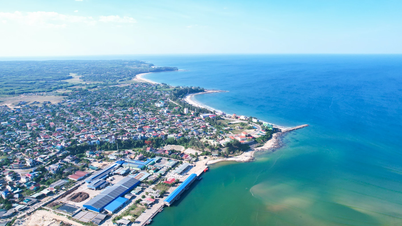
Now, occasionally, Ms. Nguyen Thi Thu from Xuan Loc village, Cua Viet commune, and her husband brave the waves, sailing their boat to search for coral reefs to cast their fishing lines for gold. Ms. Nguyen Thi Thu recalls that in 1988, she married Mr. Vo Ngoc Doan. At that time, she didn't know anything about gold fishing on coral reefs. But then, the lives of fishermen in coastal villages were difficult and full of hardships, so even though her children were still young, she and her husband still boarded a small boat and rowed out to the coral reefs to practice gold fishing.
On calm days, around 4 PM, Thu and her husband would start sailing their 40-horsepower motorboat from the Xuân Lộc village fishing harbor, navigating through the crashing waves to reach the open sea.
Mr. Doan steered the boat, while Ms. Thu adjusted the fishing line to ensure it was "smooth" and wouldn't get tangled when casting. The fishing spot was about 6-8 nautical miles from the shore. By the time they arrived, the weak afternoon sunlight was beginning to fade over the vast ocean. Ms. Thu and her husband meticulously hooked nearly 2kg of prawns onto the prepared hooks and then slowly set off to cast their lines.
 |
| Ms. Truong Thi Lai rearranges the gleaming goldfish in preparation for her fishing trip - Photo: SH |
A "golden fishing line" is a piece of line about 150-200 meters long, about the size of a toothpick, with marker buoys attached to the ends. A smaller fishing line with a hook is tied to this line every 2 meters or so. Each time they go out to sea, Thu and her husband can cast 3-4 golden fishing lines, depending on calm sea conditions.
Longline fishing typically catches fish such as grouper, snapper, sea bass, stingray, and barramundi. Longline fishing in the reefs is less strenuous now than it used to be, as most fishermen have replaced rowboats with motorboats. These boats are also equipped with satellite positioning systems so that after casting the nets, the coordinates of the nets in the reef area can be determined before the boat moves to another reef location.



After casting 2-3 fishing lines, the boat will return to the initial casting location to retrieve the lines and catch fish. At that point, simply dialing the coordinates will allow you to immediately locate the fishing line casting spot, eliminating the need to search for buoys in the pitch-black darkness of the vast ocean.
Ms. Nguyen Thi Thu shared that although the job of catching goldfish is arduous, it has many interesting and fascinating aspects, even for those who do it, like her and her husband. These include hours of struggling to bring stingrays, groupers, snappers, and other large fish weighing 20-40kg onto their small boat, which is as tiny as a leaf in the vast ocean. The moment of facing these large, monstrous stingrays, groupers, and snappers living in the reefs is unforgettable for those who make their living catching goldfish in the reefs, like her and her husband.
Unlike Ms. Thu, who works as a gold prospector, Ms. Truong Thi Lai from Cat Son village, Ben Hai commune, "stays up late and wakes up early" to work with her husband in near-shore fishing. Ms. Lai said that she was born into a family of fishermen. At the age of 16 or 17, she followed her father out to sea to cast nets and catch fish. After getting married, she continued to follow her husband out to sea to fish near the shore.
For Lai and her husband, they spend more time at sea than at home. Going to sea has become a habit; they feel sad on days when the sea is rough and they have to stay home. At sea, the wife does one thing, the husband does another, and they work together, making the job easier. Each fishing trip for Lai and her husband usually starts at 4-5 pm the day before and doesn't return to shore until 7-8 am the next morning.
Depending on the month of the year, the couple engages in different fishing activities. For example, from the Lunar New Year until the 7th lunar month, they choose to use three-layered gill nets to catch snapper and grouper, gill nets for herring, and set traps to catch squid and cuttlefish. From the 7th lunar month of this year until the 1st lunar month of next year, they will use trawl nets to catch pomfret, crab nets to catch small crabs, or longline fishing to catch other fish like barramundi and other species.
After a night at sea, Lai and her husband's 12-horsepower boat docked. She would then take the shrimp, fish, and squid they caught to the market to sell. After a hard night at sea, the couple earned about 300-400 thousand dong.



It seems that the happiness of being able to accompany and share even the smallest tasks with their partners amidst the vast ocean has given strength to many women in coastal areas. For them, although the seafaring profession is arduous, it is rewarded with overflowing happiness when they go to sea together with their husbands.
Sy Hoang
Source: https://baoquangtri.vn/xa-hoi/202607/ra-bien-cung-chong-0be079d/




![[Photo] Strengthening character and expertise: Intense training for artillery soldiers.](https://vphoto.vietnam.vn/thumb/1200x675/vietnam/resource/IMAGE/2026/06/30/1782815602541_lu-368-1875-4571-jpg.webp)