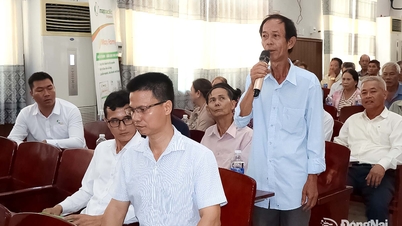
Concerns about rice production costs
The 96-page student notebook was folded in half at the corner. On the smudged blue lines were numerous expense entries for a rice crop: plowing 160,000 VND, harvesting 160,000 VND, fertilizer 300,000 VND (not including labor), transplanting + sowing 400,000 VND, snail control 70,000 VND, weed control 50,000 VND, rat control 35,000 VND… At the bottom of the page, Mr. Luong Van Han circled the total cost of over 1.7 million VND for one sao (approximately 1000 square meters) of rice field. Below was the revenue calculation: 200kg x 7,200 = 1.4 million VND.

This notebook records the production costs for one sao (approximately 1000 square meters) of rice in the spring crop of 2026, belonging to Mr. Han. Photo: Bao Thang.
He sat in his small, one-story house in Nua village, Long Hung commune, Hung Yen province, his calloused fingers tracing over the numbers in this notebook. He had kept records for many years, from the time fertilizer cost just over 100,000 dong a bag to when it nearly doubled, from the time when hiring laborers for rice planting was cheap to when it cost 400,000-500,000 dong per hectare.
He said that people in the area who grow rice no longer think about profit as much as before. "Now it's mainly about getting rice to eat. If we outsource all the processes, we'll end up losing money," he mused.
Long Hung is a low-lying area. In recent years, many rice fields have suffered crop failures due to flooding. Many households have abandoned their fields, either working in factories or renting out their land. The fields, once bustling with workers, now have many uncultivated plots. Those who remain are mostly elderly people, working in the fields during the mornings or evenings. If things continue like this, it's likely that few people will still be interested in rice farming.
Hope began to emerge this spring when Nua village participated for the first time in a rice-based emission reduction model supported by the International Rice Research Institute (IRRI) with machinery and technical assistance. The biggest difference lies in the sowing and fertilization processes.

According to Mr. Han, the rice plants in the emission reduction model are taller and more uniform. Photo: Bao Thang.
Instead of manually preparing the land and sowing as before, the machines in the project simultaneously level the fields, sow seeds in rows, and bury fertilizer in the soil. Farmers only have to pay about 60,000 VND for this process.
If done the old way, the cost of leveling the land, sowing, and labor alone would amount to about 400,000 VND per sao (a unit of land measurement). "The old way is hard work, has low productivity, and high labor costs. Machinery has significantly reduced labor," Mr. Han confided.
On the neatly arranged field in front of his house, the rice paddies in the model plot stand out distinctly. The rows of rice are even, spaced further apart, with upright, sturdy stems that are less prone to lodging. "The machine plants the seeds 3-5cm deep and the fertilizer 5-7cm deep, so there is less evaporation or washing away. The plants are more firmly rooted in the soil," Mr. Han observed.
In the traditional method, farmers in Northern Vietnam often sowed densely to ensure a good harvest. One sao (approximately 1000 square meters) could use 2-2.5 kg of seeds. With the project's seed sowing machine, the amount of seeds used is reduced to about 1.5 kg. Fertilizer use is also significantly reduced. According to Mr. Han, fields outside the model typically require about 15 kg of fertilizer per sao, equivalent to nearly 300,000 VND at current prices. Within the model, the amount of fertilizer used is only about 11-12 kg.
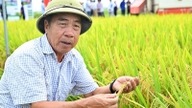

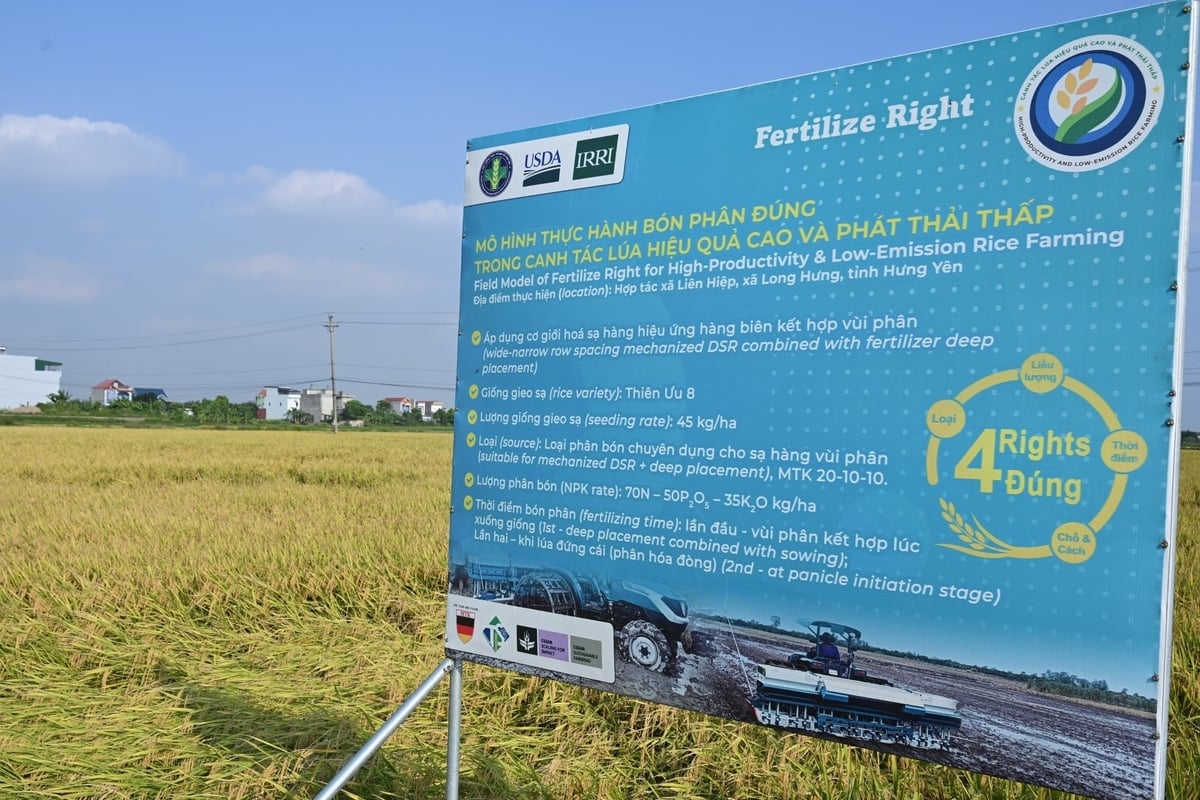
Mr. Han's rice field is a model of proper fertilization practices in low-emission rice cultivation. Photo: Bao Thang.
Originally from the rice-growing region of Thai Binh (formerly), Long Hung has welcomed demonstration models several times. But after those occasions, Mr. Han realized that what people care about most is not "low emissions" or carbon credits, but the amount of money saved after each harvest.
The man in his seventies did his calculations very quickly. With a yield of about 200kg of rice per sao (a unit of land measurement), and the current selling price around 7,000 - 7,200 VND/kg, the total revenue was only around 1.4 - 1.5 million VND, not even covering the 1.7 million VND expenses. But when the three most strenuous stages were mechanized with machines funded by IRRI, at a much lower cost, the rice crop began to generate income.
The effect is clearly visible.
Mr. Duong Van Si, Deputy Director of Lien Hiep Agricultural Service Cooperative, who directly organized the model on an area of more than 3 hectares in Nua village, admitted that the most difficult thing in the North is not the technique but the scale of farmland and labor.
The rice fields in Long Hung are small and fragmented, with each household growing a different rice variety and following a different farming schedule. Most people grow rice for their own consumption, so there's no incentive to standardize production. "Some families prefer high-quality rice, others prioritize high yields. If you force them to invest money in the same method, it's very difficult," Mr. Si said.

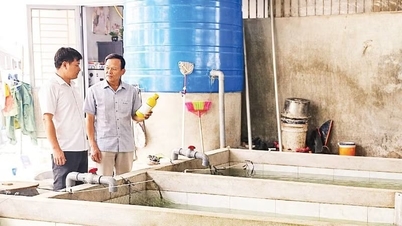
Mr. Duong Van Si, Deputy Director of Lien Hiep Agricultural Service Cooperative (left), visits the field with Mr. Han. Photo: Bao Thang.
According to him, the model can only function effectively when there is an organization coordinating everything from seed selection and planting schedules to machinery operation. Cooperatives act as intermediaries, consolidating land and connecting it with businesses or support projects. If each household were left to manage independently, the costs would exceed the capabilities of most farmers.
This reality is also why many places in the North are hesitant to implement low-emission rice production, due to the difficulty in rapidly scaling up the system as in the Mekong Delta. Rice fields in the North are small, fragmented, less mechanized, have an aging workforce, and a more complex irrigation system. Simply leveling the fields to apply alternating wet and dry irrigation is already a challenge.
In Long Hung, the biggest problem in recent years has been flooding. Village head Luong Van Han recounted that in the last three harvests, large areas of land were completely lost due to slow drainage. In some places, the concrete roads were submerged up to the surface. "If the drainage problem isn't solved, people will abandon their fields," he said.
The story of reducing emissions is therefore not simply a matter of reducing seeds or fertilizer. It entails the need to reorganize farmland, regulate water, mechanize, and foster collective cooperation. In the last crop season, what surprised many farmers most was the uniformity of the rice fields. Leveling machines helped distribute water more evenly. The rice ripened uniformly and was less prone to lodging.

In some areas of Hung Yen province, the rice crop is ready for harvest. Photo: Bao Thang.
Deputy Director Luong Van Si said many people were surprised because previously each household did things differently, with rice fields varying in height, water levels in different places, resulting in weeds and uneven yields. When the entire field was sown at the same time and using the same process, the results were clearly visible. A quick count showed that the fields in the model all achieved and exceeded the 220-230 kg per sao (approximately 1000 square meters) yield.
The initial positive results were noticeable, but over tea in the late afternoon, both Mr. Han and Mr. Si were pensive. The model still relies heavily on external support, from machinery to technology. A combined seeding and fertilizing machine costs hundreds of millions of dong, beyond the means of most farmers in the region. Without a support mechanism or a centralized organization to operate it, it is very difficult for individual households to invest on their own. "If you want people to follow, you need machines," Mr. Han confided.
Mr. Si, however, looks further ahead to the output. According to him, only when there is a brand, a business guaranteeing purchase or export, will farmers accept mass production on a large scale. "If the same variety and process are used across a large field, then a commodity production area can be formed," he said.
Currently, most of the rice in Long Hung is still kept for consumption or livestock feed. Only a small percentage is sold on the market. For farmers who have toiled under the sun and rain their whole lives, simply having a rice crop that is "no longer unprofitable" is a huge change. They are now certain that the cost of planting, sowing, and fertilizing, which used to be several hundred thousand dong, has now been reduced to only 60,000 dong per sao (a unit of land measurement).
Source: https://nongnghiepmoitruong.vn/ron-rang-lua-giam-phat-thai-d815244.html
![[Photo] The 13th National Congress of the Youth Union conducts personnel work.](https://vphoto.vietnam.vn/thumb/1200x675/vietnam/resource/IMAGE/2026/06/24/1782299943080_ndo_br_1-6868-jpg.webp)
![[Photo] General Secretary and President To Lam attends the Central Public Security Party Committee Conference](https://vphoto.vietnam.vn/thumb/1200x675/vietnam/resource/IMAGE/2026/06/24/1782302063612_a1-bnd-9302-9166-jpg.webp)
![[Photo] Opening Ceremony of the 13th National Congress of the Ho Chi Minh Communist Youth Union](https://vphoto.vietnam.vn/thumb/1200x675/vietnam/resource/IMAGE/2026/06/24/1782286753905_ndo_br_1-8510-jpg.webp)