

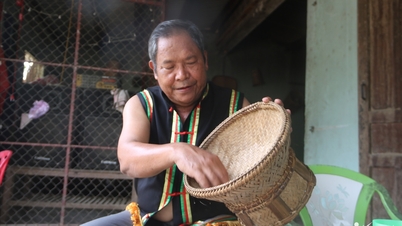
Throughout the morning, I followed Mr. Ho Ra Oi to admire the forest of nearly 1,000 precious trees such as Dalbergia tonkinensis, Dalbergia cochinchinensis, Diospyros spp., and Dalbergia spp., which he himself had painstakingly searched deep in the forest to find seedlings for planting 26 years ago. Mr. Ho Ra Oi said that even now, many Bru-Van Kieu people still do not understand the importance of forests. Just a decade ago, the Bru-Van Kieu people in Khe Van village, as well as many other villages, would go into the forest every season to clear land for farming and cut down trees to build houses. As a result, the forests gradually receded from the villages…
|
Whenever he has free time, Mr. Ho Ra Oi goes into the forest that he personally planted and cared for to count the number of trees - Photo: SH |

As for Mr. Ho Ra Oi's reforestation efforts, they took place 26 years ago. Around the year 2000, Mr. Ho Ra Oi, along with many young men from Khe Van village, due to poverty, had to venture into the deep forests and mountains of the Truong Son range to search for and excavate war relics. One day, while resting by a stream under the cool shade of the dense forest, Mr. Ho Ra Oi saw valuable timber saplings such as rosewood, Dalbergia tonkinensis, Dipterocarpus spp., and Dalbergia cochinchinensis growing well. He immediately dug up a few saplings, put them in a basket, and brought them home to try planting them in his garden. After some time cultivating the saplings, during the rainy season that year, Mr. Ho Ra Oi took them to the barren hill in front of Khe Van village to plant.
At first, Mr. Ho Ra Oi didn't believe the tree would survive because the hillside soil was too rocky and barren. But then, not only did the tree survive, it also grew lush and green. From then on, Mr. Ho Ra Oi began making trips into the forest to bring back saplings of valuable timber to cultivate.
Mr. Ho Ra Oi recalled that back then, each trip into the forest took him about 3-4 days to dig up a few dozen saplings of valuable timber. He would go from one forest to another searching for saplings. During the day, he would diligently dig, and at night, he would find rocky crevices or large tree trunks to sleep under to avoid snakes, insects, and wild animals. Many people, upon hearing his story about finding valuable timber saplings but not digging up all the trees he found, only taking a few and then moving on to find more elsewhere, thought he was "crazy." They said he should dig up everything he found and bring it back, since there were plenty of saplings in the forest, so why go through all that trouble? Mr. Ho Ra Oi just smiled dismissively. Because if he did it their way, when the trees grew and died, where would he get the seedlings to replace them? Digging up everything would be tantamount to indirectly destroying the forest.
Now, whenever he has free time, Mr. Ho Ra Oi goes into the forest he planted himself, and seeing the precious trees with their lush green canopies fills him with joy. He is happy because he has "brought the forest" closer to his village. Whenever he encourages the villagers of Khe Van to plant trees, he uses his own "forest" as an example to persuade them. Seeing his success, many people in Khe Van have started planting trees on the long-abandoned fields near the village.
Mr. Ho Ra Oi said that if every villager, not only in Khe Van village but also in many other villages, diligently planted a few trees on the barren hillsides, the forest would be green again in just a few years. We must plant and preserve forests to pass them on to future generations.
Sy Hoang
Source: https://baoquangtri.vn/xa-hoi/202601/rung-go-quy-cua-ho-ra-oi-aa846fc/











































































Comment (0)