

Kon Brăp Ju village is the long-standing settlement of the Ba Na people (Giơ Lâng group), while Kon Biêu village is the gathering place of the Xơ Đăng people (Tơ Đrá branch).
Connected by a suspension bridge over the Dak Pne River, the people here have preserved quite intact many good customs and traditions in their daily work, production, and life.
Life under the longhouse roof
At noon in March, the roof of the communal house in Kon Brăp Ju village soared high, seemingly carved against the deep blue sky.
The house of village elder A Jring Đeng is located right behind the imposing communal house, with its simple wooden stilt house architecture and tiled roof. At the end of the living room, the fire in the hearth crackles and smolders, and gray smoke lingers.
Sitting around the campfire, village elder A Jring Đeng proudly recounted to us the story of the village's founding, how the enduring strength of its inherent culture had "pushed out" the imported Western culture. The villagers of Kon Brăp Ju still preserve the traditional cultural values and customs of their ethnic group.
The saying "Our customs, we must preserve" that the elderly A Jring Đeng remembers still governs his daily life.
To this day, in Kon Brăp Ju village, the people still preserve their beautiful cultural identity in their eating habits, living habits, and clothing. Modern life has brought electricity to every home, but in the traditional stilt houses of the Ba Na people, the hearth fire is the soul of the house, smoldering and never going out.
Recalling those impoverished times, when blankets and bedding were scarce, the whole family slept around the fireplace to keep warm. Furthermore, in agricultural work, harvested produce was immediately stored in the warehouse. When needed, a basketful was spread on a winnowing tray and dried over the fire for a day and a night.
Only in the last 25-30 years have the Ba Na people changed their farming methods, drying harvested rice and corn in the sun. Therefore, the hearth is an important element, bringing warmth to the house.
Showing us the sturdily and carefully woven basket, village elder A Jring Đeng happily called it a basket "woven by the husband, reinforced by the wife."
He said: “In my ethnic group, if a man doesn't know how to weave, he shouldn't even think about getting married. If a woman doesn't know how to spin yarn or weave brocade, she shouldn't even think about finding a husband. We weave baskets to carry things to the forest and mountains. Depending on whether it's bamboo shoot season or rice season, the baskets can hold 35-50 kg. Currently, bamboo and rattan weaving is still popular in daily life. The products are mainly sold to people in the village or tourists .”
The Ba Na people currently hold two national intangible cultural heritages: traditional handicraft weaving and the Ét Đông festival (also known as the festival of eating the bamboo rat) of the Giơ Lâng (Ba Na) group in Kon Rẫy district.
Elder A Jring Đeng took us on a tour of the communal house. Despite the harsh sun and wind of the Central Highlands, the air inside the communal house was refreshingly cool.
 |
Elder A Jring Đeng, Kon Brăp Ju village. (Photo: KHIẾU MINH) |
He shared that the communal house, measuring over 300 square meters and nearly 20 meters high, is divided into two sections by a wall; the pillars are made of teak wood, and the roof is thatched; inside, many buffalo horns and symbols of the local people are hung.
The village has 186 households, and the communal house is a collective structure, with the entire village participating in its construction. In this space, the villagers of Kon Brăp Ju hold New Year celebrations, planting ceremonies, water channel repair ceremonies, Ét đông ceremonies, and new rice harvest ceremonies…
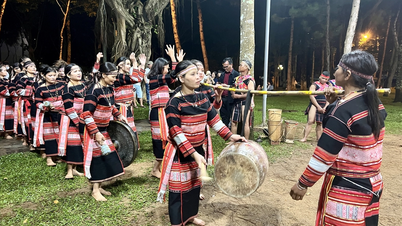
The village's gong and drum performance troupe is very active under the leadership of village elder A Jring Đeng. With the knowledge of an outstanding artisan, he takes on the role of teaching the younger generation how to play the gongs and drums.
Leaving the towering communal house characteristic of the Ba Na people, and crossing the suspension bridge in Hamlet 5 over the Dak Pne river to reach the Kon Bieu cultural village (Hamlet 4), we visited the Xo Dang ethnic minority.
The road leading into the village is paved with concrete, clean and spacious. Passing through the gate, you'll see the cool shade of green trees surrounding the communal house and the wide open courtyard.
Like many ethnic minority regions, during the process of building new rural areas, modern and traditional elements are blended in the shared space. Explaining this, village elder Kon Biêu A Hiang said: With improved economic conditions, the villagers have renovated their houses, but traditional stilt houses are still preserved.
Currently, Kon Biêu village has 163 households with over 500 inhabitants, mainly engaged in agriculture. The villagers still maintain the traditional weaving craft, but only for family use.
Similar to many ethnic groups in the Central Highlands, the communal house (nhà rông) is the face of the village, a collective structure built by the villagers together with a specific division of labor. Each household contributes materials and labor. The unique aspect is that using only axes, the artisans carve, sculpt wood, split trees, erect pillars, and reinforce the joints with rattan instead of nails.
Although knowledgeable about and possessing the traditional knowledge of building communal houses, the village elder A Hiang now lacks the resources to construct new ones. Therefore, during renovations and repairs, he personally guides the villagers through each meticulous step, ensuring the preservation of the traditional and original characteristics of the communal house while also passing on the construction techniques.
As it is a shared space, traditional customs all take place here, from traditional ceremonies such as welcoming the new year, clearing land, burning fields, thinning rice, building roads, harvesting new rice, and water trough worship ceremonies…
According to village elder A Hiang, the village population is growing. When people separate into their own households, leaving their parents' homes and having their own places to live, according to custom, on occasions when the village has an event, that household must bring wine to the communal house to offer and "report" the joyous occasion to the village.
In addition, the communal house also serves as a space for holding village meetings, Party branch activities, and discussing common village matters.
In the new way of life, the villagers encouraged each other to donate land for road construction, implementing the New Rural Development Program. Thanks to their unity and joint efforts for a better life every day, Kon Biêu village has achieved the standards of a new rural area.
Preserving national cultural identity
The indigenous culture is very well preserved, but community tourism in Kon Brăp Ju and Kon Biêu villages has not yet developed.
According to Pham Viet Thach, Head of the Culture, Science and Information Department of Kon Ray District, Kon Brap Ju village was chosen by the district to build a model community tourism destination, but tourism has not yet truly transformed.
Whether using tourism to preserve culture or using culture as a resource to develop tourism, Kon Rẫy district remains committed to sustainable development to avoid disrupting its existing cultural structure.
Home to approximately 10 ethnic groups with diverse cultural colors, Kon Rẫy district boasts 36 communal houses (nhà rông), 16 outstanding artisans specializing in folk culture, gongs, and musical instruments; diverse festivals associated with the cultural heritage of gongs and the communal house space, traditional crafts, and folk performing arts… This is a rich cultural resource for the socio-economic development of the locality.
The involvement of village elders and artisans in teaching crafts such as weaving, sculpting, pottery making, epic storytelling, gong and drum playing, and traditional dance, along with the succession of the next generation, ensures the continuous flow of culture.
Most importantly, Kon Rẫy district recognizes that the communal house (nhà rông) is both a symbol of the ethnic minorities of the Central Highlands and a unique cultural heritage that needs to be preserved. Therefore, in the conservation and restoration of the original communal house, district cultural officials regularly educate and guide ethnic minority people to use readily available natural materials and community resources for construction.
Since then, traditional festivals, cultural events of ethnic groups in Kon Rẫy district, gong competitions, etc., have been held annually, closely associated with the village space. The spatial structure of the village has not been lost.
Not only in Kon Brăp Ju and Kon Biêu villages, but also in other villages in Tân Lập commune, the imprint of local culture is very strong.
Throughout their development, the local people's eating, living, and dressing cultures have been preserved; among them, the communal house, traditional costumes, and the cultural space of gong music are indicators of the ethnic group's cultural identity. However, amidst the trend of cultural exchange and intermingling, elements of indigenous culture are sometimes fading away.
The solution lies in selectively preserving good customs and traditions, safeguarding original cultural elements against the leveling and flattening of modern lifestyles.
By emphasizing the role of artisans and the community in the process of self-preserving and practicing folk knowledge, without excessive intervention or influence on cultural elements, indigenous culture will shine on its own.
Source: https://nhandan.vn/sac-mau-van-hoa-ben-dong-dak-pne-post868526.html


![[Photo] Live Concert “Peaceful Hanoi” in the pedestrian area around Ho Hoan Kiem Lake.](https://vphoto.vietnam.vn/thumb/1200x675/vietnam/resource/IMAGE/2026/03/29/1774753509056_ha-noi-binh-yen-17-5239-jpg.)











































































Comment (0)