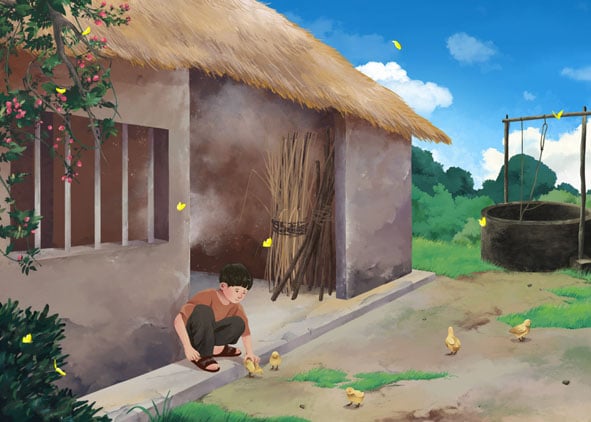
In front of our house, my father planted several spoon mango trees. This variety has small, round, glossy green fruits that are sour when unripe but sweet as honey when ripe. Along the edge of the earthen yard, under the smooth mango trees, footprints were everywhere. That's where I and my friends played shop with countless pots, pans, and baskets made from spoons and polished dried coconut shells. Regularly every morning, as soon as our friends from next door arrived, the "buying and selling" would continue until midday. Everything in the garden became a commodity, from the fallen red banana flower peels, the white gao blossoms, the dried eucalyptus fruits, to the old clusters of Sesbania leaves. And those childhood markets with their simple goods have remained a vivid part of my memory to this day.
 |
| Illustrative photo/Tra My |
There were seasons of torrential rain and storms, when the courtyard would be flooded. The muddy ground would sink deep under each step. Every day, going in and out of the alley so many times, the courtyard became a patchwork of uneven, muddy puddles. At those times, Father would brave the rain to gather all the fallen coconut fronds, neatly chop the large outer layers, and arrange them evenly to form a path leading to the porch. In the afternoon, waiting for Mother and Father to go to work in the fields, even with rain pouring down, my siblings and I would run and jump on the floating coconut fronds, feeling the cool, dry sensation on our feet without getting dirty. By evening, our hands and feet were soaked with rainwater, shivering with cold. Mother would scold us, then call us together to sit around the stove to warm ourselves. And outside, no matter how fierce the wind and rain raged, it only stopped outside the window.

The earthen courtyard bustled with activity during harvest season. At dawn, Mother would tell us to take a broom made of palm leaves and sweep the courtyard thoroughly, forbidding us from using coconut fiber brooms because they would dislodge small pebbles that would get mixed in when drying. This was so that when the sun rose, the courtyard would be warm enough to spread the rice out to dry. Mother instructed us to keep a long bamboo pole, sit in the shade under the eaves, chase away the chickens, and turn the rice stalks in the sun so it would dry evenly. But after only half a day, the sound of our friends running and jumping by the hibiscus hedge was enough to sweep us both away, playing hide-and-seek, dragon and snake, and then some other game… By the time we remembered Mother’s instructions and rushed back, the sun had already set. The hens, having finished their first brood, led the whole flock out of the nest and began to peck at the rice. The chicks couldn’t eat the rice yet, but they were incredibly mischievous. The entire courtyard was dug up by the chickens. Mother, always careful with every grain, gathered the rice mixed in with the dirt and sand, and carefully sifted it little by little. My mother hadn't even whipped me, yet my eyes were already welling up with tears. This courtyard once again bore the marks of my childish, petty mistakes.
After the rice harvest comes the cassava season. The cassava is harvested, its brown outer layer scraped off, then sliced diagonally and spread out to dry in the open air across the yard. During the cassava drying season, there's no need to plow or tend to the hens or lead the chicks to scratch the ground all over the garden; instead, each slice must be turned over in the sun until it curls up. Even now, in many hazy dreams in the city, I still see myself standing in that sun-drenched yard. And though the cassava slices are drying haphazardly, they are still perfectly even and beautiful, like a painting.
Time continues to flow, and people drift apart. Only the old earthen courtyard remains, standing silently as a witness to countless changes. The coconut shell spoons, once used as toys for "trading," lie abandoned to the elements, decaying with the passage of time, no longer passed around by children in the old market. Seasons of rice drying in the sun, forgotten and turned over, and the pristine white cassava slices have long since vanished. Only in dreams do I occasionally hear the sound of rice grains being pecked up by hens, mixing with the earth, silently stirring, a green memory of a bygone era!
Empress


Source: https://baodaklak.vn/van-hoa-xa-hoi/van-hoa/202607/san-nha-gio-thoi-d1234b7/
![[Photo] General Secretary and President To Lam working with the Technical and Professional Center, Ministry of Public Security](https://vphoto.vietnam.vn/thumb/1200x675/vietnam/resource/IMAGE/2026/07/06/1783318005842_a1-bnd-1129-2263-jpg.webp)