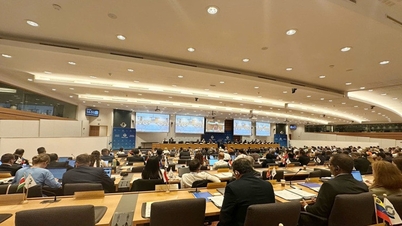
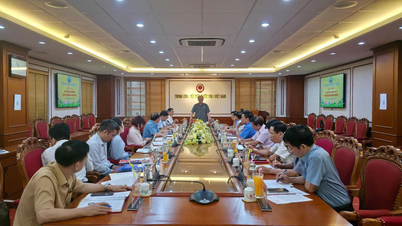
At the workshop on the project "Pilot program for electronic textbooks for grades 1, 2, and 3" organized by the Ho Chi Minh City People's Committee and the Department of Education and Training on July 18, Mr. Hua Ngoc Thuan, Vice Chairman of the Ho Chi Minh City People's Committee, said that according to the initial purpose of the project, electronic textbooks are intended to be a book that can both convey all the knowledge and reduce the burden of carrying books for students.
Each student gets a tablet…
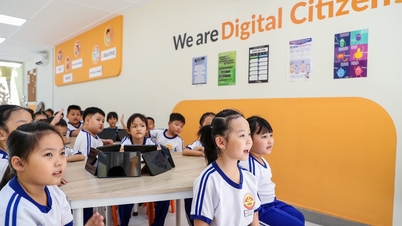
According to the Education Publishing House and Intel Corporation (the software provider for the digital textbooks), the digital textbooks are developed for 8-inch tablets. In addition to the general education curriculum, the device also includes more than 20 supplementary applications for various subjects. Furthermore, the mechanism for controlling internet access and installed applications provides schools and parents with greater peace of mind regarding their children's use of the device.

However, at the workshop, many concerns were raised, such as: Are digital textbooks suitable for very young students? Are digital textbooks a supplementary tool or a complete replacement for traditional textbooks? Ms. Cao Thi Tuyet Mai, Deputy Head of the Education and Training Department of District 4, expressed concern that at the age of first grade, children are too young to understand the importance of preserving a product for long-term use.
Agreeing with this opinion, Ms. Tran Thi Thanh Thuy, Deputy Head of the Education and Training Department of District 10, raised the question: "In the past, there have been many opinions suggesting that the use of interactive whiteboards affects the eyesight of young students, so are electronic textbooks safe for children's eyes?"
Where will the funding come from?


Many opinions at the workshop expressed concerns about the funding for the use of digital textbooks. Ms. Nguyen Ngoc Hanh, Deputy Principal of Nguyen Binh Khiem Primary School, questioned where the funding for equipping students with tablets would come from, given that the school has relatively good facilities in District 1 and receives significant investment from parents. She asked whether parents would provide the tablets themselves or if the school or local government budget would be used. “If parents provide them themselves, it won’t be uniform because not all families have the means, while the school cannot provide for all classes. Poor implementation will create inequality in the educational environment. On the other hand, if only a few sets are provided to each class, students won’t be able to take them home. Therefore, collaborative education at home will be very difficult,” Ms. Hanh explained.
Ms. Nguyen Thi Hong Yen, Deputy Principal of Dinh Tien Hoang Primary School, stated that the school's grades 1, 2, and 3 have nearly 1,000 students, making the provision of a digital textbook for each student a significant challenge. Meanwhile, representatives from many suburban districts affirmed that implementation would be difficult due to financial constraints. Ms. Cao Thi Tuyet Mai cited the example of District 4, where only one school has a multimedia room, highlighting the difficulty in investing in digital textbooks.
Ms. Tran Thi Thanh Thuy believes that the pilot project for electronic textbooks must convince society of its effectiveness and fairness. To use them effectively, a great deal of preparation is needed, at least for first-grade children, starting after the first semester.
From another perspective, many people are concerned about whether e-textbooks can replace traditional teaching methods. If traditional teaching methods are abandoned, what will happen to teacher training, and will it affect students' long-standing reading habits? “Is it okay if e-textbooks are copied exactly from old books? For example, is it necessary to describe a tree while it remains still, just like in a paper book? E-textbooks should only be a supporting tool and cannot completely replace traditional teaching methods,” suggested Mr. Tran Trong Khiem, Deputy Head of the Education and Training Department of Tan Phu District.
Investing in people requires careful consideration.
Mr. Le Thai Hy, Director of the Department of Information and Communications of Ho Chi Minh City, believes that regarding software development, especially for electronic textbooks, it must be transparent to allow software companies to compete and avoid monopolies. Meanwhile, according to Mr. Nguyen Van Lam, Deputy Head of the Budget Committee (Ho Chi Minh City People's Council), the project's costs are quite high, but one shouldn't be afraid or avoid it just because it involves a lot of money. The issue is that investing in human resources requires caution, with a process of surveying each district, each school, and each family… “There are still many issues to discuss and opinions to find the best solution,” concluded Mr. Hua Ngoc Thuan.



Source: https://nld.com.vn/giao-duc-khoa-hoc/sgk-dien-tu-gay-tranh-cai-2014071823092442.htm