

(NLĐO) - The Hubble telescope has captured an image that NASA describes as a "star volcano," located 700 light-years away from us.
In the image released by NASA, the object looks like a supervolcano in the sky erupting and flashing intensely. It is R Aquarii, a fearsome pair consisting of a white dwarf and a red giant star located 2.6 billion kilometers apart.
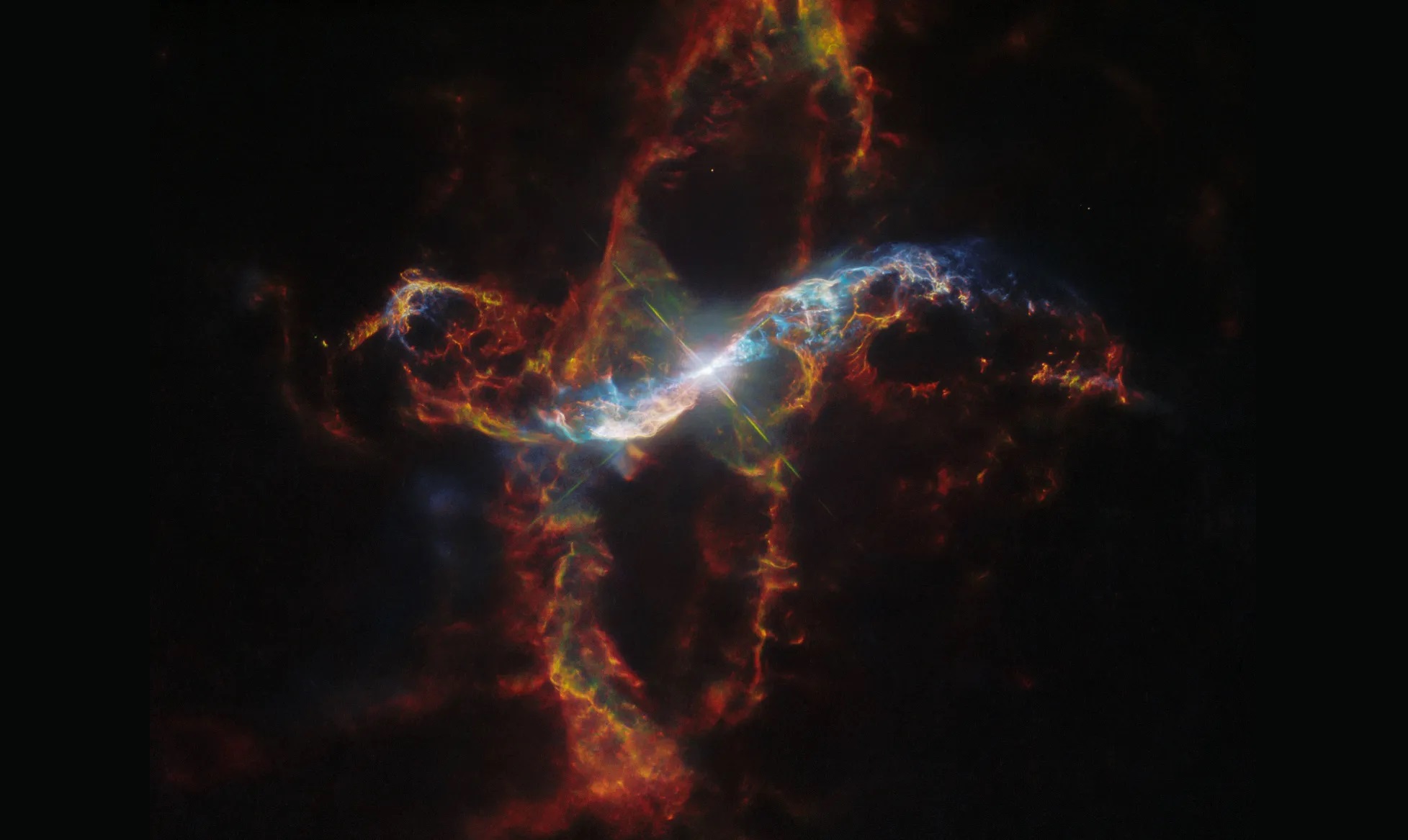
The moment the "star volcano" R Aquarii erupted - Photo: NASA/ESA
Red giant stars are dying stars that swell up and shine brightly one last time before they "die".
Meanwhile, white dwarfs are the "zombie" after that death, a compact object that is the remnant of a compressed, high-energy star.
In other words, R Aquarii consists of a dead star and a dying star, in a symbiotic relationship.
According to NASA, both are true space monsters.
This ancient red giant star is a variable star, 400 times larger than the Sun, constantly changing its temperature and brightness by a factor of 750 in a 290-day period.
At its peak, this star could be 5,000 times brighter than the Sun.
Variable stars change brightness due to their intrinsic properties as well as external influences. In this case, its companion contributed to the dramatic changes.
When the white dwarf makes its closest approach to the red giant during its 44-year orbital period, it will draw in hydrogen gas due to gravity.
This material accumulates on the surface of the dwarf star until it undergoes spontaneous nuclear fusion, causing the surface to explode like a giant hydrogen bomb. After the explosion, the refueling cycle begins again.
This explosion ejects jets of filaments resembling water jets from the core, forming strange loops and streaks as the plasma appears as streams.
The plasma is twisted by the force of the explosion and guided upwards and outwards by strong magnetic fields. The outflow appears to bend back against itself into a spiral pattern.
This stream of plasma is shooting into space at a speed of over 1 million miles per hour – fast enough to travel from Earth to the Moon in 15 minutes.
These filaments glow in visible light, powered by blistering radiation from the star pair.
The eruption of the "star volcano" shook a region of space, ejecting material as far as 400 billion kilometers - Clip: NASA/ESA
NASA called the scale of this event "extraordinary." Material ejected into space can be found at least 400 billion kilometers away from the stars, or 24 times the diameter of our solar system.
Source: https://nld.com.vn/clip-soc-sieu-nui-lua-bung-no-giua-troi-xe-toac-khong-gian-196241024111221593.htm



![[Image] Bridges and roads connecting the eastern part of Ho Chi Minh City](https://vphoto.vietnam.vn/thumb/1200x675/vietnam/resource/IMAGE/2026/04/16/1776328595108_ndo_br_bh-vt5-jpg.webp)


























































![[Infographic] Details of the Hanoi-Quang Ninh High-Speed Railway Project](https://vphoto.vietnam.vn/thumb/402x226/vietnam/resource/IMAGE/2026/04/16/1776338188424_anh-man-hinh-2026-04-16-luc-18-16-10.png)
![[Photo] National Assembly Chairman Tran Thanh Man meets with the Speaker of the Georgian Parliament](https://vphoto.vietnam.vn/thumb/402x226/vietnam/resource/IMAGE/2026/04/16/1776338494029_anh-man-hinh-2026-04-16-luc-18-21-21.png)

































Comment (0)