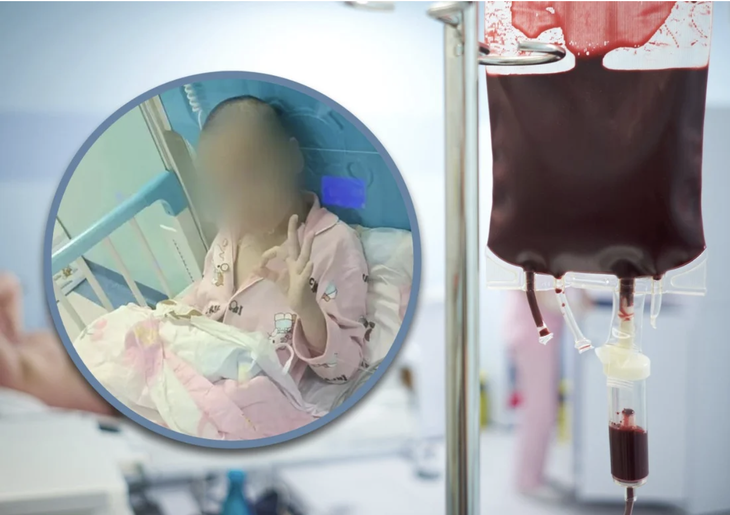
A 15-year-old girl with severe thalassemia in China received a stem cell transplant from her younger brother's umbilical cord blood (from her parents' second child) to save her life - Photo: SCMP
According to the SCMP on May 12, a girl named Xiaoyan (from Guangdong province, southern China) was diagnosed with thalassemia at just 3 months old.
The child is currently only 140cm tall and weighs 25kg - about half the weight of other children his age.
Xiaoyan's father is a construction worker, and her mother is unemployed.
I don't want to get a transplant because 'my family doesn't have much money'.
For many years, the family could only afford to give the little girl regular blood transfusions instead of standard treatment.
It wasn't until 2018, when Xiaoyan's spleen became enlarged and had to be removed, that her situation received media attention and appropriate treatment began.
Doctors then advised the family to find a suitable match from a stem cell bank or have another child to use the umbilical cord blood.
Umbilical cord blood is an important source of hematopoietic stem cells, collected from the umbilical cord and placenta after a baby is born.
This is considered an effective treatment method for blood disorders in blood relatives, as well as for future diseases that children may develop.
In China, an increasing number of parents are considering storing or donating their child's umbilical cord blood as a "lifesaving precautionary measure."
China currently has seven official umbilical cord blood banks.


According to data released in November 2025, nearly 2.5 million units of umbilical cord blood had been stored in these banks, of which 45,000 units had been used for treatment.
The cost of storing umbilical cord blood is approximately 20,000 yuan (about $3,000 USD) for 20 years of preservation.
For some families, this amount of money is a financial burden, so they often choose to have their umbilical cords transplanted from free donors instead of storing them.
In Xiaoyan's case, she once had a one-year-old younger brother, but her parents did not store his umbilical cord blood.
Xiaoyan's family fell into hardship when her father, the main breadwinner, suffered a work-related accident, and her grandparents both suffered from chronic illnesses.
Xiaoyan even messaged her mother saying she didn't want a stem cell transplant because "our family doesn't have much money."
Have more children to save Xiaoyan.
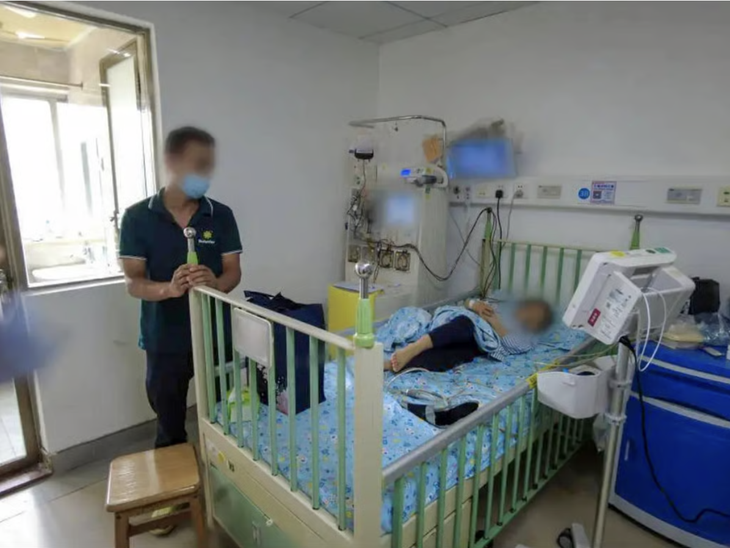
Little Xiaoyan lies in a hospital bed surrounded by medical equipment - Photo: SCMP
Because they couldn't afford the cost of receiving blood from a non-related donor—which is much more expensive than using umbilical cord blood from siblings—Xiaoyan's parents decided to have another child.
In 2021, Xiaoyan's youngest brother was born. The baby's blood was half-compatible with his sister's, and according to the doctor, this made him eligible for a transplant.
Afterward, Xiaoyan had to undergo treatments to remove excess iron from her body in preparation for the transplant.
By 2025, the girl's body will be in a condition suitable for surgery. After receiving financial support from benefactors, Xiaoyan will undergo free surgery in April 2026.
Doctors say the girl is recovering well and her blood-forming function is gradually being restored.



Although ethical debates about having more children to treat sick siblings persist in many countries, this practice is widely accepted in China.
Chinese newspapers have also reported many similar cases.
In 2016, a couple in Guangdong province reportedly gave birth to three sons to save their daughter, who suffered from thalassemia.
However, the SCMP quoted experts as saying that umbilical cord blood from newborn siblings does not guarantee a successful transplant.
A child's blood may be incompatible with that of a sick sibling, or if the parents carry the genetic problem, the child born later may also be at risk of developing the congenital disease.
Source: https://tuoitre.vn/sinh-them-em-de-hoi-sinh-chi-20260512203906311.htm

![[Image] National conference summarizing one year of operation of the overall organizational model of the political system, the three-tiered government model.](https://vphoto.vietnam.vn/thumb/1200x675/vietnam/resource/IMAGE/2026/07/01/1782882811691_ndo_br_1-jpg.webp)