Chips integrated into cameras to measure vehicle speed, chips in brainwave monitoring devices to aid sleep… these are some of the ideas from students participating in the Ho Chi Minh City Integrated Circuit Design Competition.
On the morning of March 24th, the Ho Chi Minh City High-Tech Park, in collaboration with the City Youth Union, organized the qualifying round of the first Smart City Microchip Design Competition, with the participation of 29 project teams from young people aged 18-23.
A group of students from the University of Information Technology, Vietnam National University Ho Chi Minh City, presented a design idea for a chip that measures the speed of vehicles in traffic at a competition. According to team leader Phan Hoai Lam, the chip is integrated into traditional cameras and works by analyzing collected images by measuring the distance between two points in the frame and the time taken between those points to determine the vehicle's speed. This technology can process and measure the speed of multiple vehicles simultaneously, with an initial accuracy of approximately 60%, which will increase as image processing is optimized.
The team is building a chip design architecture model and needs specialized tools and software to complete it. Hoai Lam said that the team's technology allows data to be processed directly at the camera faster, saving bandwidth costs and reducing data transmission to the server. In the future, the team will integrate additional mechanisms for identifying license plates, vehicle colors, etc.
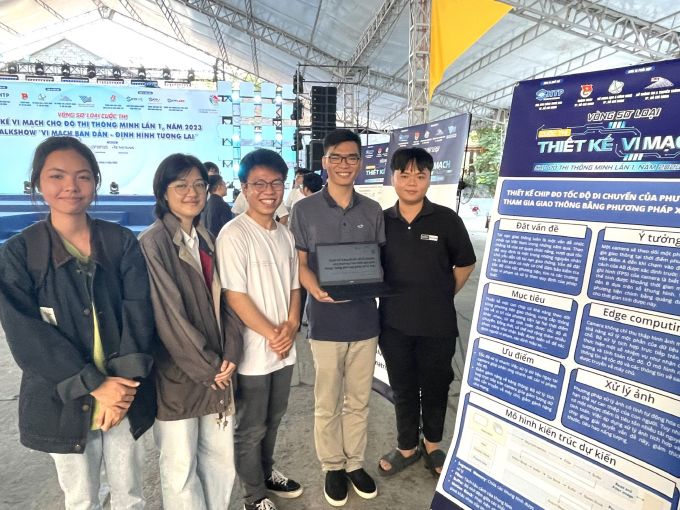
A group of students from the University of Information Technology, Vietnam National University Ho Chi Minh City, with their idea for designing a chip to measure vehicle speed. Photo: Ha An.



Designing a chip for healthcare applications, a group of students from the Ho Chi Minh City University of Technology, Vietnam National University, created a body-worn device that promotes deeper sleep through brainwave frequencies. The device works by measuring the human electroencephalogram (EEG), processing the information, and then emitting appropriate sound frequencies to support sleep maintenance.
Nguyen Xuan Trieu, representing the team, said the product can be integrated into pillows, neck straps, headphones, etc., with the most compact size possible to create comfort during use. "The product is still in the conceptual stage, so determining which devices are suitable for integration requires time and consultation from biomedical research experts," Trieu said.
With a shared vision for healthcare, a group of students from Ho Chi Minh City University of Industry and Trade proposed creating an integrated circuit with sensors combined with AI algorithms to detect falls. The product could be designed as a bracelet, necklace, etc., with the function of immediately alerting family members via their phones when elderly people or stroke victims fall. The group is currently in the architecture design phase and building a team to finalize the idea and create the product.
Through expert panel evaluation, from 29 projects, the organizing committee plans to select 10 applications to participate in the training round to support students in product development. According to Le Quoc Cuong, Deputy Head of the Ho Chi Minh City High-Tech Park Management Board, the competition helps to discover innovative semiconductor chip ideas from young people. This is an important foundation for expanding the scale and quality of human resource training to meet business needs, aiming to acquire core technologies, incubate semiconductor businesses, and attract strategic investment projects in the field to operate within the Ho Chi Minh City High-Tech Park.
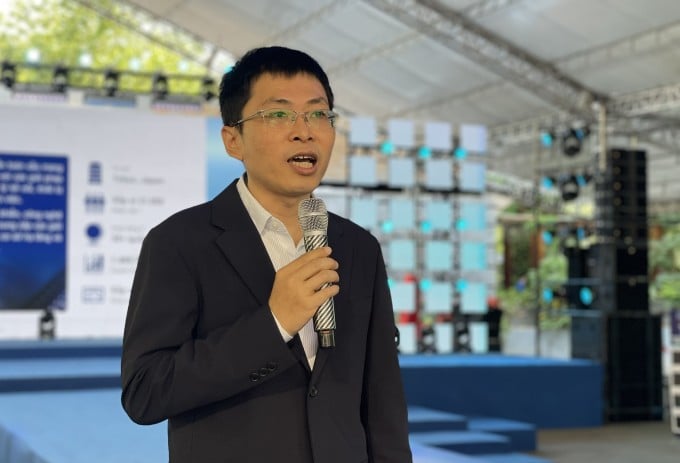
Mr. Tran Dac Khoa shared the skills students need to become integrated circuit engineers. Photo: Ha An



From a business perspective, Mr. Tran Dac Khoa, General Director of Renesas Vietnam design company, believes that students participating in seminars and academic competitions in this field is one of the six essential skills for integrated circuit engineers. This gives students the opportunity to learn in a larger environment because the integrated circuit industry is constantly evolving year after year. Competitions help students enhance their teamwork skills because it is difficult for individuals to create products independently.
Ha An
Source link