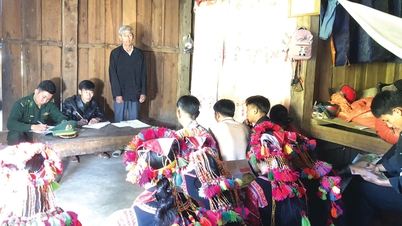
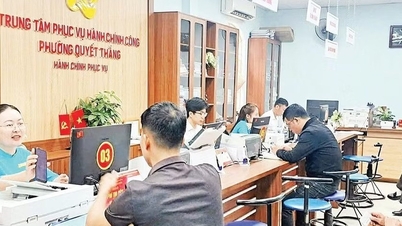
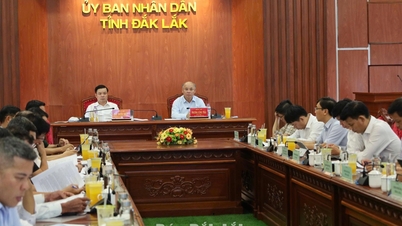
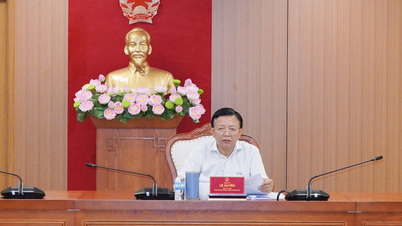
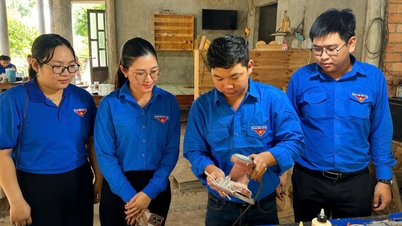
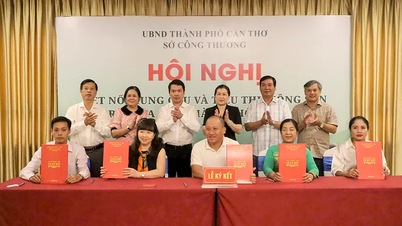
Officials in Phu Le commune guide residents in comparing information on their land use right certificates and citizen identification cards.
In early June, as the campaign to enrich and clean up the land database entered its final stage, officials from Trung Ly commune continued their trips to the villages to review and cross-check information. Ta Com village, located nearly 50km from the commune center, has 118 households with approximately 620 inhabitants. On several occasions, Mr. Thao A Su, the village head of Ta Com, along with commune officials, went from house to house to encourage residents to bring their land use right certificates and citizen identification cards for verification. Some households were out working in the fields from early morning until late at night, while others were working far away, requiring the task force to contact them multiple times to verify and supplement their records.
Mr. Su's own family was also included in the data review process. The comparison helped him realize that many records contained discrepancies or outdated information. Based on this, he and the commune officials continued to guide the villagers in preparing their documents and collaborated on the review to ensure that the information was fully and accurately updated. "The villagers mainly work in the fields and have little exposure to administrative procedures, so they need specific guidance. Cleaning up the data now will make things much easier later when carrying out land-related procedures," Mr. Thao A Su shared.
In Trung Ly commune, the local authorities had to review and cross-check 239 land plots. Of these, 14 cases required correction or supplementation of information; 6 cases involved discrepancies in citizen identification numbers (CCCD), names, or addresses; and 24 cases required multiple verifications. The large area and scattered population meant that much information could not be verified directly on file, requiring direct verification at the grassroots level. Therefore, trips to each village became a regular part of the work of the task forces. Land administration, police, and judicial officers, along with staff from the commune's Public Administrative Service Center, coordinated with village heads to visit each household to check and cross-check documents. Since people were working in the fields during the day, the task forces had to take advantage of evenings or weekends to work.



From the remote villages of Trung Ly commune, the work of enriching and cleaning up the land database is being implemented synchronously throughout the province. According to information from the Department of Agriculture and Environment, by the beginning of June 2026, the entire province had completed enriching and cleaning up 766,656 out of 941,018 land parcels, achieving 81.47% of the required volume. Among them, 9 communes completed 100% of the task: Nhi Son, Co Lung, Trung Ly, Bat Mot, Van Nho, Muong Min, Trung Son, Phu Le, and Phu Xuan.
Unlike Trung Ly commune, Phu Le commune faces difficulties stemming from its unique post-merger characteristics. The locality was formed by merging three former communes, resulting in a large volume of records and data requiring review and standardization. Many certificates still contain old administrative addresses. These discrepancies directly impact data synchronization and the processing of administrative procedures.
Mr. Nguyen Van Binh, Chairman of the People's Committee of Phu Le Commune, said that from the very beginning of the project, the locality determined that this was not only a requirement for digital transformation, but also directly related to the rights of people in carrying out land-related procedures. The commune mobilized relevant forces to participate in reviewing and cross-referencing data; cases of information discrepancies or arising difficulties were assigned for specific verification and handling. “After the merger of the three old communes, the volume of files and data that needed to be reviewed was enormous. However, the locality determined that it had to be done thoroughly and correctly from the start to ensure accurate and synchronized data. When the data is standardized, people will find it easier to carry out administrative procedures, and at the same time, improve the efficiency of state management of land,” Mr. Binh said.
To date, Phu Le commune has completed data cleaning for 352 households and individuals and 4 organizations, achieving 100% of the assigned target. This result not only helps the locality fulfill its assigned task but also makes it easier for people to carry out land-related procedures. Previously, when information on land use right certificates and citizen identification cards was inconsistent, people often had to supplement documents or verify information multiple times. For households in remote villages, each trip could take almost a whole day. With the data standardized, much information has been cross-referenced and updated on the system, helping to reduce verification time and limit the need to supplement documents.
Information received from localities indicates that the implementation process has helped to detect and correct many information discrepancies in a timely manner; land data is gradually being synchronized with the national population database. As a result, verifying and cross-referencing information is faster, reducing errors when carrying out land-related procedures. When data is cleaned up, people have fewer trips and fewer documents to submit, and land procedures become more convenient and transparent.



Text and photos: Tang Thuy
Source: https://baothanhhoa.vn/so-hoa-dat-dai-nbsp-giam-phien-ha-cho-nguoi-dan-291329.htm
































![[Photo] Thousands of people participate in a run to show their support for the campaign "Sharing a common determination to build drug-free communes, wards, and special zones".](https://vphoto.vietnam.vn/thumb/1200x675/vietnam/resource/IMAGE/2026/06/27/1782554475933_0673e2a3df7b5e25076a-8283-jpg.webp)