

Kinhtedothi - According to Associate Professor Dr. Nguyen Danh Tien - Director of the Institute of Party History (Ho Chi Minh National Political Academy), the establishment of the Hanoi Party Committee is a historical event of great significance to the revolutionary movement of the whole country in general and the capital city of Hanoi in particular...
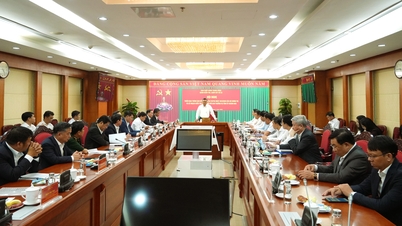
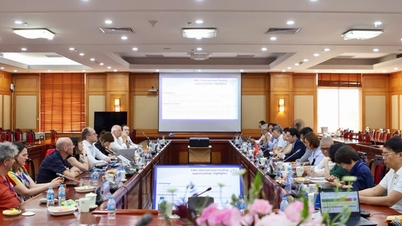
On the morning of March 11th, the Hanoi City Party Committee, in coordination with the Ho Chi Minh National Political Academy, organized a scientific conference with the theme "95 Years of the Establishment of the Hanoi City Party Committee: Its Historical Significance (March 17, 1930 - March 17, 2025)".
Dr. Nguyen Van Phong - Standing Deputy Secretary of the Hanoi City Party Committee; Assoc. Prof. Dr. Nguyen Danh Tien - Director of the Institute of Party History (Ho Chi Minh National Political Academy); and Member of the Standing Committee of the Hanoi City Party Committee, Head of the Propaganda and Mass Mobilization Department of the Hanoi City Party Committee Nguyen Doan Toan chaired the workshop.
The workshop was attended by 150 delegates, including representatives from central agencies, the Ho Chi Minh National Political Academy, leaders of the City Party Committee, People's Council, and People's Committee; leaders of departments, agencies, districts, and towns; experts, scientists, and representatives of the families of former senior leaders.
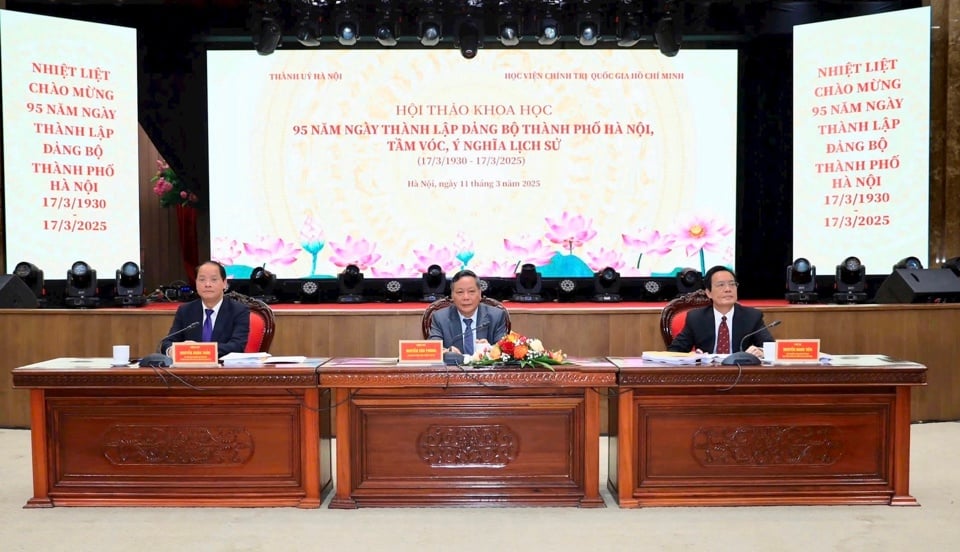
A new period of development in the revolutionary movement of Hanoi City.
Speaking at the conference, Associate Professor Dr. Nguyen Danh Tien - Director of the Institute of Party History (Ho Chi Minh National Political Academy) stated that on March 17, 1930, at house number 42, Hang Thiec Street, the Provisional Executive Committee of the Hanoi Party Committee was established, marking the birth of the Party organization and opening a new period of development in the revolutionary movement of Hanoi.
The establishment of the Hanoi Party Committee was a historic event of immense significance for the revolutionary movement of the entire country in general and the capital city of Hanoi in particular. Over 95 years of development and growth, with its wisdom and unwavering resolve, the Hanoi Party Committee has creatively applied the Party's principles, guidelines, and policies to the practical conditions of the capital city. At the same time, it has flexibly guided practical actions to awaken and harness the strength of national unity combined with the strength of the times, contributing alongside the entire Party, people, and army to achieving independence, national liberation, national reunification, building socialism, and carrying out the reform process, promoting industrialization, modernization, and international integration.
More than a month after the founding of the Communist Party of Vietnam, on March 17, 1930, at house number 42 Hang Thiec Street, the Provisional Executive Committee of the Hanoi Party Committee was established, consisting of three comrades: Do Ngoc Du, Nguyen Ngoc Vu, and Le Tho Nam; among them, Comrade Do Ngoc Du was appointed as the Provisional Secretary of the City Party Committee. The establishment of the Hanoi Party Committee had great significance for the revolutionary movement of the capital in particular and the revolutionary movement of the whole country in general.
Firstly, the establishment of the Hanoi City Party Committee was the result of a heroic and arduous struggle, overcoming countless difficulties and hardships in the face of the fierce terror inflicted by the enemy on revolutionary fighters and the revolutionary movement in the capital city.
Secondly, the establishment of the Hanoi Party Committee was a significant milestone in the development of the Vietnamese revolutionary movement, especially in Hanoi, the capital city – the center of the French colonial and feudal administrative apparatus.
Thirdly, as the capital and the cultural and political center of the country, Hanoi plays a particularly important role in the nationwide revolutionary movement. Therefore, the establishment of the Hanoi Party Committee is not only significant for the revolutionary movement in the capital but also creates a solid foundation and strongly impacts the revolutionary movement throughout the country.
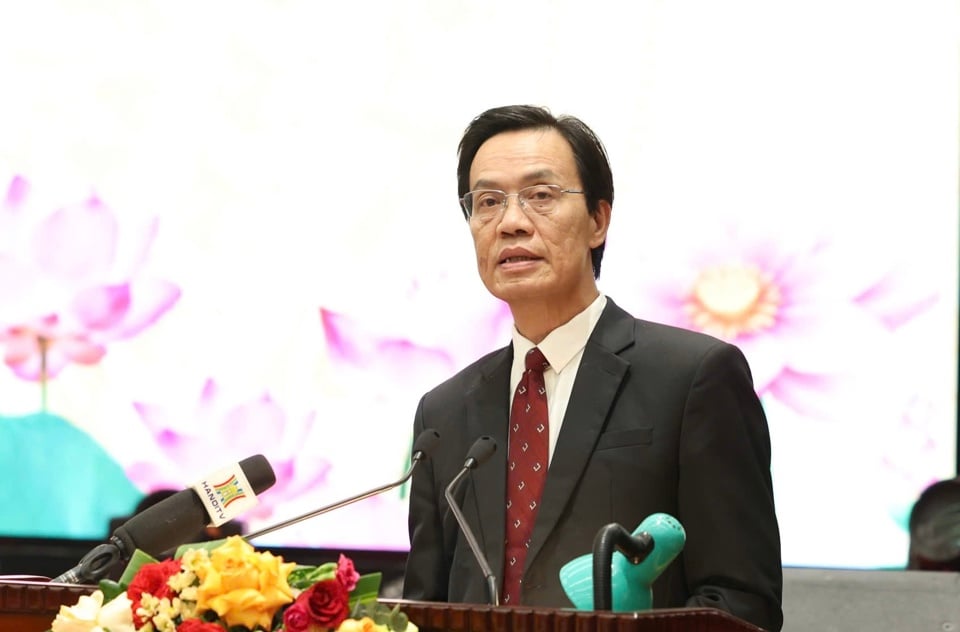
Fourth, the establishment of the Hanoi Party Committee contributed to consolidating and expanding the revolutionary forces. From here, the Party organization would serve as the core in building and organizing mass movements in Hanoi. The birth of the Hanoi Party Committee also demonstrated the maturity and unified leadership of the Party over all strata of the people, from workers and farmers to intellectuals and other social groups. The Hanoi Party Committee created a tightly-knit organizational system, contributing to promoting the people's participation in the national liberation struggle.
Impact on the development process of the Capital Revolution
According to Associate Professor Dr. Nguyen Danh Tien, after the establishment of the Communist Party of Vietnam and the Hanoi City Party Committee, the French colonialists carried out fierce repression, aiming to break the revolutionary movement throughout the country, especially in areas where the revolutionary struggle was strong. In Hanoi, Party organizations and mass organizations were relentlessly attacked by the enemy, causing the Hanoi City Party Committee to repeatedly collapse and requiring its establishment many times.
In that situation, under the leadership of the Central Party Committee, directly the Northern Regional Party Committee, and especially the proactive, creative, and flexible leadership of the City Party Secretaries, the Hanoi City Party Committee persistently led the restoration of party organizations and revolutionary movements; mobilized the masses to participate in the revolutionary high tide of 1930-1931 and the movement for people's livelihoods and democracy (1936-1939); actively built safe zones for the Central Committee in the suburban districts; and intensified efforts to mobilize workers and enemy soldiers.
"In particular, during the period 1944-1945, while preparing in all aspects for partial uprisings leading to a general uprising, the Thanh Hoang Dieu Propaganda Shock Team was established, sparking a strong anti-Japanese fascist movement in Hanoi, Ha Dong, and Son Tay," Associate Professor Dr. Nguyen Danh Tien emphasized.
According to Associate Professor Dr. Nguyen Danh Tien, based on the preparations for the uprising, on August 16, 1945, the Hanoi Revolutionary Military Committee was established, actively preparing for the general uprising, leading the people of the capital and the people of the whole country to achieve the earth-shattering victory of the August Revolution of 1945, shattering nearly 90 years of French colonial rule and liberating the nation from the yoke of Japanese fascism. With the success of the August Revolution of 1945, power returned to the people, and the Democratic Republic of Vietnam was born – the first people's democratic state in Southeast Asia, opening a new era – an era of national independence linked with socialism. From then on, Hanoi became the capital of an independent, sovereign nation, creating new momentum and strength for the revolutionary movement in Hanoi.
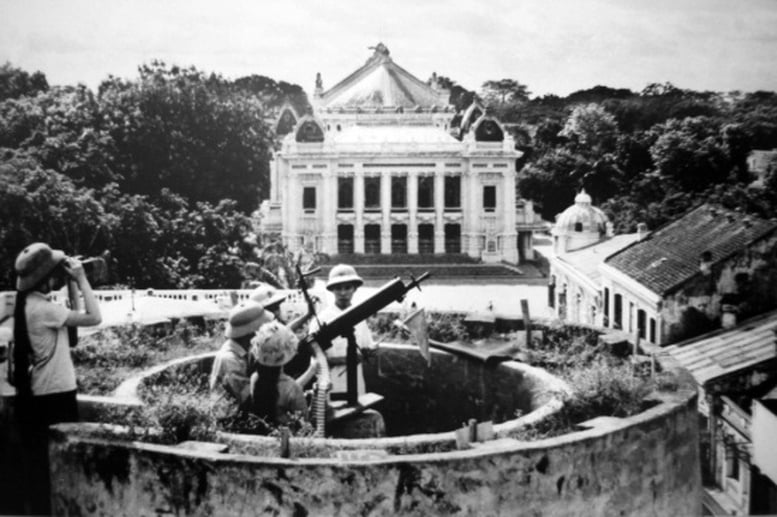
During the protracted resistance war against French colonial aggression, overcoming countless difficulties, hardships, and sacrifices, the Hanoi Party Committee led the army and people of Hanoi in both building and consolidating organizations in the liberated areas and the temporarily occupied enemy zones, while also actively participating in battles to defeat the military strategies of the French colonialists. At the same time, they directly fought within Hanoi. After nine years of protracted resistance, with many sacrifices and hardships, but with immense bravery and pride, under the leadership of the Party, our army and people achieved the historic victory of Dien Bien Phu, "renowned throughout the world and shaking the earth." With this victory, "for the first time in history, a small and weak colonial country defeated a powerful colonial power."
The victory at Dien Bien Phu in 1954 paved the way for the troops who had left Hanoi for the resistance zones to return and liberate the capital. On October 10, 1954, Hanoi – the capital of the Democratic Republic of Vietnam (now the Socialist Republic of Vietnam) – was completely free of enemy troops, becoming a milestone, affirming the complete victory of our army and people in the resistance war against French colonial aggression, and simultaneously opening a new era in the thousand-year history of Thang Long - Hanoi.
Following the liberation of the capital, the Party Committee, government, and people of Hanoi, along with the people of North Vietnam, embarked on building socialism. All levels, sectors, and strata of Hanoi's people focused on restoring production facilities destroyed by the war, gradually stabilizing the economic and social situation; reorganizing production, ensuring people's livelihoods, and gradually building the initial material and technical foundations of socialism. By 1965, Hanoi had become a major cultural, educational, and industrial center of North Vietnam.
During the first bombing campaign against North Vietnam, with the spirit of "Nothing is more precious than independence and freedom" and with the unwavering belief that "Our people's struggle against the US and for national salvation will surely be completely victorious," the army and people of Hanoi, along with the people of North Vietnam, bravely fought and defeated the US imperialist air war of destruction. In particular, during the 12 days and nights at the end of 1972, the army and people of Hanoi bravely fought, achieving the miracle of "Hanoi - Dien Bien Phu in the air" - one of the greatest victories of the Vietnamese nation in the 20th century, contributing to fundamentally changing the situation of the resistance war against the US and for national salvation, forcing the US government to sit down at the negotiating table and sign the Paris Agreement (January 27, 1973) on ending the war and restoring peace in Vietnam, withdrawing all US and allied troops from South Vietnam, creating a turning point for the resistance war against the US and for national salvation. The victory of "Hanoi - Dien Bien Phu in the air" laid the groundwork for our army and people to advance and achieve decisive victory in the resistance war against the US, saving the nation...
Upholding the glorious tradition
According to Associate Professor Dr. Nguyen Danh Tien, in implementing the Party's policy, on May 29, 2008, the 5th Session of the 12th National Assembly passed Resolution No. 15 on adjusting the administrative boundaries of Hanoi City. After the adjustment, Hanoi City covers an area of 3,344.7 km² , 3.6 times larger than its previous size; with 29 subordinate administrative units, including 10 inner-city districts, 18 suburban districts and 1 suburban town; the population is 6,232,940 people.
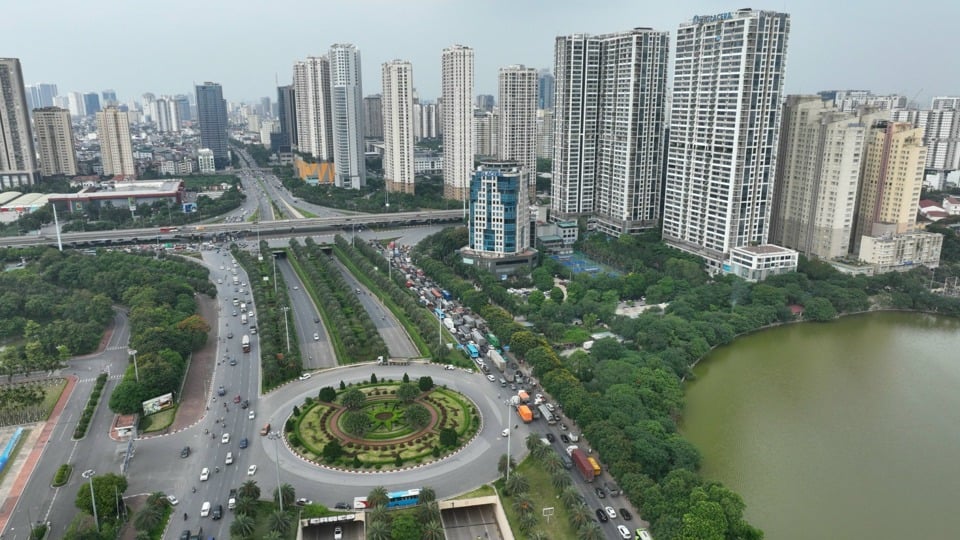
Throughout the process of reform and industrialization, the Hanoi Party Committee and government have consistently adhered to the principle that socio-economic development is central; Party building is crucial, coupled with cultural development – the spiritual foundation of society; and national defense and security are vital and ongoing, aiming for comprehensive and sustainable development of the capital city. Thanks to this, after nearly 40 years of reform, especially after the merger of Hanoi and Ha Tay, Hanoi has consistently maintained an average growth rate of over 7% per year. The size of Hanoi's economy (GRDP) in 2024 reached over 1.4 trillion VND, equivalent to over 59 billion USD. State budget revenue ranked first nationwide for the first time, at approximately 508,000 billion VND.
As the heart of the nation, the Party Committee, government, and people of Hanoi City pay special attention to building culture and developing the people of Hanoi to be worthy of being the thousand-year-old capital of culture and heroism - a place where the noble values of the Vietnamese nation converge, crystallize, and shine.
Recognizing the efforts of the Party Committee, government, and people of Hanoi, the city has been honored by UNESCO as a "City for Peace"; it has also been awarded the Golden Star Order three times by the State, and the title of "Heroic Capital". This serves as a foundation for the Party Committee, government, and people of Hanoi to continue achieving new victories in the new era – the era of national prosperity.
According to Associate Professor Dr. Nguyen Danh Tien, to develop Hanoi to a new level, on May 5, 2022, the Politburo issued Resolution No. 15-NQ/TW on the direction and tasks for the development of Hanoi until 2030, with a vision to 2045. The goal by 2030 is for Hanoi to be a "Cultural - Civilized - Modern" city; becoming a center and driving force for the development of the Red River Delta region, the key economic region of Northern Vietnam, and the whole country; deeply integrated into the international community, highly competitive with the region and the world, striving to develop to the level of capitals of developed countries in the region. The vision by 2045 is for Hanoi to be a globally connected city with a high standard of living and quality of life, with a GRDP per capita exceeding US$36,000; with comprehensive, distinctive, and harmonious economic, cultural, and social development; a model for the whole country. It has a level of development comparable to that of capital cities in developed countries in the region and around the world.
Developing Hanoi into a "Cultural, Civilized, and Modern" capital city is a particularly important political task in the strategy of national construction and defense, with the spirit of "The whole country for Hanoi, Hanoi for the whole country." This is the responsibility and duty of the entire Party, the entire people, and the entire political system; it is the top priority of the Party Committee, the government, and the people of Hanoi.
Effectively implementing the Hanoi Capital City Planning for the period 2021-2030, with a vision to 2050, and the revised General Planning for the construction of the Capital City to 2045, with a vision to 2065, as well as other planning projects, especially the zoning plans for satellite cities, the regional construction plans for districts within the city, and other specific plans, is crucial. The development of Hanoi's urban system not only promotes the economic, cultural, and social development of the Capital City itself, but also of the region, creating conditions for the city to integrate internationally and develop to the level of capitals in developed countries in the region. Implementing the 2024 Law on the Capital City in practice, with its fundamental advantages, will enable Hanoi to become a modern, smart city that leads and creates a ripple effect, linking urban areas; with a high standard of living and quality of life; and with comprehensive, distinctive, and harmonious economic, cultural, and social development.
Furthermore, building a truly exemplary, united, clean, and comprehensively strong Party organization and political system in Hanoi, as President Ho Chi Minh often instructed during his lifetime: "The Hanoi Party organization must set an example for other Party organizations." Building a team of highly qualified, morally upright, dynamic, creative, and proactive cadres in Hanoi, capable of meeting the demands of the new situation; and cultivating Hanoians who are refined, elegant, compassionate, civilized, and representative of Vietnamese culture, conscience, and human dignity.
"95 years have passed since its establishment, and the Hanoi City Party Committee has upheld the tradition of unity, creativity, and determination to overcome all difficulties and challenges, building Hanoi into an increasingly prosperous, civilized, and modern city, becoming a symbol of the heroic Vietnamese nation; the faith and hope of the people nationwide; and the capital of conscience and human dignity, a city for peace... gradually enhancing the position and stature of the capital of "a thousand years of culture and heroism," building Hanoi into a cultured, civilized, and modern capital, a city connected globally," Assoc. Prof. Dr. Nguyen Danh Tien emphasized.
Source: https://kinhtedothi.vn/su-ra-doi-cua-dang-bo-ha-noi-ket-qua-cua-qua-trinh-dau-tranh-anh-dung.html
![[Photo] Prime Minister Pham Minh Chinh receives the Chinese Ambassador to Vietnam](https://vphoto.vietnam.vn/thumb/1200x675/vietnam/resource/IMAGE/2026/04/05/1775397481797_ndo_br_dsc-5512-jpg.webp)













































![[INFOGRAPHICS] Exploiting children's personal images for profit can result in fines of up to 50 million VND.](https://vphoto.vietnam.vn/thumb/402x226/vietnam/resource/IMAGE/2026/04/06/1775442200854_1775442148.webp)












Comment (0)