

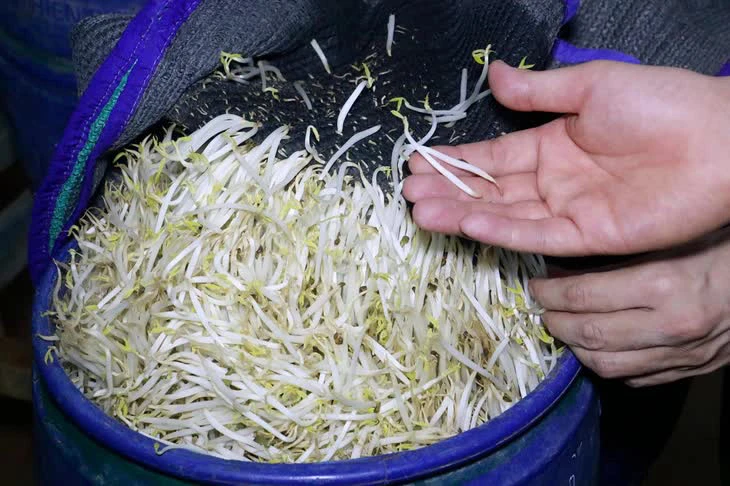
The bean sprouts are bigger, fatter, have shorter roots, and look more appealing after being soaked in chemicals - Photo: Nghe An Provincial Police.
1 - Those who produce dirty and harmful bean sprouts show no hesitation, as after four people involved in bean sprout production in Dak Lak were arrested at the end of last year, recently (April 19th) four more people in Nghe An were arrested for similar acts.
Thousands of barrels of bean sprouts soaked in chemicals have caused widespread anxiety: many wonder if they've been eating something toxic. Another question arises: Why aren't those producing these harmful bean sprouts aware of the consequences or afraid?
Consumers are also wondering where the authorities are, given that the incident in Dak Lak caused a public outcry, yet no agency has been seen reviewing or inspecting whether a similar situation exists in their area.
Time passed, until the police got involved. First Dak Lak, then Nghe An, and where else?
These questions remain unanswered but keep lingering because the current food safety inspection mechanism mainly deals with problems after they have already occurred – that is, when contaminated and toxic food has already reached the dinner table and into the stomachs of consumers, rather than preventing it from happening.
Those who sell toxic and contaminated food continue to rake in money without a care until... they get caught! Because post-inspection is practically useless.
Many people recall the words of a suspect after the toxic pricing scandal in Dak Lak was exposed: "If the market were completely clean, I would have an easy time."
This shows that the market may still have many sources of harmful products infiltrating the distribution network, as evidenced by the case in Dak Lak where they once controlled the supply chain for an entire large chain of stores.
Therefore, consumers are concerned that these discoveries are just the tip of the iceberg. Measures are needed to uncover that iceberg, so that no more similar cases of toxic bean sprout production will recur.
2. Continuously and relentlessly, over the past month, consumers have been repeatedly shocked by food issues: from Kera vegetable candies exaggeratedly advertised as containing the same amount of fiber as a plate of vegetables, to the fake milk scandal involving 573 types of milk flooding the market (including hospitals), and now the reappearance of toxic bean sprouts.
Substandard food, counterfeit food, contaminated food, toxic food... these products take turns deceiving consumers and "bypassing" authorities, and are only stopped when the police discover them.
The rampant spread of counterfeit and toxic food not only reveals loopholes in regulations, management, and inspection, but more sadly, it is aided by a segment of the community.
These include celebrities involved in advertising exaggerated claims about candy and fake milk. These are also officials from relevant agencies who failed to fulfill their responsibilities in inspecting food products.
Even more dangerous is the possibility of complicity, cover-up, or protection of illicit gains by some corrupt and degenerate officials.
3 - Everyone wants a liberal environment, a favorable setting for business, but this situation shows that being too liberal can also be problematic.
Calling for ethical business practices is necessary but insufficient without strict penalties. Rigorous post-inspection and tight control could inadvertently discourage business activities.
That is a difficult problem that the State needs to find a solution to, one that harmonizes the interests of all parties: producers, businesses, and consumers.
But whatever the case, consumer health and rights must come first. Let's wait and see what the solution is.
Read more Back to Homepage
Back to the topic
HUYNH HIEU
Source: https://tuoitre.vn/sua-gia-gia-doc-va-con-gi-nua-20250421083345185.htm





















































































Comment (0)