

Tan Lac District is a land that preserves the unique and distinctive traditional cultural values of the Muong ethnic group, clearly demonstrated through traditional festivals such as: the Muong Bi Opening Ceremony Festival, the Ke Pagoda Festival, the traditional stream fishing festival in Lo Son commune... These festivals not only have spiritual significance but also provide an opportunity for tourists to learn more about the customs, beliefs, and daily life of the local people.
The area also boasts many scenic spots recognized as national historical sites, such as Thac Bo Cave, Hoa Tien Cave, Bung Cave (Suoi Hoa commune), Nam Son Cave (Van Son commune), Muong Chieng Cave, Muoi Cave (Man Duc town), and provincial-level historical and cultural relics: Luu Ai hamlet shrine (Phong Phu commune), Cot Co Mountain, Trang Waterfall (Nhan My commune)... These are must-visit locations for those who love exploring pristine nature and experiencing exciting trekking and camping.
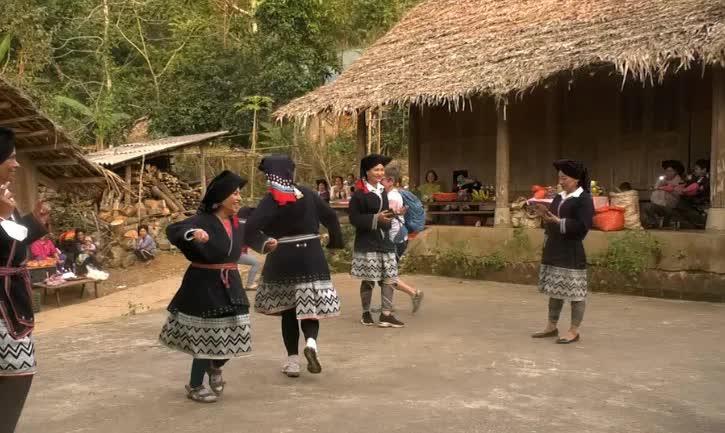
Ban Dao village, Sung hamlet, Cao Son commune, Da Bac district is developing community tourism , attracting tourists.
With its natural and cultural advantages, Tan Lac district has great potential for developing ecotourism, cultural tourism, community tourism, and experiential tourism. Recently, the opening of the Ngoi Hoa - PriorBay Resort ecotourism area in Suoi Hoa commune, with its many unique resort tourism products, has become a prominent destination, creating a special attraction in the Hoa Binh Lake tourist area.
Thanks to the implementation of many synchronized solutions and the effective exploitation of its potential, tourism in Tan Lac district has undergone positive changes. In the first quarter of 2025, the total number of tourists visiting the area reached 153,230 (4,980 international tourists and 148,250 domestic tourists). In the not-too-distant future, Tan Lac promises to become an attractive destination – a place where nature converges, culture shines, and unforgettable experiences are offered to domestic and international tourists, making a significant contribution to the socio-economic development of the locality.
Da Bac District is a locality planned to be included in the Hoa Binh Lake National Tourist Area. With a lake surface area of over 6,000 hectares within the Hoa Binh hydroelectric reservoir, numerous large and small islands, extensive forests, abundant aquatic species, and a waterway connecting Hoa Binh City through Da Bac to Son La, the district has great potential for economic development, especially tourism.
Over the years, Da Bac district has focused on developing its potential, attracting investment, and encouraging the development of the tourism industry, making Da Bac a tourist destination that attracts many domestic and international visitors.
In addition to exploiting the advantages of its natural beauty, the district directs agencies, departments, Party committees, and local authorities to develop various types of tourism, focusing on improving the quality of distinctive tourism products, linking spiritual tourism with cultural tourism, relaxation, and entertainment activities.
Tourism development should be linked to the preservation and promotion of the cultural heritage of ethnic groups, natural heritage, landscapes, and ecological environments; and the development of green, environmentally friendly tourism products. The quality of community-based tourism products should be improved by developing production models that apply ecological farming processes, focusing on creating new, distinctive, and unique local tourism products to attract tourists. Currently, some community-based tourism destinations in the district have already been listed on tourism maps both within and outside the province, such as Sung hamlet (Cao Son commune), Ke hamlet (Hien Luong commune), and Duc Phong hamlet (Tien Phong commune)...
Furthermore, Da Bac is blessed with abundant natural resources, especially land and forest resources. The Phu Canh Nature Reserve, covering over 5,000 hectares, with over 90% being natural forest, spans four communes: Doan Ket, Dong Chum, Dong Ruong, and Tan Pheo, creating favorable conditions for the development of ecotourism. In addition, to capitalize on the customs, traditions, and cultural beauty of the Tay ethnic group, the district has directed its specialized departments to survey and develop a project for preserving the Tay ethnic group's culture to promote community tourism.
In 2024, the total number of visitors to the district reached over 266,000, including 257,580 domestic tourists and over 8,430 international tourists. Tourism revenue was estimated at 114,679 million VND.
Cao Phong District also possesses great tourism development potential thanks to its diverse topography, mild climate, and abundant natural resources, gradually asserting its position on the national tourism map. Cao Phong is known as one of the four ancient Muong regions of Hoa Binh province, with beautiful natural landscapes, majestic mountains, hydroelectric lakes, ancient forests, distinctive ethnic cultural identity, and many historical and cultural landmarks.
Over the years, Cao Phong has done a good job of disseminating information to raise awareness among officials and the people about the position, role, and importance of tourism in the socio-economic development of the district; promoting the orientation of tourism development to become a key economic sector of the province and the district. At the same time, it has focused on planning, investing in infrastructure, attracting investment, and developing tourism products to meet the needs of tourists.
Cao Phong also prioritizes investment in the construction, expansion, and upgrading of inter-commune and town road systems; and the expansion and upgrading of the power grid system. Postal and telecommunications businesses are upgrading internet connectivity, extending mobile phone coverage to all areas in the district, and installing 4G networks at tourist destinations in the area.
A prime example is Mung hamlet (Hop Phong commune), located about 10km from the commune center. Previously, the road to the hamlet was steep and difficult to navigate. The main source of livelihood for the villagers was growing corn, cassava, and rice on terraced fields, or relying on the forest for sustenance. Thanks to the attention of the State and local authorities, Mung hamlet, once a remote area, has undergone a transformation, becoming a community tourism destination attracting visitors.
To develop sustainable tourism, the authorities at all levels in Hoa Binh province have implemented many synchronized solutions, effectively exploiting the tourism potential of each locality, thereby attracting tourists to explore and experience, contributing to promoting local socio-economic development.
Source: https://bvhttdl.gov.vn/suc-hut-dac-biet-tu-du-lich-hoa-binh-20250417141544593.htm



![[Photo] Prime Minister Pham Minh Chinh casts his ballot with voters in Tay Ho ward, Hanoi.](https://vphoto.vietnam.vn/thumb/1200x675/vietnam/resource/IMAGE/2026/03/15/1773544401565_dsc-4144-9718-jpg.webp)










![[Photo] Election atmosphere at polling station No. 7, Xuan Dinh ward, Hanoi city](https://vphoto.vietnam.vn/thumb/402x226/vietnam/resource/IMAGE/2026/03/15/1773543204075_img5935-1773539854991135573309-154-0-1707-2484-crop-17735409472061858573395.jpeg)










































Comment (0)