In June, lychee-growing regions in Bac Ninh province (formerly Luc Ngan district, Bac Giang province) enter their peak harvest season. On the hillsides of Tan Son commune, Chu ward, and Kien Lao commune, convoys of trucks carrying lychees line the orchards. Under the trees laden with fruit, the growers' conversations are no longer just about yield, but also about the color, brightness of the peel, and appearance of the fruit.
For export markets, especially China , the appearance of lychees is becoming a decisive factor. Even a certain percentage of fruit with blemishes or dark spots on the skin can significantly reduce the value of the entire shipment. The fruit may still be usable, but its poor appearance makes traders hesitant, and they may even refuse to purchase it for export orders.
A memorable fabric incident.
Standing amidst his lychee orchard in full bloom in Tan Son commune (Bac Ninh province), Mr. Ngo Van Tinh still clearly remembers last year's harvest. Back then, many fruits on the trees had dark spots. These fruits were difficult to sell fresh, and many households had to accept selling them as raw materials for processing, which fetched a lower price.

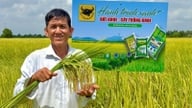
Mr. Ngo Van Tinh (Tan Son commune) next to his family's lychee orchard. Photo: Pham Minh.
"Last year, some orchards had about half their area affected by aphthous fruit blight. Because so much of the fruit was blighted, it couldn't be sold to China. Many households had to switch to selling it as raw material for canning," Tinh recounted.
Looking at the clusters of lychees changing color on the tree, his voice softened: "This year the fruit looks much brighter, the percentage of blemished fruit has decreased significantly, and sales are easier because Chinese traders really appreciate the appearance."
Not only in Tan Son, but also in the Bung Nui lychee growing area of Chu ward, Mr. Nguyen Van Suu noticed a significant change in his orchard. According to him, the peel color of the fruit this year is brighter, and the percentage of fruit with black spots has decreased sharply compared to the previous season.
“Last year, at one point, I found that 40-50% of the fruit had dark spots. Chinese traders were very critical of such shipments. This year, based on actual monitoring, only about 15% of the fruit is affected. What I noticed most clearly is that the trees that were treated from the early stages of bud development are more uniform and sprout about 10 days earlier than the untreated trees,” Mr. Suu said.
This shift shows that lychee growers are viewing the issue from a different perspective. Previously, fruit blight was generally understood as a phenomenon appearing on the fruit near harvest. Therefore, many treatment methods focused on the canopy, leaves, and fruit. But this year's production reality suggests a deeper approach: for beautiful fruit, the tree must be healthy; for healthy trees, the soil must be restored and balanced.
Results from investigations at three monitoring sites during this year's lychee crop show positive signs. Of the 829 fruits surveyed in the models applying technical solutions, 98 fruits showed symptoms of eczema, accounting for 11.82%. Meanwhile, on the control trees without the solution, 95 out of 324 fruits showed eczema, corresponding to 29.32%.


Thus, the percentage of fruit affected by fruit blight in the models decreased by nearly 60% compared to the control. This is a remarkable figure, especially in the context of increasingly high demands for lychee fruit appearance. The differences were also quite clear at each monitoring point. In Tan Son, the infection rate was only about 9.9%. In Bung Nui - where fruit blight was quite common last year - the recorded rate was only about 15.9%. And in Ho hamlet, Kien Lao commune, the percentage of fruit affected by fruit blight remained at over 10%.
For plants to thrive, the soil must first be healthy.
Mr. Luong Quang Ngoc, a technical officer at the Department of Crop Production and Plant Protection of Bac Ninh province, who directly monitors the model, said that while many orchard owners previously considered fruit blight simply a disease appearing on the fruit, the approach has now changed significantly. Soil health is becoming an increasingly important factor in lychee production.
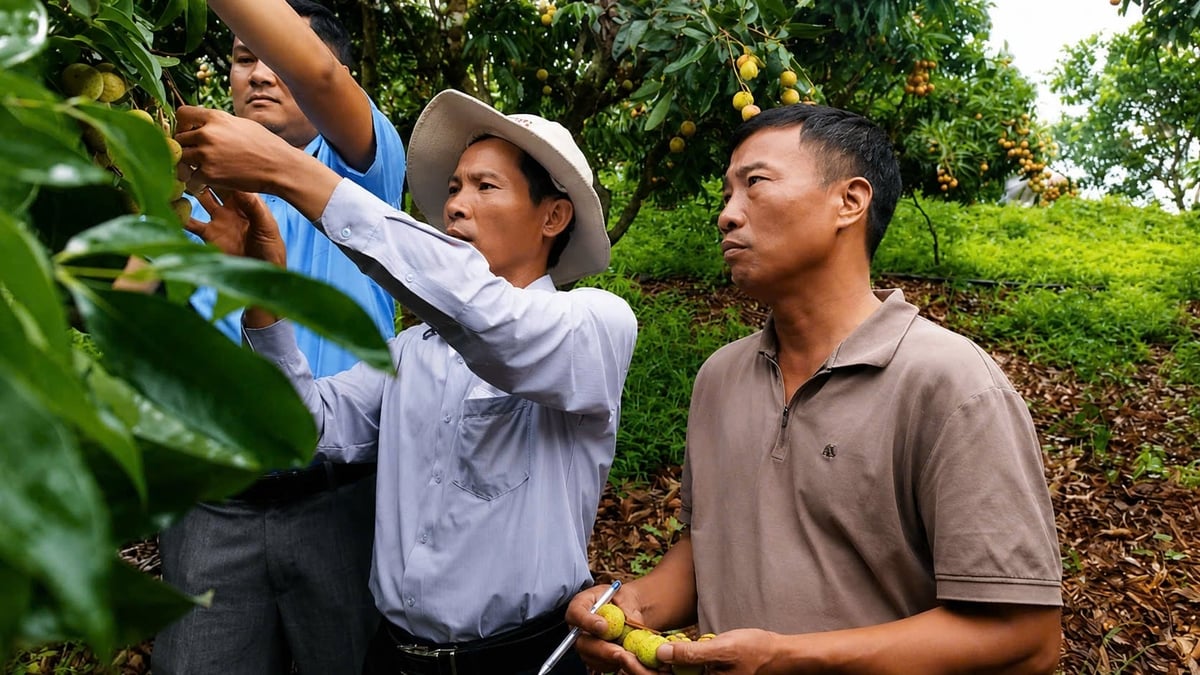
Mr. Luong Quang Ngoc (center), a technical officer at the Department of Crop Production and Plant Protection of Bac Ninh province, inspects birthmarks on lychee fruit. Photo: Pham Minh.
“Soil is like a living organism. After many years of continuous cultivation, especially with the use of many chemical fertilizers and pesticides, certain residual compounds will remain in the soil. When the soil environment becomes unbalanced, beneficial microorganisms decline, the root system becomes less efficient, and the plants also lose their resistance to harmful agents. We often focus on the canopy, but in reality, many problems start from the soil,” Mr. Ngoc analyzed.
According to Mr. Ngoc, for plants to be healthy, the soil must first be healthy. Restoring the soil ecosystem, increasing beneficial microorganisms, improving the soil's self-cleaning ability, and creating conditions for root development are gradually becoming a farming trend that many gardeners are interested in.
This perspective has practical implications for lychee-growing regions. After years of intensive cultivation, pressure for yield, appearance, and market demand has led farmers to use more agricultural inputs. If the soil becomes unbalanced, the root system weakens, making it difficult for lychee trees to absorb nutrients effectively, while also reducing their resistance to weather, pests, and other adverse factors during fruit development.
From the perspective of a business researching biological solutions, Mr. Nguyen Hong Vu, a technical officer at Vietnam Green Ecology Joint Stock Company, said that for many years, the company has focused on an approach based on the soil ecosystem rather than just directly intervening on the fruit.

Mr. Nguyen Hong Vu (far left), a technical staff member of Vietnam Green Ecology Joint Stock Company, explains the mechanism of the Blue Cozym product and checks the treatment results on lychee fruit. Photo: Pham Minh.
“Blue Cozym is a product that helps activate and increase the activity of beneficial microorganisms in the soil, promoting the decomposition of residual compounds and improving the root zone environment. When the soil is more balanced, the root system develops better, plants absorb nutrients more efficiently, and their resistance to adverse conditions during growth and fruit development increases,” Mr. Vu said.
According to Mr. Vu, a lychee tree with a good foundation from the sprouting stage usually maintains a more stable fruit appearance until ripening. This also aligns with the observations of orchard owners like Mr. Suu, where trees treated early develop more evenly, sprout earlier, and have a lower percentage of affected fruit.



Market demands for lychees are becoming increasingly stringent. While previously buyers were primarily concerned with price, now appearance, uniformity, peel color, and sensory quality are becoming decisive factors in determining product value.

The graph shows that the percentage of diseased fruit in the model decreased by nearly 60% compared to the control. Photo: Pham Minh.
Brightly colored lychees with fewer defects not only help farmers sell them at better prices but also expand their access to markets that demand high quality. These markets require safe farming practices, control of chemical residues, traceability, and consistency between batches.
A sustainable approach for lychee cultivation in Bac Ninh is one that focuses on soil health, ecological balance, and enhancing the natural resilience of the crop. To increase the value of Bac Ninh lychees, growers must start with more fundamental elements including soil, roots, microorganisms, and ecological balance within the orchard.
Source: https://nongnghiepmoitruong.vn/suc-khoe-dat-quyet-dinh-mau-ma-vai-thieu-d815957.html


![[Photo] Strengthening character and expertise: Intense training for artillery soldiers.](https://vphoto.vietnam.vn/thumb/1200x675/vietnam/resource/IMAGE/2026/06/30/1782815602541_lu-368-1875-4571-jpg.webp)