

Hydroelectric reservoirs across the country have all risen above their dead water levels, but some, such as Son La and Lai Chau, have not yet resumed power generation because they need to store water to serve the peak of the hot season.
According to Vietnam Electricity Group (EVN) on the afternoon of June 20th, the water level in Lai Chau hydropower reservoir was 282 meters, exceeding the dead water level by 17 meters; Son La reservoir was 179 meters, exceeding it by 4 meters; Ban Chat reservoir was 438 meters, exceeding it by 7 meters; and Tuyen Quang reservoir was 96 meters, exceeding it by 6 meters. Reservoirs such as Thac Ba, Huoi Quang, Ban Ve, and Tri An also exceeded the dead water level by 0.5 to 3 meters.
According to representatives of the management units of the Lai Chau and Son La hydropower plants, the current water levels are sufficient to resume power generation. However, the Lai Chau hydropower plant, with a capacity of 1,200 MW, can only operate all three turbines for nearly 90 hours before reaching its dead water level. The Son La hydropower plant, with a capacity of 2,400 MW, can operate for more than 50 hours. Therefore, both hydropower plants remain shut down to accumulate water for the upcoming hot weather.
Many other hydropower plants are also not operating, such as Tuyen Quang, Huoi Quang, Ban Chat, Ban Ve, Song Tranh 2, Dong Nai 4, and Dong Nai 3.
Water levels in reservoirs have risen due to the shutdown of hydropower plants and the frequent moderate to heavy rain in the North over the past few days. Specifically, from last night until 7:00 AM on June 20th, meteorological agencies recorded rainfall exceeding 60 mm in many areas, such as Nam Loong (Lai Chau) with 86 mm, Ta Leng (Lai Chau) with nearly 70 mm, and Quan Ba (Ha Giang) with nearly 65 mm.
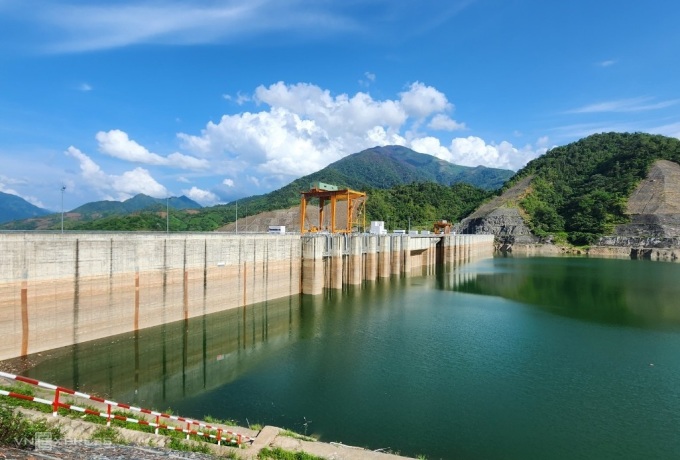
Water level of Lai Chau hydroelectric reservoir at 3 PM on June 20th. Photo: GC
Heavy rains have caused an increase in water flow into hydroelectric reservoirs. According to EVN, the current water inflow into Lai Chau reservoir is nearly 950 m3/s, almost 19 times higher than the lowest point at 5 PM on June 8th (50 m3/s). This figure is more than twice as high at Son La hydroelectric plant and nearly three times higher at Ban Chat hydroelectric plant. The Thac Ba hydroelectric plant, however, has zero water inflow.
The National Center for Meteorological and Hydrological Forecasting predicts that from now until the end of June, the heatwave will continue, with rainfall in the Northwest, Northeast, Northern Delta, and North Central regions generally 10-20% higher than the multi-year average, while other areas will experience 10-30% lower rainfall. The peak of El Nino may occur from November 2023 to January 2024.
Source link
![[Image] Expediting land clearance at Alley 310 Nghi Tam to facilitate the construction of Tu Lien Bridge](https://vphoto.vietnam.vn/thumb/1200x675/vietnam/resource/IMAGE/2026/04/14/1776160406551_ndo_br_z7724148990408-9e5d4777e3c4504998b4286178b2e66e-jpg.webp)

![[Photo] General Secretary and President To Lam presents the Politburo's Decision on personnel matters to 4 Party Committees directly under the Central Committee.](https://vphoto.vietnam.vn/thumb/1200x675/vietnam/resource/IMAGE/2026/04/13/1776077847172_a1-bnd-8005-950-jpg.webp)
![[Photo] General Secretary and President To Lam holds telephone conversation with Chairman of the Liberal Democratic Party of Japan and Prime Minister of Japan Takaichi Sanae](https://vphoto.vietnam.vn/thumb/1200x675/vietnam/resource/IMAGE/2026/04/13/1776077840503_a1-bnd-7942-6402-jpg.webp)



























![[Photo] Prime Minister Le Minh Hung and Prime Minister Robert Fico attend the Slovakia-Vietnam Business Forum](https://vphoto.vietnam.vn/thumb/1200x675/vietnam/resource/IMAGE/2026/04/13/1776075264359_ndo_br_dsc-6775-jpg.webp)









































































Comment (0)