"In an all-out war, Russia has significantly upgraded its Kh-101 cruise missiles, particularly by updating the radio wave-absorbing coating to reduce radar detection range."
This statement was made by Colonel Oleksandr Zaruba, principal researcher at the National Research Institute for Testing and Certification of Weapons and Military Equipment, at the event "The Russian Federation's Use of Air Attack Means Against Civilian Infrastructure: Technical and Humanitarian Aspects," attended by numerous military journalists.
The researchers noted that the Kh-101 is a relatively old missile but has undergone a "major modernization process." Starting on January 24, 2022, the guidance system, warhead, airframe, and passive jamming system were updated, along with several other components.
"The radio wave-absorbing coating on the missile body has been upgraded to reduce the reflection area. This means they will be detected at shorter ranges and the probability of being destroyed is also reduced."
"The missile uses an integrated defense system throughout its flight. It is equipped with modules for engaging decoy heat targets and dipole reflectors. This system is automatically activated upon detection by air defense radar or upon approaching the target," the researcher described.
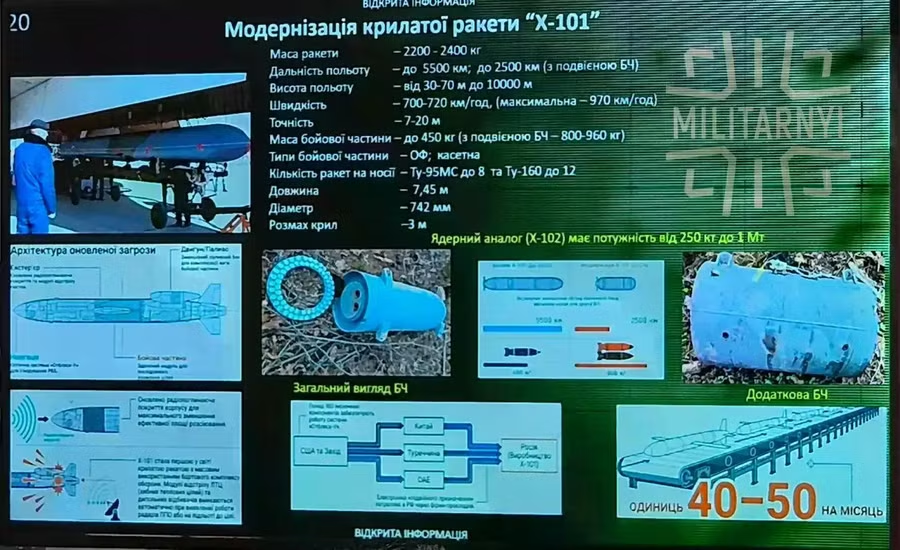



According to Zaruba, analysis of the fragments from the 2024-2025 period shows a shift from using general-purpose consumer chips to specialized components, often sourced from Asian countries.
Starting in the spring of 2024, missiles with dual warheads appeared, allowing for an increase in total warhead weight from 450kg to approximately 800kg.
This was achieved by reducing the fuel tank volume, resulting in a reduction in range from 5,500 km to 2,500 km. However, considering the launch distance and the territory of Ukraine, the reduction in range is not very significant.
In this case, the second warhead could be guided to drop and detonate at a certain altitude, allowing for effective utilization of the cluster munition.
Estimates suggest Russia's Kh-101 production is 40-50 missiles per month, but analysis of the debris indicates the bombardment was carried out primarily with missiles manufactured just weeks before the attack.
This information was also confirmed by Mr. Vladyslav Vlasyuk, the Presidential Commissioner for Sanctions Policy.



According to reports, the Kh-101 cruise missiles that Russia used in the large-scale attack on May 14th came from a single production batch in the second quarter of 2026.
Source: https://giaoducthoidai.vn/ten-lua-kh-101-cuc-ky-dang-so-voi-loat-nang-cap-moi-post781544.html

![[Image] Overview of the construction site for the underground station of metro line 5 at the Hanoi Ring Road 1 intersection.](https://vphoto.vietnam.vn/thumb/1200x675/vietnam/resource/IMAGE/2026/07/03/1783065595682_ndo_br_z7974930852369-100ca093c306e72675f1d3700966a86b-jpg.webp)