European nations are actively seeking ground-launched cruise missiles to expand their strike range. Germany had hoped to purchase Tomahawk missiles from the US, but when that deal fell through, MBDA's NCM-LCM MK2 is emerging as a potential alternative.
For the second consecutive year, MBDA continues to unveil a new cruise missile model at a major defense exhibition. In 2025, this leading European missile group introduced the Stratus – a missile series with two different configurations. This year, at Eurosatory 2026, MBDA announced the MK2 Naval-Land Cruise Missile (NCM-LCM).
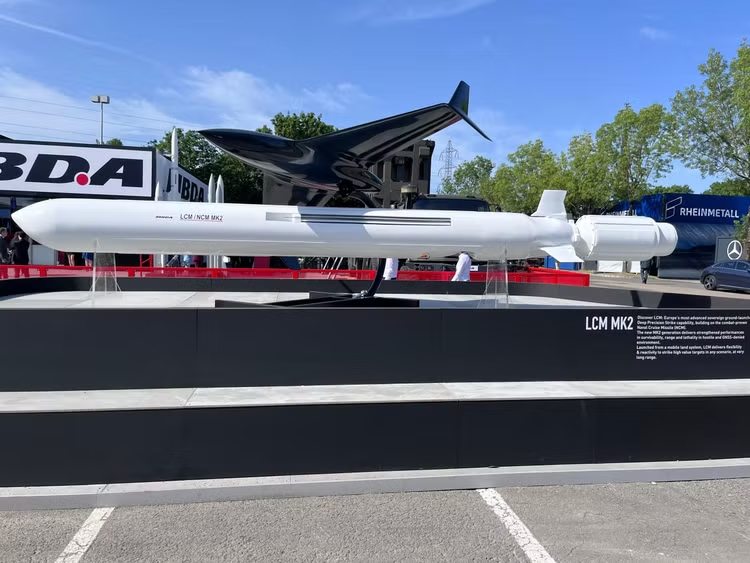
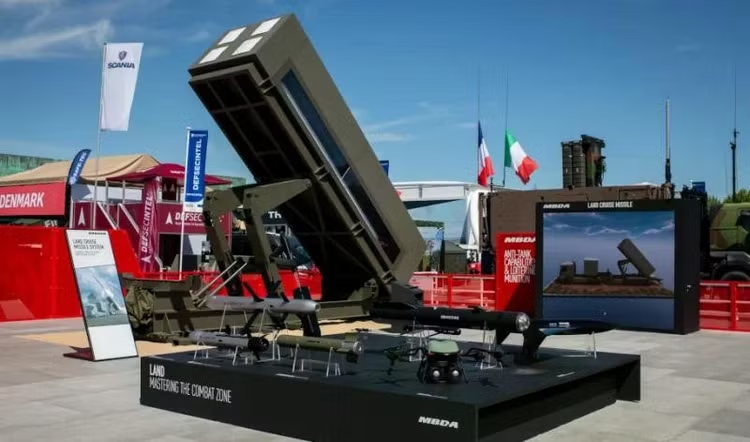
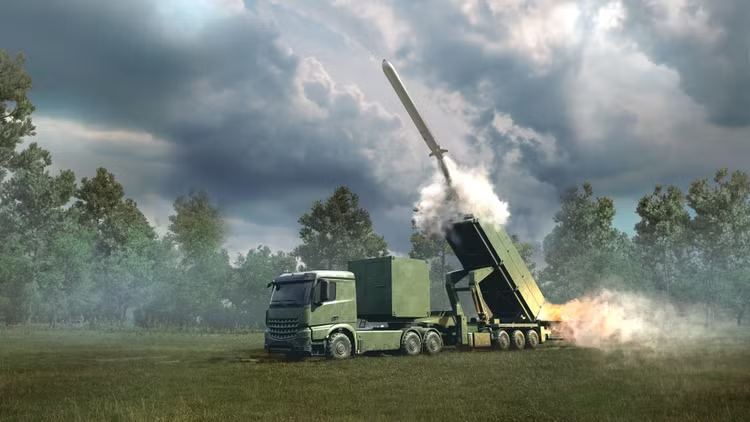
Based on the original NCM design, the new missile is designed to be launched from a transport-and-erect pod launcher. This pod holds four missiles and will most likely be mounted on a truck, although MBDA has not confirmed the specific platform.
According to MBDA, ground-based launch capability will be ready from 2029, based on the A70 SYLVER vertical launch system – currently used on French Navy warships to carry NCMs and also capable of carrying Aster anti-aircraft missiles.
MBDA's development shares many similarities with the U.S. Army's Typhon launcher, which utilizes the MK 41 vertical launch system on U.S. warships to deploy Tomahawk and SM-6 missiles from the ground.
According to a press release dated June 15th, the NCM-LCM MK2 has a range of 1,000 km and is designed to resist GPS jamming. The LCM version also features enhanced stealth capabilities, improving survivability compared to the NCM, while also increasing range and destructive power. MBDA did not disclose the warhead specifications, but given the overall weight of the NCM is 1,400 kg, it can be inferred that the warhead is a 400 kg type.
The American Tomahawk cruise missile has long been the benchmark for long-range precision strike capability, with a range of up to 2,000 km, multiple guidance layers, and a large warhead, often launched from warships or submarines in the opening salvos of NATO air campaigns.
After the Cold War, NATO largely abandoned ground-launched cruise missiles, except for their anti-ship role, but is now reconsidering their value. This is because launching cruise missiles from the ground creates additional attack directions, forcing the enemy to contend with the risk of attack from multiple directions.
Ground-based launchers themselves offer higher survivability and are easier to maintain than aircraft or warships performing the same mission. This is likely why Germany is particularly keen on purchasing Tomahawk missiles. Denmark is also seeking a long-range strike solution, although it may need a greater range than the NCM-LCM MK2's capabilities.
Overall, the need to enhance Europe's long-range strike capabilities is very clear, most evident in the European Long-Range Strike Initiative (ELSA) with its six members: the United Kingdom, France, Germany, Poland, Italy, and Sweden.
When this group was formed, the goal was to develop a ground-launched cruise missile with a range of 1,000–2,000 km, comparable to the Tomahawk. However, Sweden was primarily interested in air- and sea-launched options.



It appears MBDA is positioning the NCM-LCM MK2 to meet this need, especially as the company plans to conduct its first flight tests in 2028 and begin delivering weapons from 2029.
In the context of Western governments needing to increase defense spending but facing limited resources and numerous gaps that need to be filled to deter and confront adversaries, investing in the development and procurement of ground-launched cruise missiles like the NCM-LCM MK2 could provide value in creating additional attack options.
Source: https://khoahocdoisong.vn/ten-lua-ncm-lcm-mk2-lap-day-khoang-trong-tomahawk-de-lai-post2149104950.html


![[Photo] Strengthening character and expertise: Intense training for artillery soldiers.](https://vphoto.vietnam.vn/thumb/1200x675/vietnam/resource/IMAGE/2026/06/30/1782815602541_lu-368-1875-4571-jpg.webp)























![[INFOGRAPHIC] HONOR Watch X5i, a smartwatch with a 21-day battery life.](https://vphoto.vietnam.vn/thumb/402x226/vietnam/resource/IMAGE/2026/06/30/1782813499155_info-dongho-26-6-a-thumb-jpg.webp)