

From traditional to export-oriented processing
In previous years, Mr. Ngo Xuan Truong's family in Lam Thao commune regularly raised various types of fish: grass carp, silver carp, common carp, and bighead carp to maximize the use of available feed. Since 2023, with the support of the Provincial Agricultural Extension Center, his family has boldly implemented a tilapia farming model for processing and export. With a pond area of 1.1 hectares, his family specializes in raising monosex tilapia in a linked chain for processing and export. Speaking with us, Mr. Truong said: “Previously, with traditional farming, all that mattered was that the fish grew quickly; hardly anyone cared about traceability or chemical residue. Now, farming according to export standards, I have to consider what the fish eat, the quality of the feed, and whether the product meets the standards.”
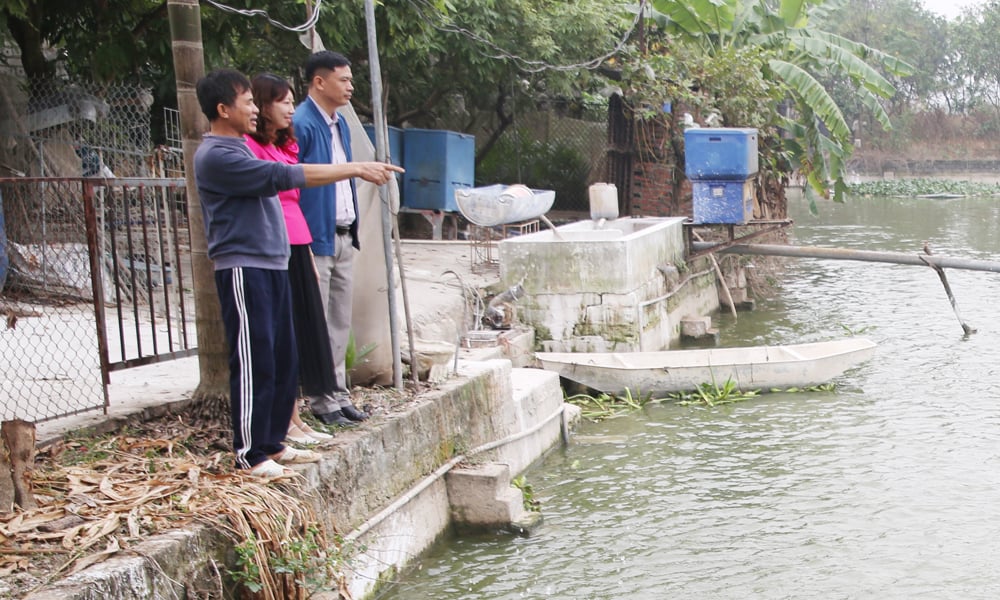 |
Officials from the Provincial Department of Livestock, Veterinary Medicine, and Fisheries inspected the tilapia-carp-grass carp farming model of Mr. Nguyen Van Thuy in Tan Dinh commune. |
It is known that before stocking the pond with fish fry, Mr. Truong drained and dredged the pond bottom, leaving only a 5-10 cm layer of soft mud. He then disinfected the pond bottom with lime powder and dried it for 7-10 days before filling it with water. In addition, several environmental factors such as temperature, oxygen, and pH were checked to prepare for and implement solutions after the fish fry were introduced. A key difference in this model is the feeding method based on four principles: location, quality, quantity, and timing. To ensure a clean and stable pond environment and minimize disease outbreaks, the family uses biological products and some disinfectants, and employs weekly environmental monitoring equipment to adjust and maintain the pond environment within acceptable limits.
Using scientific farming methods, after 8-10 months, the tilapia raised by Mr. Truong's family reach a weight of 1.3-1.4 kg/fish, with a survival rate of 83-85%. On a 1.1-hectare pond, his family harvests 25-25.5 tons; after deducting expenses, their total income increases by approximately 20% compared to raising other fish species.
The integrated farm of Ms. Nguyen Thi Hoa's family in Chua village, Tan Dinh commune, covers 1.7 acres of ponds stocked with various fish species such as tilapia, grass carp, and common carp, with approximately 1 acre dedicated to specialized tilapia farming for export processing. To meet the standards of the purchasing unit, Ms. Hoa's family boldly applied many automated technologies to the production process. All the ponds for raising fish fry and mature fish are equipped with surveillance cameras and the family actively controls the operation of water aerators and feed pellet sprayers, significantly reducing labor and increasing fish productivity.
In a conversation with us, Ms. Hoa shared that previously, raising traditional fish species like carp, catfish, and tilapia, her family only harvested about 26-30 tons of fish per year. Since adopting automated intensive aquaculture technology, her family has been able to switch to raising tilapia because this species grows and develops quickly, requiring a short rearing period. Thanks to the application of many automated technologies combined with strict control of pond environment quality, the yield and production of fish have increased 4-5 times compared to before. Specifically, in each farming cycle lasting 6-7 months, her family can harvest 60-70 tons of fish, with a profit of 120-150 million VND. “For my family, the greatest value that the cooperative model brings is not just profit, but the belief in a sustainable path. The domestic market fluctuates erratically, but when raising livestock for export, my family feels more secure because there is a commitment to price and output. Working directly with the company also helps reduce intermediaries, resulting in more reasonable feed prices,” Ms. Hoa said.
Potential for expanding the area
The province currently has approximately 16,200 hectares of aquaculture area, of which 9,520 hectares are dedicated to specialized farming. There are about 100 concentrated aquaculture zones with an area of 10 hectares or more, raising high-yield, economically valuable fish species such as grass carp, hybrid carp, tilapia, red snapper, black catfish (American catfish), and crispy carp. The annual aquaculture production is estimated at 99,700 tons, including about 40,000 tons of tilapia.
According to Mr. Nguyen Huu Tho, Head of the Department of Livestock, Veterinary and Fisheries of the province, in recent years, the province's aquaculture production has developed in the direction of intensive farming, applying scientific and technical advancements to production, improving income efficiency, and making an important contribution to the development of the province's agricultural economy.
| The province currently has approximately 16,200 hectares of aquaculture area, of which 9,520 hectares are dedicated to specialized farming. There are about 100 concentrated aquaculture zones with an area of 10 hectares or more, raising high-yield, economically valuable fish species such as grass carp, hybrid carp, tilapia, red snapper, black catfish (American catfish), and crispy carp. The annual aquaculture production is estimated at 99,700 tons, of which about 40,000 tons are tilapia. |
To support aquaculture farmers in increasing value and economic efficiency, in addition to technical support, breeding stock, and strict disease management, in recent years, the Provincial Department of Livestock, Veterinary Medicine, and Fisheries has proactively sought out businesses to link production and consumption of products for farmers, including tilapia for processing and export, following a closed-loop model that ensures synchronization from input to output. Businesses support the supply of standard breeding stock, guide farmers in using specialized feed produced from sustainable raw materials, especially soybeans and soybean meal… In addition, businesses and farmers agree on care procedures, water quality criteria, nutrition programs, feed, care logs, and operation of aeration and oxygen systems. Upon harvest, businesses commit to purchasing the products at the agreed-upon price, an important guarantee that helps farmers feel secure in investing in expanding production.
Currently, the entire province has only about 100 hectares dedicated to monoculture tilapia farming for processing and export. The remaining area is used for mixed farming of other fish species, with tilapia accounting for approximately 35-40% of the total stock. Tilapia has high adaptability, white, flavorful meat, is easy to process, and its export value is steadily increasing. In the context of an international market increasingly prioritizing traceability, biosafety, and sustainability, aquaculture farmers in the province can see this as an opportunity and potential to expand their scale, increase value, and improve economic efficiency per unit area.
Source: https://baobacninhtv.vn/tham-canh-ca-ro-phi-phuc-vu-che-bien-xuat-khau-postid439307.bbg




















































































Comment (0)