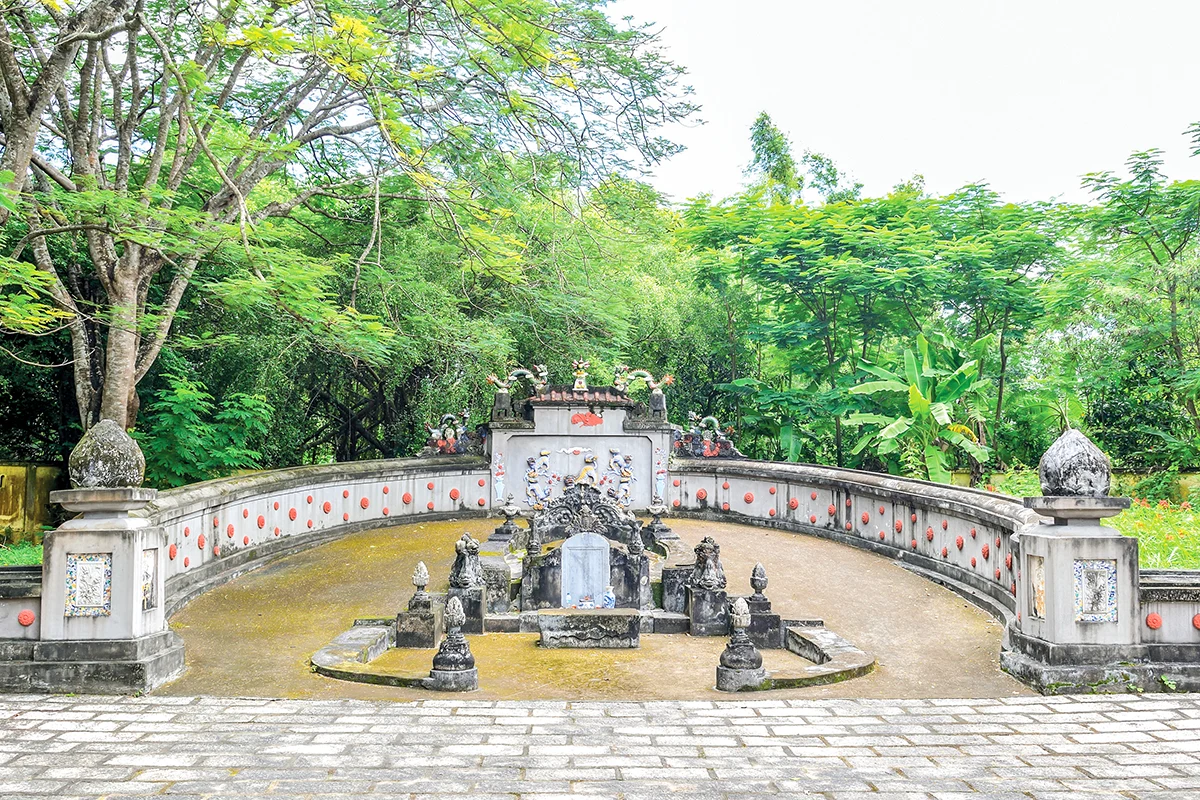
Royal Mausoleum.
Mr. Pham Dang Hung was a virtuous and upright official highly valued by Emperor Minh Mang. His daughter, Mrs. Pham Thi Hang, later became Empress Chuong, wife of Emperor Thieu Tri, mother of Emperor Tu Duc, and was bestowed the title of Tu Du Bac Hue Khuong - Tho Thai Thai Hoang Thai Hau.
He was born in the year of Giap Than 1764. In 1784, he passed the Tam Truong examination and was initially appointed by the court as a Le Sinh in the prefecture. Later, he was promoted to Lai Bo Tham Tri. In 1819, he was appointed Deputy Director of the National History Institute. In the 5th year of Minh Mang (1824), he was bestowed the title of Minister of Rites. In the year of At Dau 1825, he was entrusted with guarding the capital city of Hue . In the summer of that year, he fell ill and died. He was posthumously granted the title of Vinh - Loc Dai - Phu Tru Quoc, Hiep Bien Dai Hoc Si. In 1849, King Tu Duc bestowed upon him the title of Dac - Tan Vinh - Loc Dai - Phu Thai Bao Can Chanh Dien Dai Hoc Si, Tuoc Duc Quoc Cong(1).
When he died, according to court rituals, his coffin was brought back to his hometown and buried at Son Quy Hill. Son Quy Hill is a fairly high sand dune, shaped like a lying turtle. In the past, it was called Turtle Hill, later changed to Son Quy (Turtle Mountain), meaning this is the place where the maternal side of King Tu Duc originated. Quy is one of the four sacred creatures: Dragon,麒麟 (Kirin), Quy, and Phoenix. Son Quy will be sacred and enduring like a mountain (2).
Located on a plot of land approximately 2,000m2, the tomb of Duke Pham Dang Hung is built in the shape of a spire, resembling a farmer's conical hat, gently divided into eight petals resembling lotus buds. In front, to the right, is the stele house. At the outermost part of the tomb complex is the main hall (curved wall) with four brick pillars (similar to the front of Thien Tho tomb - Hue). In addition to the above details, this tomb complex has another special feature: the "feng chuan" (wall built as a screen behind the head) is sculpted with five lions of varying sizes, representing the five ranks (duke, marquis, count, viscount, baron), signifying: "Five generations of noble families - Auspicious unicorn appears" (3).
In the 11th year of the reign of Emperor Thành Thái (1899), the stele house on the right was built, preserving the stone stele commemorating the merits of Mr. Phạm Đăng Hưng. In 1998, a second stele house was built, opposite the first, containing a very valuable 2.2-meter-high white marble stele, made in Huế in the 11th year of the reign of Emperor Tự Đức (1858), as the Emperor wanted to show his respect for his maternal grandfather, but it took many years to arrive. This was because in 1859, when transporting the stele from Huế to Gò Công, the ship passing through Cần Giờ estuary was seized by the French colonialists. In December 1860, a French marine captain named Barbé was killed by Trương Định's resistance forces near Khải Tường Pagoda (Saigon). Having the large stele readily available, the French carved inscriptions onto the old stele and erected it in front of his grave in the Western cemetery. In 1985, the cemetery was cleared to build a park, and the tombstone was subsequently moved to Tien Giang province, finally reaching its rightful place after more than a century of being lost.

Temple dedicated to Duke Pham Dang Hung.
Within the architectural complex of the Royal Mausoleum, there is an important structure: the temple dedicated to Duke Pham Dang and his family, located on the road leading to the mausoleum. This ancestral temple was built in 1826 and completed during the reign of Emperor Tu Duc. It includes a temple, guesthouse, warehouse, and other auxiliary structures such as lotus ponds and ornamental plants. All the buildings are constructed of precious wood, with tiled roofs, brick walls, and beautifully decorated interiors.
Entering the ancestral hall, you will see the main hall where Duke Pham Dang Hung is worshipped, on the left is Phuoc An Hau Pham Dang Long, on the right is Binh Thanh Ba Pham Dang Dinh, the last room on the left is worshipped My Khanh Tu Pham Dang Tien, the great-grandfather of Pham Dang Hung; the last room on the right is worshipped Thiem Su Phu Pham Dang Khoa, the great-great-grandfather of Pham Dang Hung. In the past, there were two annual sacrificial ceremonies presided over by the district chief of Tan Hoa, but since the French arrived, this ceremony has ceased (4).
Due to the prolonged war, the Royal Mausoleum complex suffered severe damage, especially the temple area. In 1998, the authorities of Tien Giang province restored the temple, giving it its current appearance.
With its preserved architectural and artistic values, the Royal Mausoleum Complex was classified as a national historical site by the Ministry of Culture and Information (now the Ministry of Culture, Sports and Tourism) in 1992.
HUYNH HA
(1) Multiple authors (2007), “National historical and cultural relics in Tien Giang”, Tien Giang Department of Culture and Information, p.55.
(2) Multiple authors, op. cit., 56.
(3) Tran Huy Hung Cuong (2006), “Introduction to Southern Vietnam tourist routes”, Tre Publishing House, pp. 192-193.
(4) Multiple authors, op. cit., 59-60.
Source: https://baocantho.com.vn/tham-di-tich-lang-hoang-gia-a196791.html




















































































Comment (0)