

Seventy-nine years ago, under the leadership of the Provincial Party Committee, the people of Thanh Hoa rose up in unison to drive out the fascist forces and their collaborators, regaining independence and freedom, and together with the entire Vietnamese nation, wrote a new and glorious chapter in the cause of building and defending the Fatherland.
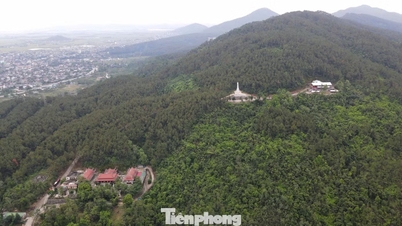
 Con Ma Nhon historical site (Hoang Dao commune, Hoang Hoa district).
Returning to visit the Con Ma Nhon historical site (Hoang Dao commune, Hoang Hoa district) on an autumn day in August. 79 years ago, at this very spot, the Viet Minh forces of Hoang Hoa district launched a surprise attack, catching the security forces of the puppet government off guard. This laid the groundwork for the Hoang Hoa uprising to achieve ultimate victory.
History records that, faced with the increasingly strong revolutionary movement in Hoang Hoa, the Japanese fascists and their reactionary feudalist collaborators clearly recognized the danger that the Hoang Hoa revolutionary movement would cause the collapse of their government apparatus and would be the spark for the revolutionary movement throughout the province. Therefore, they used concentrated violence to suppress the revolution in Hoang Hoa, hoping to break this spearhead. Hoang Hoa at that time became a "hot spot," a target attracting the repression and terror of the Japanese fascists and their puppet government. On July 23, 1945, Provincial Governor Nguyen Trac dispatched a unit of more than 30 security guards commanded by Quan Hien to Hoang Hoa. On the morning of July 24, after discussions and assignments between District Chief Pham Trong Bao and Quan Hien, the enemy divided into two wings, terrorizing two places they considered the cradle of the Hoang Hoa revolution.
The Viet Minh forces closely monitored the enemy's movements and implemented a counter-strategy. This involved deploying self-defense forces to lie in ambush at Con Ma Nhon – a large, densely forested area with only one road leading through it, bordering a series of swamps and ponds. Taking advantage of the rugged terrain, the Viet Minh in Hoang Hoa district deployed three platoons of self-defense forces from the villages of Dang Trung, Dang Xa, and Du Khanh to intercept the enemy. After only a few minutes of fighting, the revolutionary forces achieved a complete victory, capturing 13 enemy soldiers (including the district chief Pham Trong Bao), and seizing 12 guns and 36 rounds of ammunition.
The victory at Con Ma Nhon boosted the morale of the people of Hoang Hoa, so that on July 24, 1945, when a core self-defense platoon under the direction of the district Viet Minh seized the district headquarters, the people unanimously rose up to support the Viet Minh, converging on But Son district. Faced with the overwhelming force of armed self-defense forces and the people, the officials and patrolmen at the district headquarters did not dare to resist and quickly handed over all public property, weapons, and documents to the revolution... With the event of July 24, 1945, Hoang Hoa became the first district in the province to successfully seize power during the historic August Revolution, with minimal bloodshed and minimal damage. The victory in Hoang Hoa demonstrated the "creativity, boldness," and decisiveness of the leaders of the Party Branch and the Viet Minh Cadre Committee of Hoang Hoa district. Therefore, Hoang Hoa "deserves to be the leading flag of the uprising to seize power in Thanh Hoa province".
In April 1945, upon receiving the Central Party Standing Committee's directive, "The Japanese-French conflict and our actions," the Thanh Hoa Provincial Party Committee promptly shifted its leadership, vigorously promoting the anti-Japanese movement and preparing for the general uprising. The Provincial Party Committee convened a conference in Vi Liet village (now part of Ha Tan commune, Ha Trung district) to implement the Central Committee's directive. Based on the situation in Thanh Hoa at that time, the conference outlined specific policies: Continuing to intensify the fight against famine; openly propagating anti-Japanese sentiment and exposing the true nature of the Dai Viet collaborators; continuously expanding the influence of the Viet Minh, building self-defense forces, and intensifying training and preparation of weapons for armed resistance against the Japanese...
Following this conference, the anti-Japanese movement in Thanh Hoa intensified. The Viet Minh, initially operating clandestinely, gradually moved towards semi-open and then open operations in many areas. By the end of April 1945, the Provincial Party Committee and the Provincial Viet Minh Committee launched a province-wide struggle against tax and rice collection, and a campaign to persuade local leaders not to work for the enemy. Under the leadership of the Viet Minh at the grassroots level and with the support of the self-defense forces, the struggle against tax collection, the campaign to persuade local leaders, and the suppression of reactionary elements were carried out in many districts of the province.
It can be said that the anti-Japanese national salvation movement of the Party Committee and people of Thanh Hoa in the days leading up to the revolution created a new phase in the province's revolutionary movement, contributing to the rapid maturation of the situation for the uprising. Widespread and vigorous political and armed struggles trained the revolutionary masses, guiding them from political struggle to a combination of political and armed struggle. From there, they gradually advanced towards a general armed uprising, overthrowing the colonial and feudal regimes and regaining independence and freedom for the Fatherland. Because, "Once the people's hearts are willing and understand, nothing can stop them, not even guns, bullets, swords, and knives... Driving out the Japanese invaders and liberating the Fatherland is no longer just words but has been expressed in action. Struggles, large and small, are taking place everywhere. All it takes is a convenient opportunity, and the entire nation, like a flood breaking through a dam, will send the barbarians and Vietnamese traitors to the bottom of the Pacific Ocean!"
And then, in the month of August, amidst the surging revolutionary fervor across the country, the opportunity to seize power in Thanh Hoa had arrived. To promptly direct the revolutionary movement in the province, on August 13, 1945, the Thanh Hoa Provincial Party Committee convened an expanded conference at the house of Mr. To Dinh Bang (Mao Xa village, Thieu Toan commune, Thieu Hoa district). Based on the revolutionary situation in Thanh Hoa at that time, the conference concluded that the revolutionary situation was ripe, and therefore it was necessary to focus on discussing and developing a plan to prepare for a general uprising. The conference decided that the general uprising throughout the province would take place at midnight on August 18, 1945, leading into the morning of August 19, 1945.
On August 17th and 18th, preparations for the general uprising were carried out urgently everywhere. Comrades assigned to lead the uprising in the prefectures and districts quickly fanned out to their localities to make urgent preparations for the hour of action. Revolutionary masses throughout the province were ready to rise up and shatter the shackles of nearly a hundred years of slavery, reclaiming independence and freedom for the nation. And finally, precisely at midnight on August 18th, into the early morning of August 19th, the alarm bell signaling the end of the fascist colonial regime in Thanh Hoa province rang.
According to the plan, at midnight on August 18th, and into the early morning of August 19th, throughout the lowland plains of Thanh Hoa province, under the leadership of the revolutionary committees of Tho Xuan, Vinh Loc, Thieu Hoa, Yen Dinh, Dong Son, Quang Xuong, Hoang Hoa, Hau Loc, Ha Trung, and Nga Son districts, revolutionary masses rose up en masse to surround and attack assigned positions and targets. In the centers of the district towns, armed self-defense units quickly threatened and seized the district and provincial offices, swiftly taking power for the revolution. In the villages and hamlets, armed self-defense units, armed with rudimentary weapons but encouraged and enthusiastically participated in by all strata of the people, also quickly overthrew the rule of local tyrants and reactionaries, confiscated weapons, seals, and stamps, and suppressed the stubborn elements. By the morning of August 19th, the administrations of Tho Xuan, Yen Dinh, Hau Loc, Vinh Loc, Nga Son, Ha Trung, Quang Xuong, Thieu Hoa, and Hoang Hoa districts were in the hands of the revolutionary forces. On the afternoon of August 19th, solemn rallies were held in these districts to demonstrate the strength of the revolutionary masses and to inaugurate the new government, much to the joy of the people.
In Thanh Hoa City, amidst the rising revolutionary fervor, the enemy authorities were in utter panic. From the morning of August 18th, accepting our ultimatum, the Japanese fascist army units occupying various locations quietly withdrew and concentrated in the area around the Convent. On the morning of August 20th, by order of the City Uprising Committee, the self-defense forces marched in four vehicles, starting from Lo Chum and advancing towards Truong Thi, the intersection near Hai Voi Pagoda, then through Paul Be Street, the main street, and in front of the Rayno Hotel... Thanks to effective preparatory work, when our armed forces stormed the barracks, all officers and security soldiers laid down their weapons and surrendered, handing over all their ammunition to the insurgents. Along with liberating important positions, the self-defense forces and revolutionary masses quickly took over government offices and streets throughout the city. By the afternoon of August 20th, the uprising to seize power in Thanh Hoa City was completely victorious. These important victories spurred the uprising in the remaining localities of the province to quickly reach its final triumph.
Thus, within just one week of the decision to launch a general uprising throughout the province at the Provincial Party Committee meeting (in Mao Xa village), the people of Thanh Hoa, under the leadership of the Provincial Party Committee, rose up in unison to overthrow the fascist and feudal rule, regaining independence and freedom. The general uprising to seize power in Thanh Hoa took place quickly and efficiently, minimizing casualties. This achievement contributed to the great victory of the historic August Revolution – a glorious golden page in the heroic tradition of nation-building and national defense of the Vietnamese people.
Text and photos: Hoang Xuan
(This article uses material from the book "History of Thanh Hoa, Volume V, 1930-1945").
Source: https://baothanhhoa.vn/thanh-hoa-nhung-ngay-suc-soi-lua-cach-mang-222428.htm
![[Image] "Journey of Hope" promotes the organ and tissue donation movement in Vietnam.](https://vphoto.vietnam.vn/thumb/1200x675/vietnam/resource/IMAGE/2026/05/20/1779294400833_1-8910-jpg.webp)
![[Photo] National Assembly Chairman Tran Thanh Man working with the Standing Committee of the National Assembly's Ethnic Council](https://vphoto.vietnam.vn/thumb/1200x675/vietnam/resource/IMAGE/2026/05/21/1779337435930_ndo_br_1-jpg.webp)





































































Comment (0)