

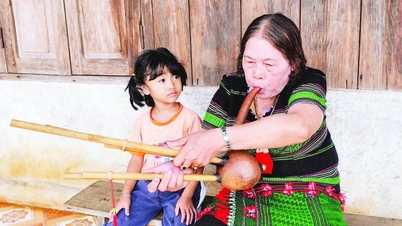
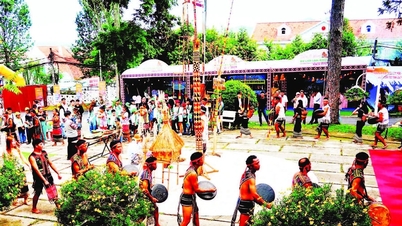
On weekends, holidays, or whenever tourists request it, gong ensembles in many villages of Dak Lak province are always ready to perform gong music for entertainment.
Today's gong ensembles include not only elderly artisans but also many young people who have received formal training and possess a passion for traditional culture, contributing to spreading the gong heritage to the community... This is the result of 20 years of persistent preservation and promotion of the Central Highlands gong culture in Dak Lak province.
The village resounds with the sounds of gongs and drums.
Nestled beside the picturesque Serepok River, Kuop village in Ea Na commune has been home to the Ede ethnic group for generations. Despite many changes in lifestyle, the village still preserves over 50 traditional longhouses, a space dedicated to gong music, folk songs, Xoang dances, and traditional crafts such as brocade weaving and rice wine making. In March 2024, Kuop village received support from the Dak Lak Provincial Department of Culture, Sports and Tourism to develop it into a community tourism village. Since then, the village has always been filled with the vibrant sounds of gongs welcoming visitors.
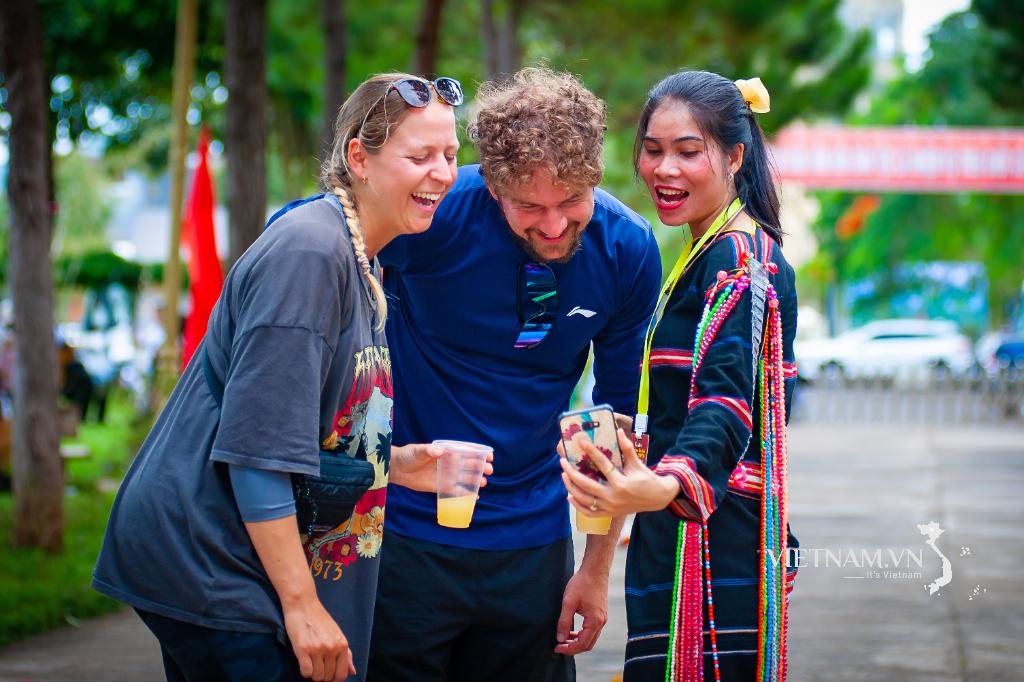
In early December, a group of tourists from Ho Chi Minh City traveled over 235 km to Dak Lak. After visiting the Dray Nur waterfall, they sought refuge in Buon Kuop village to rest and learn about the cultural heritage of gong music. As night fell, by the flickering campfire amidst the peaceful Central Highlands, the tourists enjoyed spectacular gong performances by the village's artisans. The majestic sound of the gongs, combined with the graceful Xoang dances of the charming Ede girls, created a magical and enchanting atmosphere. Ms. H'No HDot, an artisan in Buon Kuop village, said: "Previously, due to difficult conditions and the impact of modern life, the sound of gongs gradually faded from the village for a period of time."
In recent years, thanks to the promotion and support of the cultural sector and local authorities in preserving and promoting traditional cultural values, as well as assisting and guiding the people in developing community tourism, traditional cultural activities have gradually been restored, especially the gong music. As a result, the number of tourists visiting the village has increased.
In the Tơng Jú hamlet, Ea Kao ward, over the past five years, traditional cultural and artistic activities of the Ê Đê people have been revived. The hamlet has established performing arts groups, gong ensembles, folk instrument performance groups, and culinary groups. Every week, they enthusiastically practice the xoang dance, the wine-offering ritual, and gong performances... both to entertain tourists and to preserve traditional culture, with the sound of gongs echoing throughout the village. Mr. Trần Quang Vũ, a tourist from Hanoi, shared: "I was very impressed to enjoy the cultural program staged and performed by the people of Tơng Jú hamlet themselves; they respect and preserve traditional culture very well."
Ms. H'Yam Bkrong, head of the Tơng Jú community tourism group, said: "The good news is that not only the elderly but also the younger generation love traditional culture and often practice together. The village's performing arts team and gong ensemble have been invited to participate in major events at the ward and provincial levels many times, which makes us very proud."
Not only in Buon Kuop and Buon Tong Ju, but over the years, Dak Lak province has always focused on preserving and promoting the traditional cultural values of ethnic minorities, especially the gong and drum heritage. In the villages, many training classes have been opened, creating opportunities for the younger generation to access, practice, and preserve the unique cultural space of the Central Highlands. Meritorious Artist Vu Lan believes that the teaching of gong and drum music to the next generation has yielded positive results and is increasingly spreading widely and deeply within the community and society.
Efforts to preserve the cultural heritage of gong music
In 2005, the Central Highlands Gong Culture Space was inscribed by UNESCO as a Masterpiece of Oral and Intangible Cultural Heritage of Humanity. In 2008, it was included in the Representative List of Intangible Cultural Heritage of Humanity. Since then, the Dak Lak Provincial Party Committee and Provincial People's Council have issued resolutions and policies to support and facilitate the preservation and promotion of the gong culture heritage.
According to statistics from the Department of Culture, Sports and Tourism, after 20 years of implementing the conservation and promotion of gong culture heritage in Dak Lak, many positive results have been achieved. The province has restored and recreated many traditional rituals and festivals associated with gong culture; maintained hundreds of gong ensembles; provided 214 sets of gongs and 1,140 sets of traditional brocade costumes to gong ensembles and clubs; organized classes to teach gong performance; promoted gong culture heritage to the world; and combined conservation with community tourism development…
To date, the province has 1,603 sets of gongs, including 1,178 sets of Ede gongs, 219 sets of M'nong gongs, 118 sets of Jrai gongs, and 88 sets of gongs from other ethnic groups; there are 3,749 artisans preserving the heritage, including 1,015 young artisans… This is a great effort by the province and the ethnic minority communities themselves in preserving and promoting the gong heritage.
According to Tran Hong Tien, Director of the Department of Culture, Sports and Tourism: "The most encouraging aspect of preserving and promoting the gong culture heritage in Dak Lak is that it's not just about numbers; in the villages, the teaching and performance of gong playing has spread widely, especially among the younger generation. At the same time, in most festivals and traditional rituals, people use gongs as a way to preserve, promote, and spread traditional cultural values."
However, at the conference summarizing 20 years of implementing the conservation and promotion of gong culture heritage in Dak Lak province (2005-2025), with orientations to 2030, many delegates argued that, in addition to the achievements, the conservation of gong culture heritage is also facing many difficulties, such as: the decline of folk knowledge, the impact of urbanization, the risk of disruption in the transmission of knowledge, the difficult economic life of ethnic minority communities, and the influence of modern culture…
According to Vice Chairman of the People's Committee of Dao My province, the best way to preserve and promote the cultural heritage of the Central Highlands' gong culture is to integrate it into contemporary life. Therefore, the province will propose to the Ministry of Culture, Sports and Tourism to develop a comprehensive plan for the Central Highlands Gong Culture Space, which will identify the necessary infrastructure, equipment, personnel, and training for the next generation of artisans…
In addition, local Party committees and authorities need to take strong action to support artisans and create more confidence and motivation for ethnic minority communities to continue preserving, promoting, and spreading the gong culture heritage in harmony with contemporary life.
Source: https://baolamdong.vn/20-nam-ben-bi-bao-ton-van-hoa-cong-chieng-409721.html

![[Photo] Prime Minister Pham Minh Chinh holds a phone call with the CEO of Russia's Rosatom Corporation.](/_next/image?url=https%3A%2F%2Fvphoto.vietnam.vn%2Fthumb%2F1200x675%2Fvietnam%2Fresource%2FIMAGE%2F2025%2F12%2F11%2F1765464552365_dsc-5295-jpg.webp&w=3840&q=75)
![[Photo] Closing Ceremony of the 10th Session of the 15th National Assembly](/_next/image?url=https%3A%2F%2Fvphoto.vietnam.vn%2Fthumb%2F1200x675%2Fvietnam%2Fresource%2FIMAGE%2F2025%2F12%2F11%2F1765448959967_image-1437-jpg.webp&w=3840&q=75)





![[Infographic] Preventing students from making their own firecrackers: 7 things parents need to know](https://vphoto.vietnam.vn/thumb/402x226/vietnam/resource/IMAGE/2025/12/11/1765466656703_img_0320_20251211183542.jpeg)































![[OFFICIAL] MISA GROUP ANNOUNCES ITS PIONEERING BRAND POSITIONING IN BUILDING AGENTIC AI FOR BUSINESSES, HOUSEHOLDS, AND THE GOVERNMENT](https://vphoto.vietnam.vn/thumb/402x226/vietnam/resource/IMAGE/2025/12/11/1765444754256_agentic-ai_postfb-scaled.png)












































Comment (0)