

Visitors to Da Lat not only experience the rhythm of life amidst the mist and cool sunshine, surrounded by the myriad colors of the city of a thousand flowers, but also get to enjoy and immerse themselves in the unique cultural identity of the indigenous ethnic groups of the southern Central Highlands.
There, the sounds of gongs, traditional dances, rituals, and community life are performed and recreated, creating a captivating beauty that is both sacred and familiar.
The gong culture of the Central Highlands encompasses five distinctive qualities of the world of sound: musical uniqueness, a complex polyphonic system and a unique heritage when placed within the regional frame of reference; sacredness without boundaries due to an infinite force field; spatial diffusion, shaping living cultural layers, possessing both symbolic and empirical elements in a continuous flow; the synthesis of space and time, of subject and object; and finally, distinctiveness. The cultural space of the gong is "the living memory of humanity."
Whether there are 3, 6, or 12 gongs, whether they have knobs or are flat, whether they are played by hand or with mallets, worn on the shoulder or placed on a stand, whether the musician is male or female… each ethnic minority group in the Central Highlands has its own unique characteristics. However, whenever the gong sounds, whether resonant or deep, fast or slow, the sound of the gong is sacred. “The gong music of the Central Highlands is not monophonic like many neighboring musical traditions; it forms a complex polyphonic system, with each gong maintaining a specific pitch, linking together to form a thick layer of sound. This is an ancient form of orchestration, rarely found in Southeast Asian culture” (quoted from Professor, Dr. Tran Van Khe). It is also worth mentioning the assessment of UNESCO: “The cultural space of the Central Highlands gong music is not a single instrument or practice, but a synthesis of music, rituals, beliefs, architecture, performance, and community life.” (Intangible Heritage Files, 2005)
In the midst of the village, the village elder called out: “O villagers! After a year of hard work in the fields and on the hillsides, today the granaries are full of rice, and the jars of rice wine are ready to be opened. We gather here to thank Yang and the spirits for granting our village a year of favorable weather, for the fields and hillsides to be bountiful, for the rice to be heavy with grain, for the pigs to be as numerous as black ants, and for the buffaloes to be as numerous as snails in the stream. O villagers! Let us all come together to celebrate! Oh… Yang…” With that, the sounds of small and large gongs, small and large drums, blended together like rain and wind. Sometimes they sounded gentle like flowing water, sometimes soothing like an evening breeze, sometimes roaring like a waterfall, like the thunder of August, like the downpour of October. When struck loudly, the gongs penetrated deep into the forest and climbed high into the mountains. When struck slowly, the gongs crept across the grasslands; the forest animals forgot to eat and drink, raising their heads to listen to the sound of the gongs.
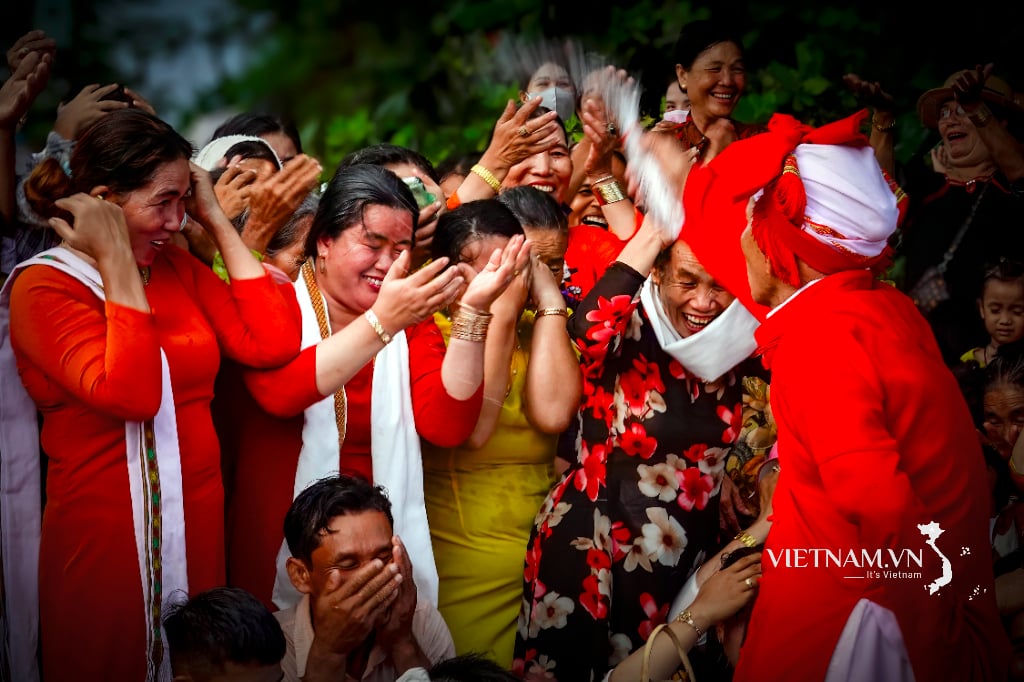
Harmonizing with the sounds of gongs and the performers, the stream of tourists is suddenly carried along by the rhythmic dances of the villagers. The circle of dancers grows wider and wider in the vibrant, uplifting atmosphere. Elder K'Brèm from the Lam Dong region, known for its thousands of flowers, couldn't hide his pride: "I'm so happy to introduce the unique culture of my Ma people! I hope to perform in many places so that more people will know about it." Distinguished Artist Touneh Ma Bio and the villagers of Diom enthusiastically immerse themselves in the Tamya, Ariya, T'rumpô, Păhgơnăng, and Đămtơra dances of the Chu Ru people. The rhythmic circle of dancers around the ceremonial pole clatters with the sound of tassels and symbolic animal models clashing in the wind. Ma Bio sings: "Oh bird, oh bird. Birds fly to find food. Birds return to their nests, feeding their young so they grow quickly, their voices echoing far across this vast forest…"
Witnessing the "rain-praying" ceremony, Ms. Bui Thi Ngoc My, an elderly tourist from Ho Chi Minh City, expressed: "This is my first time seeing a festival of the ethnic groups in the southern Central Highlands. Indeed, the traditional culture here is very special and captivating." Joining in the traditional dances and enjoying the traditional dishes of the Co Ho people at the "new rice harvest" ceremony were a group of Korean tourists, all expressing their delight at experiencing the highland culinary culture. Mr. Kim Seong Yul shared: "It's so interesting to experience the Central Highlands culture, it's very special. I feel they are very proud of their ethnic culture." Ms. Choi Jongeun also couldn't hide her emotions: "I will definitely return here because I know their culture is still very rich. I will also introduce it to my friends in Korea to enjoy."
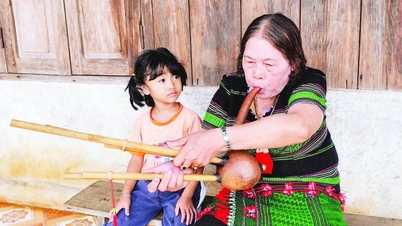
The atmosphere of the ethnic minority cultural festival becomes even more vibrant as visitors join the mountain girls in a rhythmic circle dance around a blazing bonfire; accompanied by the sounds of gongs, drums, and gourd-shaped horns playing a welcoming melody of the mountains. Everyone enjoys rice wine brewed with forest yeast, Southern Central Highlands cuisine, and engages in friendly interactions. Mr. Nguyen Van Dat from Khanh Hoa province said: "I am fortunate to come to Lam Dong during the festival season, to learn and experience more about the cultural rituals of the Central Highlands ethnic minorities."
Today, with the modern pace of life, the sounds of gongs, the melodies of gourd-shaped horns, and the traditional folk songs and dances of the ethnic minorities in the southern Central Highlands are no longer confined to the villages. The beauty of their culture has been brought by the indigenous people of the Co Ho, Ma, Chu Ru, and M'Nong ethnic groups to cultural events in urban areas, amidst the bustling footsteps of travelers. This ensures that "the gongs are no longer hungry, the drums are no longer sad, the horns are no longer silent..." and that the sounds of the vast forests continue to invite visitors from near and far to this majestic highland region.
Source: https://baolamdong.vn/quyen-ru-van-hoa-dan-toc-nam-tay-nguyen-409697.html
![[Photo] Closing Ceremony of the 10th Session of the 15th National Assembly](/_next/image?url=https%3A%2F%2Fvphoto.vietnam.vn%2Fthumb%2F1200x675%2Fvietnam%2Fresource%2FIMAGE%2F2025%2F12%2F11%2F1765448959967_image-1437-jpg.webp&w=3840&q=75)
![[Photo] Prime Minister Pham Minh Chinh holds a phone call with the CEO of Russia's Rosatom Corporation.](/_next/image?url=https%3A%2F%2Fvphoto.vietnam.vn%2Fthumb%2F1200x675%2Fvietnam%2Fresource%2FIMAGE%2F2025%2F12%2F11%2F1765464552365_dsc-5295-jpg.webp&w=3840&q=75)




![[Infographic] Preventing students from making their own firecrackers: 7 things parents need to know](https://vphoto.vietnam.vn/thumb/402x226/vietnam/resource/IMAGE/2025/12/11/1765466656703_img_0320_20251211183542.jpeg)






























![[OFFICIAL] MISA GROUP ANNOUNCES ITS PIONEERING BRAND POSITIONING IN BUILDING AGENTIC AI FOR BUSINESSES, HOUSEHOLDS, AND THE GOVERNMENT](https://vphoto.vietnam.vn/thumb/402x226/vietnam/resource/IMAGE/2025/12/11/1765444754256_agentic-ai_postfb-scaled.png)












































Comment (0)