

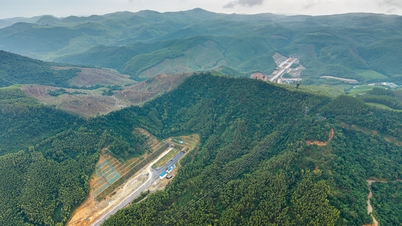
Over the years, mountainous communes in western Quang Ngai province have made efforts to restructure crop production towards increasing productivity and value per unit area of land.
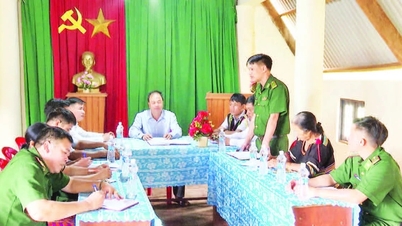
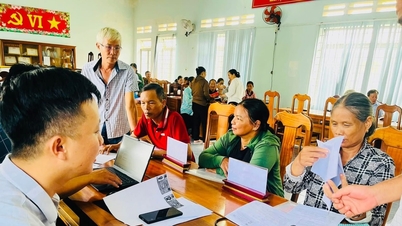
After more than 5 months of implementing the two-tiered local government system, grassroots officials continue to inherit the task, mobilizing the people to promote crop conversion to avoid wasting land and create strong changes in agricultural production.
Crop diversification, increased productivity
Mr. A Dom's family in Dak Koi commune cultivates nearly 20 hectares of coffee and 5 hectares of cassava. In recent years, thanks to stable coffee prices, his family has had a decent income. Meanwhile, the cassava crop was frequently infected with disease, and prices were volatile, so he left it fallow without investing in improvement. After being encouraged by commune officials, Mr. A Dom converted over 5 hectares of cassava to coffee cultivation. “My family has a stable income from coffee, so we only do a little bit of cassava farming. Now that the commune is supporting us with seedlings and encouraging the conversion, I'm boldly following their advice to increase productivity,” Mr. A Dom shared.
The Party Committee and local government of Dak Koi commune have identified crop restructuring as a key task in socio-economic development. Therefore, the commune is focusing on reviewing and implementing measures to increase the area of coffee and fruit trees, while gradually reducing the area of low-yield traditional crops such as cassava and upland rice. Approximately 650 hectares of cassava, sugarcane, and upland rice in the commune need to be converted to high-value crops such as coffee and macadamia nuts. After a period of campaigning and supporting the people, the commune has converted over 23 hectares of cassava and sugarcane to coffee cultivation. In addition, the locality continues to support people in improving their orchards and expanding the area of medicinal plants in suitable hilly areas.
According to Nguyen Van Thuy, Secretary of the Commune Party Committee: "The commune's goal is to increase the total coffee growing area to over 760 hectares; to establish a high-tech fruit growing area of 490 hectares; and to organize a production and consumption chain. We are focusing on crop conversion and applying high technology to production and processing to increase the value of agricultural products; mobilizing people to work together and implementing it step by step to gradually increase household income."
Increase income from forests and fields.
After more than 5 months of implementing the two-tiered local government system, mountainous communes in Quang Ngai province have quickly adapted to the new environment and land. Maximizing the advantages of the land for agricultural production, mountainous communes and wards have proactively reviewed and gradually transformed, reducing the area of low-yield crops and increasing the area of suitable, higher-yield crops.
In 2025, Dak Rve commune will plant over 2,000 hectares of industrial crops including rubber and coffee; at the same time, it will encourage people to switch from less efficient crops in hilly areas and mixed orchards. The commune has planted 21 hectares of fruit trees, 15 hectares of macadamia nuts, and 42 hectares of coffee, replacing old, unsuitable crops. Chairman of the People's Committee of Dak Rve commune, Huynh Ngoc Phong, said: Commune officials have been promoting and encouraging people to choose and restructure crops to form large-scale, concentrated production areas.
Along with Dak Rve commune, other mountainous communes in Quang Ngai province are also striving to transform their crops to suit the soil and production conditions of each region, bringing high economic efficiency. “Sa Thay commune is strengthening efforts to increase the value per unit area of cultivated land. We are orienting the transformation of the crop structure towards market demand, participating in production-consumption linkages to ensure production efficiency,” said Comrade Y Sam, Secretary of the Party Committee of Sa Thay commune.
Restructuring crop production has helped mountainous communes in Quang Ngai province increase productivity and improve income from forests and fields. With new development opportunities, localities are maximizing their advantages and resources for socio-economic development to achieve their set goals. Comrade Nguyen Duc Tuy, Deputy Secretary of the Provincial Party Committee and Chairman of the Provincial People's Council of Quang Ngai, affirmed: Currently, the two levels of local government are operating stably, and localities need to focus on calculating solutions for economic development. For mountainous communes with large land resources, the local government should identify key crops, convert suitable planting areas; and implement appropriate policies to avoid land waste and form specialized farming areas to develop agricultural economy towards commodity production in the highlands of Quang Ngai.
Source: https://baolamdong.vn/chuyen-doi-cay-trong-nang-cao-doi-song-nhan-dan-mien-nui-409700.html



![[Photo] Prime Minister Pham Minh Chinh holds a phone call with the CEO of Russia's Rosatom Corporation.](/_next/image?url=https%3A%2F%2Fvphoto.vietnam.vn%2Fthumb%2F1200x675%2Fvietnam%2Fresource%2FIMAGE%2F2025%2F12%2F11%2F1765464552365_dsc-5295-jpg.webp&w=3840&q=75)
![[Photo] Closing Ceremony of the 10th Session of the 15th National Assembly](/_next/image?url=https%3A%2F%2Fvphoto.vietnam.vn%2Fthumb%2F1200x675%2Fvietnam%2Fresource%2FIMAGE%2F2025%2F12%2F11%2F1765448959967_image-1437-jpg.webp&w=3840&q=75)
![[Infographic] Preventing students from making their own firecrackers: 7 things parents need to know](https://vphoto.vietnam.vn/thumb/402x226/vietnam/resource/IMAGE/2025/12/11/1765466656703_img_0320_20251211183542.jpeg)




























![[OFFICIAL] MISA GROUP ANNOUNCES ITS PIONEERING BRAND POSITIONING IN BUILDING AGENTIC AI FOR BUSINESSES, HOUSEHOLDS, AND THE GOVERNMENT](https://vphoto.vietnam.vn/thumb/402x226/vietnam/resource/IMAGE/2025/12/11/1765444754256_agentic-ai_postfb-scaled.png)





















![[Photo gallery] Long Thanh Airport 'lights up' ready to welcome its first flight](https://vphoto.vietnam.vn/thumb/402x226/vietnam/resource/IMAGE/2025/12/11/1765467251707_bia_20251211222704.jpeg)













Comment (0)