


Exploring areas with advantages like Huu Lien and Bac Son, community-based tourism opens up a new business opportunity that doesn't require large land holdings or significant initial investment. The story of Mr. Duong Cong Trong from Na Rieng village, Bac Son commune, illustrates how young people can start businesses through community-based tourism. Since 2018, as the number of visitors to Quynh Son community-based tourism village increased, he renovated his family's stilt house and over 400 m² of grounds to create a homestay. Besides accommodation and food services, his family also organizes experiential activities for tourists, such as visiting Quynh Son community-based tourism village and the yin-yang tile-making village; mountain climbing; planting and harvesting rice; making banh chung (traditional Vietnamese rice cakes) and pounding wormwood; and maintaining a club for singing then (a traditional folk song) and playing the zither to serve cultural activities.

Mr. Trong said: On average, the facility welcomes 80 to 100 overnight guests and 100 to 200 day-trip visitors each month, creating jobs for 3 to 5 family members with an income of about 7 million VND/person/month, and a profit of over 20 million VND/month.
In Huu Lien commune, the model of Mr. and Mrs. Phan Van Mon demonstrates that this approach can be expanded to meet market demand. In 2020, they renovated their 900 m² property into a rest stop combined with a homestay. Besides accommodation and food, the model added services such as guided mountain climbing, herbal baths, and motorbike rentals. Thanks to the gradual improvement of services, the number of guests remains stable at 10 to 15 per day. Currently, the model provides employment for family members and local workers with an income of approximately 8 million VND per person per month, and an average profit of about 30 million VND per month.
Specific examples show that community-based tourism is creating an "entrepreneurial ecosystem" with many opportunities for young people to participate. According to preliminary statistics, the province currently has about 20 homestay models owned by young people; approximately 100 youth union members are involved in activities within the tourism chain. Beyond accommodation and food services, young people are also involved in developing various products such as experiencing orange and tangerine harvesting combined with camping at farms; visiting strawberry and grape gardens; harvesting and processing chestnuts; and participating in activities such as renting costumes, taking photos, providing camping equipment, transportation, and guidance. This diversity helps reduce investment pressure while creating many avenues for young people to choose suitable entrepreneurial paths.
According to Mr. Doan Thanh Cong, Vice Chairman of the Vietnam Fatherland Front Committee of the province and Secretary of the Provincial Youth Union, community tourism is opening up new entrepreneurial opportunities for young people. In recent times, the Provincial Youth Union has coordinated with banks to receive entrusted loan capital, supporting young people in accessing preferential loans; proposing additional resources to expand the model; organizing training in tourism skills, promoting the local image, and guiding union members to participate in service development. These activities contribute to helping young people transition from seasonal work to forming business models associated with community tourism.
Simultaneously, specialized agencies and local authorities are focusing on development orientation, skills training, connecting tours and routes, and promoting products, thereby helping youth-led models transition from trial runs to stable operations. This process not only provides technical support but also helps young people clearly see how to do things, avoid scattered investments, gradually improve services, and enhance competitiveness.
From the experiences in various localities, it is clear that community-based tourism is no longer just an experiment but is gradually becoming a concrete entrepreneurial direction for young people. With the available resources, young people can start on a small scale, accumulate experience, expand services, increase income, and gradually form a stable business model right in their hometown.
Source: https://baolangson.vn/du-lich-cong-dong-co-hoi-khoi-nghiep-cho-thanh-nien-5087485.html
![[Photo] General Secretary and President To Lam and his wife, along with General Secretary and President Xi Jinping and his wife, attending a tea party.](https://vphoto.vietnam.vn/thumb/1200x675/vietnam/resource/IMAGE/2026/04/15/1776245678527_vna-potal-tong-bi-thu-chu-tich-nuoc-to-lam-va-phu-nhan-cung-tong-bi-thu-chu-tich-nuoc-tap-can-binh-va-phu-nhan-du-tiec-tra-8702812-9829-jpg.webp)
![[Image] Overview of the Tam Trinh-Giai Phong connecting road section after land clearance is completed.](https://vphoto.vietnam.vn/thumb/1200x675/vietnam/resource/IMAGE/2026/04/15/1776245679644_ndo_br_dji-0195-jpg.webp)
![[Photo] General Secretary and President To Lam and General Secretary and President Xi Jinping meet with youth from both countries.](https://vphoto.vietnam.vn/thumb/1200x675/vietnam/resource/IMAGE/2026/04/15/1776245687540_vna-potal-tong-bi-thu-chu-tich-nuoc-to-lam-va-tong-bi-thu-chu-tich-nuoc-tap-can-binh-gap-go-thanh-nien-hai-nuoc-8702371-jpg.webp)
![[Photo] Capturing each moment at the "People We Meet" photography exhibition.](https://vphoto.vietnam.vn/thumb/1200x675/vietnam/resource/IMAGE/2026/04/15/1776245695648_1-8944-jpg.webp)
![[Image] Current status of the land area of over 5.5 hectares that Ho Chi Minh City is considering reclaiming.](https://vphoto.vietnam.vn/thumb/1200x675/vietnam/resource/IMAGE/2026/04/15/1776245690095_1-3102-8409-jpg.webp)
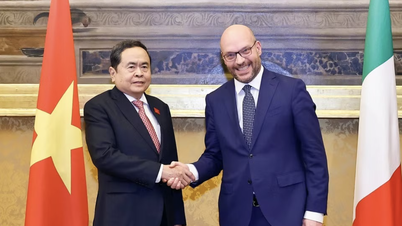
![[Photo] National Assembly Chairman Tran Thanh Man concludes official visit to Italy, departs for IPU-152](https://vphoto.vietnam.vn/thumb/1200x675/vietnam/resource/IMAGE/2026/04/15/1776253436109_vna-potal-chu-tich-quoc-hoi-ket-thuc-tham-chinh-thuc-italy-len-duong-du-ipu-152-tai-tho-nhi-ky-8702876-7969-jpg.webp)















































Comment (0)