


The Vatomus high-performance foldable drone, designed and manufactured by Saolatek - Photo: QUANG DINH
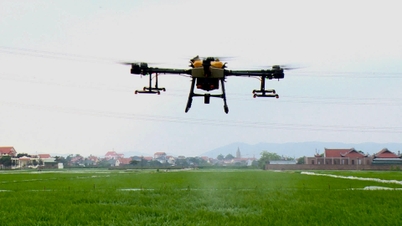
The rescue and relief drones used during recent storms and floods have demonstrated the enormous potential for future applications of drones in particular, and UAVs in general.
Drone made in Vietnam
In early October 2025, Thai Nguyen was submerged in a historic flood. River levels rose, isolating many communes and preventing rescue vehicles from reaching them. Drones developed by Viettel Post, deployed for the first time in emergency relief efforts, truly became the only link between the relief center and the people in the flooded areas.
Drones have become "life-saving wings," performing two vital tasks: transporting essential supplies and guiding rescue boats. In fact, drones have identified safe coordinates, helping local forces accurately reach each point requiring assistance.
With a maximum payload of 50kg, a flight range of 5km, an altitude of 100m, and an accuracy of only 10cm, these drones operate continuously day and night amidst fierce rain and wind. In just two days, October 8th and 9th, Viettel Post carried out more than 200 deliveries and 30 guidance missions...
In addition to civilian drones, Viettel also produces reconnaissance UAVs, long-range multi-purpose UAVs, and suicide UAVs. For example, the VU-C2 suicide UAV is equipped with a warhead, sensor cameras, and integrated artificial intelligence (AI), capable of automatically searching, detecting, and locking onto targets, and attacking targets on command from the commander. This model achieves a maximum attack speed of over 130 km/h.
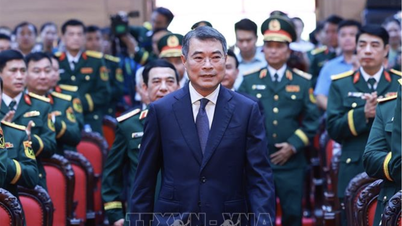
Lieutenant General Tao Duc Thang, Chairman of Viettel, shared: "Viettel is beginning to focus on developing UAVs for the low-altitude economic ecosystem, considering this a strategic step towards a complete, flexible, and multi-functional ecosystem, with the goal of expanding from UAVs to specialized flying devices serving civilian purposes such as rescue, logistics, and defense."
Meanwhile, the Hera drone from RtR Company, founded by Dr. Luong Viet Quoc, is foldable, carries a payload of 15kg, flies for 56 minutes without a payload, and has an operating range of 11km, outperforming many competitors of similar size.
The product has been patented in the US and Australia and has passed rigorous testing to be approved for use by the Los Alamos National Laboratory (USA) and the US and Dutch police forces.
Not only have many Vietnamese companies created impressive products, but they have also quickly secured huge export contracts with foreign countries.

A high-performance foldable drone designed and manufactured by Saolatek was unveiled at the Xponential 2025 event in Houston, USA - Photo: NVC
"Truck driver" makes drones
Meeting the "father" of the Vatomus drone, Mr. Tran Anh Tuan (founder of Saolatek) pointed to the product he had recently brought to Vietnam after attending the Xponential 2025 exhibition in Houston, one of the US's energy and aerospace economic centers.
Many experts at Xponential were curious about the drone brought from Vietnam. At that time, the Vatomus appeared with a distinctive design, from its asymmetry to its ability to fold (wings, frame) vertically in less than 5 seconds...
When I met Tuan, the first story he told was about his time as a "bus conductor," helping his father on inter-provincial passenger bus trips. Tuan's childhood was filled with the sound of sudden braking, the roar of engines, learning to observe the road, and quietly fixing small things... Then, a traffic accident that nearly claimed his life shocked him.
Leaving his hometown for Ho Chi Minh City to study mechanical engineering at the Polytechnic University, Tuan once started a used car forum but failed. After trying various other projects, Saolatek was quietly launched in 2022.
We chose drones because they could solve many tasks simultaneously. It was also a concern given the then-nascent, fragmented, and heavily reliant market for drones in Vietnam.
At the three-story building of the Ho Chi Minh City High-Tech Park Business Incubator, where Saolatek Co., Ltd. has its "headquarters," each floor houses the workspace of a different department, including research and development, innovation, mechanics, AI, etc. Even on the ground floor, products and machinery are crammed in from the courtyard to the building itself.
There are countless suppliers of drone propeller components on the market, and while they're ready to use upon installation, they didn't satisfy Tuan. He wanted more; besides ensuring flight stability and good lift, the propeller system had to be able to retract and neatly arrange itself when stationary.
Standing and inspecting the drone that had just been brought back from the exhibition, Huynh Thanh Hieu - the mechanical engineer in charge at Saolatek - said that most of the mechanical parts were meticulously crafted by the company's young engineers, who stayed up all night to create superior performance.
Among Saolatek's accomplishments, Hieu frequently mentions a small but significant detail: the wing-folding mechanism.
A typical drone takes 20 seconds to deploy or fold. With Saolatek's drones, that takes only 5 seconds. When fully extended, the device measures 85cm in length and 59cm in width, but when folded, it's only 32x28cm. The body weighs only about 4.2kg (6.9kg with battery), demonstrating an optimized structure that balances payload capacity, flight time, and energy efficiency.
Tuan said his efforts weren't aimed at creating a technological shock, but rather at solving a very practical problem in the specialized task: rapid deployment, reduced risk, low cost, and high performance.
Saolatek has now mastered and localized approximately 50-60% of its total input materials for production. For the same line of industrial drones with the same performance, Vatomus confidently offers a price that is about 20-30% lower.

Viettel's drones will be used for rescue and relief efforts for people in storm and flood-affected areas in 2025 - Photo: DUC THO
"We're trying to persuade the village head to build a football field."
When Trần Anh Tuấn and some friends started developing drones, they identified a major bottleneck: many drone projects in Vietnam failed not because of weak technology, but because of difficulties in testing space, market challenges, and a lack of collaboration between businesses, research institutions, and management.
"You can't expect good players if the whole village doesn't even have a football field," Tuan said, using a metaphor. He and his friends began... persuading people. They went to technology forums and met with people at all levels to talk about the potential of drones and the opportunities of "low-level economy," a concept still very new in Vietnam. He recounted that at times it felt like a football fan "going door-to-door, convincing the village head that if you want a football team, you need a football field first."
From those efforts, the Aerospace and Drone Network (AUVN VN), and later the Low Level Economic Alliance (LAEP), gradually formed, helping to connect businesses, research institutes, start-ups, and regulatory agencies.
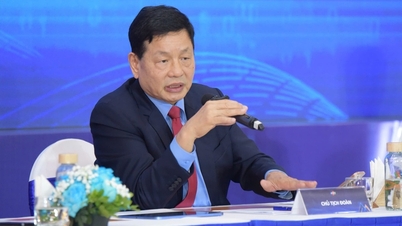
Mr. Truong Gia Binh, Chairman ofFPT Group, expressed his appreciation for the efforts and dedication of Tran Anh Tuan and his group of co-founders of the Low-Level Economic Alliance. He believes that Vietnam has great opportunities in manufacturing UAVs for global export. However, the major obstacle currently is the institutional framework.
Vietnam completely lacks regulations for this type of business, as well as regulations for business cooperation with foreign investors. Businesses face difficulties due to the lack of many standards and regulations regarding certificates, origin, licenses, business conditions, or a sandbox mechanism for implementation.
Tran Anh Tuan understands that: "Saolatek cannot grow if it is surrounded by desert. Only when there is a forest, that is, an ecosystem, do small trees have a chance to grow." Saolatek's drone is not yet large enough to change the market. But Tran Anh Tuan's journey shows something more important: doing technology in Vietnam requires not only products, but also pioneers.

Viettel's unmanned aerial vehicle (UAV) system at the A80 parade and march - Photo: DUC THO
Drone or UAV?
A drone is a type of unmanned aerial vehicle (UAV), but the term drone usually refers to small, versatile (multi-rotor) UAVs used for civilian purposes, entertainment, filming, and delivery, while UAV is a broader term encompassing all types of unmanned aircraft. This means that all drones are UAVs, but not all UAVs are drones (in the modern, common sense).
Developing Vietnam's genuine UAV capabilities.
Associate Professor Dr. Le Hoai Quoc - Chairman of the Ho Chi Minh City Automation Association - highly praised Saolatek's "father," Tran Tuan Anh, for his mastery of design and technology, something that not many Vietnamese drone/UAV startups achieve. This means that instead of following the "buy and assemble" approach, he designs everything from concept and blueprints to optimizing every technical detail, showcasing the true value of Vietnamese technology.
Saolatek developed Vatomus with approximately 60% localization in materials and 100% in design intelligence. According to Mr. Quoc, this is a "highlight," proving that Vietnam can create UAV products with high technical content.
He emphasized that improvements such as folding wings and rapid deployment are commendable efforts, but the core value still lies in designing, manufacturing, optimizing, and building a domestic supply chain.
Vietnam could become the drone capital.
During a meeting between Mr. Tran Luu Quang - Secretary of the Central Committee of the Communist Party of Vietnam and Secretary of the Ho Chi Minh City Party Committee - and the science, technology, and innovation startup community, themed "Ho Chi Minh City aiming to become a digital economic center and an international-level innovation and startup hub," Mr. Truong Gia Binh - Chairman of the Board of Directors of FPT Group - stated that the Low-Level Economic Alliance is collaborating with Ho Chi Minh City to aim for the formation of a $10 billion UAV industry within the next 10 years and create approximately 1 million jobs. "We are dreaming of building a drone capital in Vietnam," Mr. Binh said.
According to Mr. Truong Gia Binh, the UAV industry in Vietnam is currently worth approximately $100 million per year, with the goal of increasing it 100 times within a decade. Vietnam possesses significant advantages in labor costs and software development capabilities, factors that can help it compete globally. "Software is a field where we can win in almost any arena. I believe the low-level economy will be the same," Mr. Binh affirmed.
Back to the topic
Meritorious Deeds - Virtuous Conduct
Source: https://tuoitre.vn/thap-sang-tri-tue-viet-บน-uav-20260212093215551.htm







































































Comment (0)