More than a month after Decree 232/2025 (amending and supplementing some articles of Decree 24/2012 on the management of gold business activities) came into effect - notably including the regulation abolishing the state monopoly mechanism in the production, export and import of gold bars - the domestic gold market has not seen much change. The price of SJC gold bars remains above 150 million VND/ounce, 20 million VND higher than the world price.
A maximum of 20 tons of gold can be imported.
In this context, the State Bank of Vietnam has just announced a draft Circular regulating the gold position of credit institutions, replacing Circular 38/2012/TT-NHNN, to solicit feedback.
According to the draft, the State Bank of Vietnam plans to increase the end-of-day gold position of credit institutions authorized to produce, import and export gold bars and raw gold to a maximum of 5% of their equity capital.
For institutions only permitted to buy and sell gold bars, the position size must not exceed 2%, and no credit institution is allowed to have a negative gold position.
The State Bank of Vietnam explained that relaxing this position limit is to prepare the conditions for credit institutions to participate more deeply in the gold supply chain, thereby supplementing the official supply to the market.
To date, eight commercial banks have met the capital requirements as stipulated, including: Vietcombank, VietinBank, BIDV, Agribank, Techcombank, MB, VPBank, andACB . If these banks are simultaneously licensed to produce, import, and export gold bars and raw gold, the amount of gold supplied to the market is estimated to be very significant.
Based on equity figures as of the end of September 2025, and assuming a world gold price of approximately $4,000 per ounce and an exchange rate of VND 26,135/USD, the State Bank of Vietnam calculated that 5% of the equity capital of this group of banks is equivalent to $2.56 billion, or about 20 tons of gold.

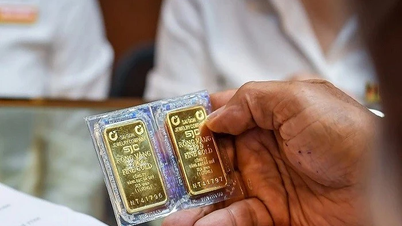
When access to gold becomes difficult, the fear of missing out can easily lead people to rush to buy, potentially disrupting the market. Photo: HOANG TRIEU
The drafting committee of the aforementioned circular argues that such a gold position size is "not too large compared to the financial capacity of eligible banks," sufficient to create a significant supply for the domestic market, contributing to narrowing the gap between domestic and international gold prices and reducing psychological pressure on investors. As a result, the gold market will become less dependent on a few businesses and more transparent.
The draft also adheres closely to Article 19 of Circular 34/2025 (guiding the implementation of Decree 24/2012 - amended and supplemented by Decree 232/2025). Accordingly, annually, the State Bank of Vietnam will base its total import and export limits on monetary policy objectives, gold supply and demand, and market developments. Based on this general limit, the State Bank of Vietnam will allocate and adjust limits for each enterprise and commercial bank according to its charter capital, risk management capacity, and market stability requirements for each period.
Gold expert Tran Duy Phuong believes that the State Bank's expansion of eligible participants in the market and raising the gold holding limit to 5% is a suitable step, especially given the continued high demand for gold among the public. According to him, the additional 20 tons of gold "is sufficient to meet basic needs and, more importantly, alleviate concerns about gold scarcity."
When supply remains stable, domestic gold prices will track world prices more closely, reducing opportunities for short-term speculation. "Investors will see that domestic gold prices are under control, instead of the 'buy and win' mentality seen recently. When supply is secure and gold imports are stable, speculation will shrink, and capital may shift to stocks or productive business sectors," Mr. Phuong optimistically stated.
Reduce the rush to buy gold.
Speaking with a reporter from the Nguoi Lao Dong newspaper, Dr. Can Van Luc, a member of the Prime Minister's Policy Advisory Council, said that in order to stabilize the gold market, Vietnam needs to reassess the level of "goldization" in the economy and accurately evaluate the amount of gold currently hoarded by the population.
He emphasized the need for public and transparent data disclosure and a firm commitment to completely ending gold-backed lending and borrowing relationships to reduce systemic risk. This is because excessive reliance on this precious metal has repeatedly plunged the gold market into chaos.
According to Dr. Can Van Luc, the primary factor in narrowing the gap between domestic and international gold prices remains increasing the legal supply. When access to gold becomes difficult, the fear of missing out easily leads people to rush to buy.
"It is necessary to increase transparency in the gold market while simultaneously creating other attractive investment channels so that people can redirect their money towards production and business instead of speculating on gold. When Decree 232/2025 is fully implemented, it will contribute to increasing the supply of gold bars legally and transparently," Mr. Luc commented.
In addition to Decree 232/2025, the State Bank of Vietnam is also coordinating with relevant ministries and agencies to study the establishment of a national gold exchange. This is considered an important step to overcome the fragmented and opaque gold market situation that has persisted for many years.
Associate Professor Ngo Tri Long, an economic expert, believes that piloting a gold exchange is necessary because gold has long exerted pressure on exchange rate and interest rate management. With Decree 232/2025 and Circular 34/2025 removing the monopoly mechanism for gold bar production and shifting to a conditional licensing principle, it will pave the way for the exchange to distribute imported raw gold transparently to businesses and commercial banks.
"This is a necessary condition to end the supply shortage, the inexplicable price discrepancies, and to lay the foundation for a mechanism to benchmark domestic and international gold prices," Associate Professor Ngo Tri Long assessed.
To operate a gold exchange effectively, Dr. Can Van Luc believes Vietnam needs to clearly define a suitable model: independent operation, integration with a commodity exchange, or placement in an international financial center in Ho Chi Minh City. The price listing mechanism, transaction taxes and fees, import and export procedures, and coordination between ministries and agencies also need to be meticulously designed from the outset.
According to experts, the biggest advantage of a gold exchange is that all transactions are recorded and reported in real time, providing regulatory authorities with a comprehensive database to manage the market. This significantly reduces speculation, manipulation, and the creation of artificial price surges, replacing them with market movements that accurately reflect supply and demand.
A specialized agency is needed to regulate the gold trading floor.
Mr. Nguyen The Hung, Vice Chairman of the Vietnam Gold Business Association, believes that building a transparent gold market management mechanism is an urgent issue, not only to address violations but also to ensure national monetary security. He proposed that the State Bank of Vietnam should soon establish a unified management and coordination center, where data, standards, and operating mechanisms for the gold market would be centralized.
"Vietnam has the necessary technology and infrastructure to build a modern gold exchange model following a cautious roadmap. The goal of the exchange is not just trading, but to achieve three core values: modernizing buying and selling operations, serving state management with transparent data, and creating a foundation for the development of gold-related financial products in the future," Mr. Hung observed.
Source: https://nld.com.vn/them-co-che-on-dinh-thi-truong-vang-19625112521372075.htm

































































































Comment (0)