The feeling of ingenuity in President Ho Chi Minh's use of words to guide various sectors and groups, especially the armed forces, is striking. His concise yet profound generalizations, particularly his comprehensive understanding of the specific tasks assigned to each sector and group, are both simple and clear, yet vast and expansive. Paving the way to victory has become a tradition of the engineering corps for nearly 80 years and will undoubtedly continue to accompany the engineering soldiers on their journey to the future.
According to historical records, the engineering corps was formed as soon as the Vietnam Liberation Army was established. Under the leadership of the Party and President Ho Chi Minh, during the nationwide resistance war, the people from North to South enthusiastically destroyed roads and bridges, dug trenches, built fortifications, cut down trees, and implemented the scorched-earth policy. When we launched major campaigns in the North, the engineering corps was always the vanguard, leveling mountains, excavating rocks, and building bridges... serving the campaign while also directly fighting the enemy. In the Dien Bien Phu Campaign, 20 engineering companies and tens of thousands of volunteer youth and civilian laborers worked day and night, opening thousands of kilometers of roads through towering mountain passes such as Pha Din, Lung Lo, Deo Khe, Deo Ca... building bridges and constructing ferries to cross the fierce rivers of the Northwest, ensuring timely support for the campaign and making a significant contribution to the historic victory. The heroic deeds of the engineering soldiers at key locations such as Ta Khoa, Co Noi, Ban Chen, Pha Din... and especially the digging of a tunnel straight into the heart of Hill A1 to deliver a thousand-pound explosive charge to destroy the enemy's last stronghold at Dien Bien Phu are historical milestones of the engineering corps.
|
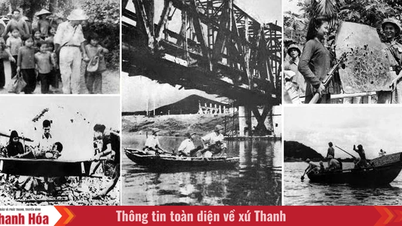
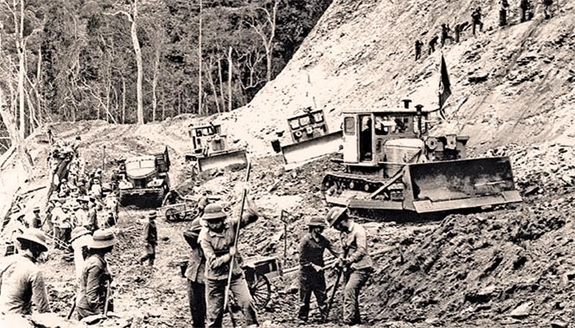
The heroic 6th Engineering Regiment of the Truong Son Army Corps, on a mission to build a major road using motorized vehicles in preparation for the Spring 1975 General Offensive. (Archival photo) |
Once again, during the war against the US , President Ho Chi Minh directly assigned the task of building the Ho Chi Minh Trail to the army, with the engineering corps as the core. From an initial liaison route involving carrying supplies and supplies, it gradually developed into a strategic transport route spanning tens of thousands of kilometers, involving hundreds of thousands of people and motorized vehicles simultaneously fighting the enemy and building the road. That road has now become the "Ho Chi Minh Highway," running from North to South, guiding the country towards a prosperous future.
Among the countless soldiers of the Truong Son Mountains in those days, the engineering troops were always at the forefront, always present in areas heavily bombarded, ready to sacrifice themselves to ensure every road leading to the front lines remained open.
The battlefield. Bombs and bullets. Life and death hang in the balance. Cutting through the Truong Son Mountains to save the country, the hands and minds of eighteen- and twenty-year-olds. Layers of fire, high mountains, deep ravines, challenging, equal, and undulating. The Truong Son engineering soldiers, the slender, girlish young women volunteers clearing the way. A stream of vehicles heading to the front lines. Their wheels turning through bombs and bullets, through rain and sun, moving forward. Beside the burning forests, the rocky underpasses, the deadly coordinates, the soldiers silently and stealthily continued clearing the way. What haunts me most are the young women, the young women volunteers on the front lines. Facing bombs and bullets, death day and night, they silently cherished a little personal wish. A deep, private feeling in their eyes. A sky filled with the scent of grapefruit and basil, softening the bombs and steel. It's Thao, Huong, Yen, Thu, Quyen... or the sim, mua, wild sunflowers, and reeds along every path of the vast Truong Son Mountains. Each individual blossoms beautifully, then unites in the embrace of the forest and mountains. "The bitter chrysanthemum forgets its own bitterness / Blooming yellow flowers along the stream for bees to fly." The soldiers who opened the Truong Son Road through countless bombs and bullets inscribed a unique and miraculous stroke of glory into victory.
That's my image, my sketch of a combat engineer in wartime.

|
Soldiers of the 29th Engineering Regiment building the Truong Son Road. Photo: VNA You may also like  Spreading the spirit of community service through an exemplary act of donating land to build a road.Despite knowing that "every inch of land is worth its weight in gold," especially residential land with high economic value, Mrs. Tran Thi Sau (Hamlet 2, Bat Bat Commune) voluntarily donated nearly 70m² of residential land and demolished 42m² of her solid boundary wall to expand the traffic corridor. Mrs. Sau's action has become a beautiful symbol of community spirit, inspiring a movement to build advanced new rural areas in Bat Bat.  The heroic epic of the Thanh Hoa Public Security Force on the front lines against the Americans.The 80th anniversary of the Traditional Day of the People's Security Force (July 12, 1946 - July 12, 2026) is an occasion to recall the glorious tradition and express gratitude for the immense contributions and sacrifices of generations of officers and soldiers on the front lines of national security protection. In the heroic epic of the Vietnamese People's Security Force, the Thanh Hoa Public Security force made a special mark in the resistance war against the US, joining the army and people of the whole country in firmly protecting the great rear area of the North and maintaining the smooth flow of strategic supplies to the front lines in the South. |
What about military engineers in peacetime today?
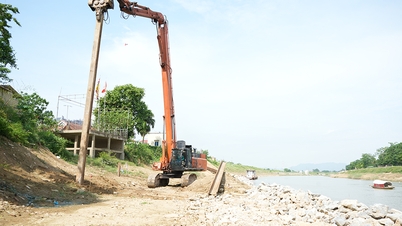
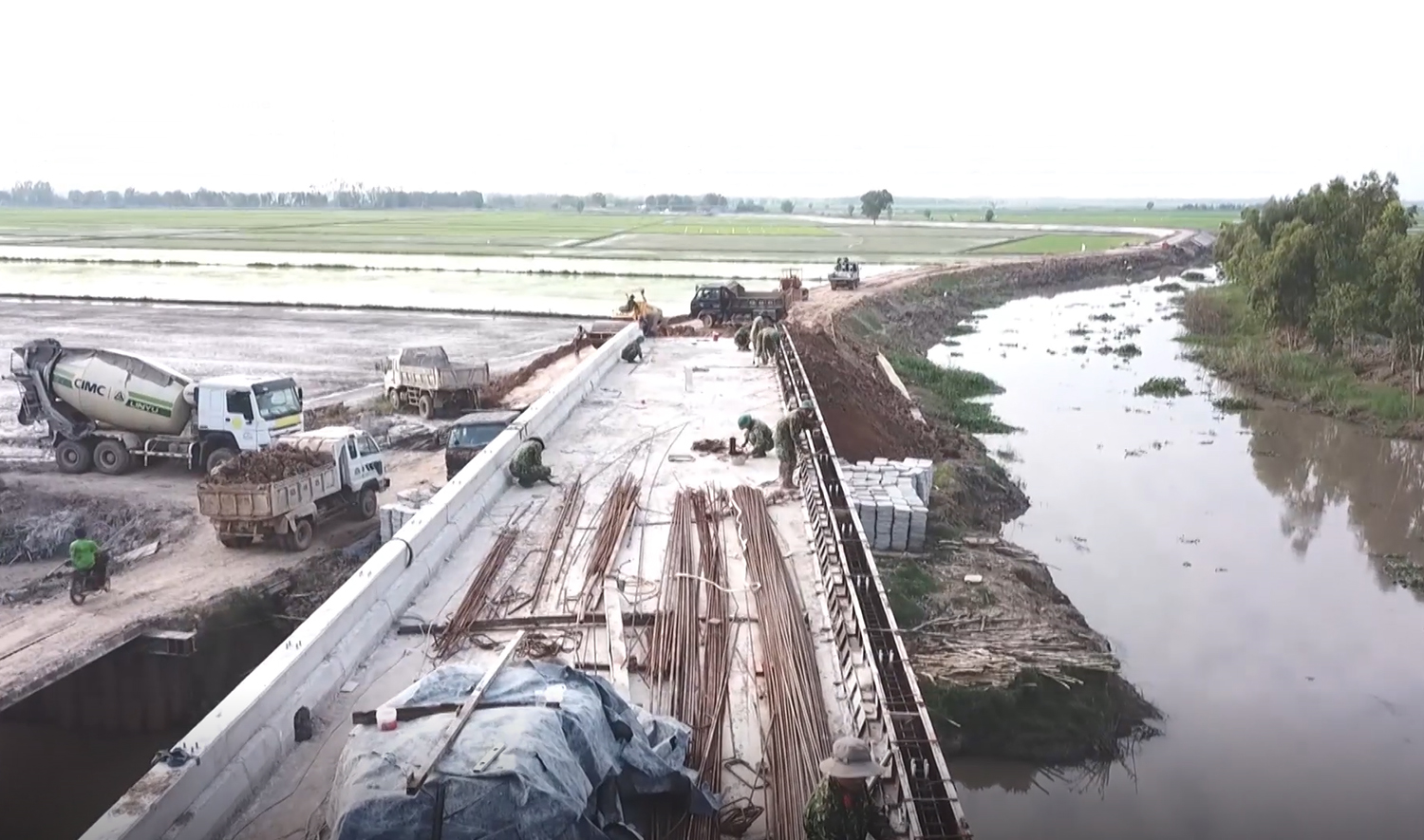
Road construction is an arduous job, requiring constant living and working at the construction site. For the military engineers building roads for border patrols, the hardships are even greater. During previous assignments on roads in Gia Lai, Dak Lak , Dak Nong, and Kon Tum, no one imagined the construction process would be so complex. Deploying machinery and equipment to the furthest reaches of the border is difficult enough, but ensuring the machinery and personnel can operate is the real challenge. There are shortages of everything, from fuel and food to provisions, but the most difficult is the lack of water. Not only is clean water for drinking scarce, but water for mixing concrete is also severely lacking. Digging wells dozens of meters deep only yields a bottomless pit of earth and rock, with absolutely no water. The streams are too far away and constantly dry. Waiting for the rainy season is impossible, let alone construction work, so the soldiers' solution is to carry water on their backs and transport it from distant places. At times, water is as precious as gold; no one dares to bathe because they need to save it for mixing concrete. The soldiers had to dig trenches and lay tarpaulins to store water. Often, the tarpaulins would tear, and water would seep into the ground, causing heartbreak. Yet, these roads continued to stretch along the border. Many innovative ideas emerged. One such idea, discovered by combat engineers, is using sand and sacks to cover the surface of newly poured concrete roads to absorb dew and retain moisture, and is being effectively applied along the entire route. Some things seem very simple, but only in times of practical difficulty do people come up with such ingenuity.
We arrived at the stone crushing station next to Border Guard Post 703. This is also the quarry supplying stone for the road under construction. Strong young men drove excavators and bulldozers amidst the deafening noise of the crushing and grinding machines. Nguyen Nhu Hieu, a technician at the station from Hoi Son - Anh Son - Nghe An, completed his vocational training in bridge and road construction and came straight here, working at the station from the beginning. Hieu's current salary is over ten million dong a month. Because he lives in a mountainous area with nowhere to spend money, Hieu always sends his money home regularly, including his Tet bonus, while he celebrates Tet at the stone crushing station with his colleagues. Pham Van Dien, from Kim Dong, Hung Yen, a young unmarried man who has been driving an excavator for three years, also celebrated Tet on the excavator's hood this past year. Dien confided: "I had planned to go home for Tet, but when I received news that my girlfriend was getting married on the 6th day of Tet, I decided to stay." Then the young man from the longan-growing region gazed intently at the forest ahead. I don't know what to say to the young man either. Life has so many things that are beyond our control and influence.
|
The 25th Engineering Brigade, Military Region 7, participates in building border patrol roads. Photo: qdnd.vn |
We went further inside.
The car stopped in front of a dilapidated shack nestled amidst the wild, untouched mountains and forests. A Captain was intently focused on a pile of books and papers. A rare scene unfolded before their eyes: rows of makeshift buildings constructed from crudely carved wood, containing construction materials and machinery. Beside the charred remains of burnt earth, contrasting with the blackened, half-burned stumps of ancient trees, miraculously, were patches of green vegetables ready for harvest.
A feeling of unease and restlessness crept over me. In this remote border region, there are soldiers who not only know how to plant forests, clear land, dig canals, install electricity, build schools, and set up medical stations, but also organize the construction of patrol routes—truly miraculous.
That night we slept in the outpost with the soldiers building the road.
The night in the Central Highlands was gloomy. The monsoon winds grew stronger, making everything dry and barren. People recounted how the men on duty here would go down to the stream to cast their nets and catch fish to supplement their diet during the days leading up to Tet (Lunar New Year). The white nets swayed and bobbed against the wooden walls. In the firelight, which the young men had just lit, each contributing a piece of firewood, the flames licked together, licking the stream fish. Around the fire, stories poured in, overflowing with tales of wives and children, villages, farming, production, and personal aspirations.

Vietnam encourages US businesses to expand investment in high technology.On the morning of June 26th, at the Government Headquarters, Deputy Prime Minister Ho Quoc Dung received Mr. Jeff Place, Supply Chain Director of Coherent Group (USA). During the meeting, the Deputy Prime Minister affirmed that Vietnam encourages US businesses to expand investment, especially in high-tech, innovation, and semiconductor industries. Night falls. The sky, like a giant, pitch-black net, hangs down upon the small figures of people. Outside, the forest breathes; outside, mist hangs, obscuring the machinery, iron rods, detonators, fuel drums, bulldozers, excavators... Who knows if any tigers or elephants from the deep forest are lurking, strangely teasing those new machines? In the deep forest, we seem to never sleep. To transport these machines and technical equipment over hundreds of kilometers of mountain passes to the summit, thousands of meters high, takes months of enduring wind and mist – an overwhelming challenge for the soldiers. In some of these journeys, the engineering troops have had to forgo holidays, leave, sleep, and food to carry and guide the machinery up the towering mountain slopes. Hundreds of innovative ideas have emerged. For example, when engineering soldiers cross rivers, their innovative idea is to get the machinery over the mountain peaks. There is no room for dogmatic, petty, or trivial thinking here. On New Year's Eve of the Year of the Ox, nearly 100% of the officers and soldiers working on construction sites celebrated the holiday on the spot at an altitude of a thousand meters. The sound of dynamite blasting continued to echo throughout the night. These engineering soldiers, some deployed from Nam Dinh, Thai Binh, Bac Giang, Hung Yen... thousands of kilometers away from their families, had spent months lying on wooden platforms along the roads, surely burdened with many thoughts. On New Year's Eve, the wildflowers in the forest were buried in the cold mist, not yet having bloomed. Only the reeds, still wet with snow and dew, swayed in the early, dry, hot winds from Laos, lashing fiercely against the young men stationed at the border.
Those New Year's Eve nights in the remote mountains and forests will never be forgotten in the memories of the soldiers who pioneered the road construction.
In peacetime, the private lives of combat engineers are diverse. They possess little material wealth, mostly just a backpack that faithfully rests on their shoulders during every march. I remember a mission years ago to the Northwest border. We stopped at the Bản Cún ferry terminal in Chiềng Cang commune, Sông Mã district, Sơn La province. We spent the night there. I tossed and turned, unable to sleep. It was almost dawn. I vaguely heard the sound of roosters crowing – the roosters of the Nùng ethnic people, let out by roaming the cornfields, their clear, melodious calls echoing through the hills. Outside, the wind howled. We lay in a makeshift hut on this side of the Mã River. On the other side was the mountain range we would cross the next day. The Mã River – what a name, so full of hardship. So winding, so rugged. The name of the river, like the name of the soldiers' lives, full of hardship and struggle. The name of the river… I drifted off to sleep, lost in thought about the officers and soldiers there. After more than three months of marching from Bac Giang, covering hundreds of kilometers with vehicles, artillery, bridges, and ferries, they are now stationed at this stretch of river.
The Ma River flows silently and slowly. During the dry season, the river narrows and meanders like a silver thread in the deep, dark night. The Ma River receives water from upstream Laos. The life of a river is no different from the life of a soldier. Always flowing, always carrying and transporting silt to build up the motherland. I quietly left my iron bed, slipped down to the dock and sat with two young soldiers on the makeshift ferry. Private Hoang Van Phu, from Hiep Hoa, Kinh Mon, Hai Duong, had a face covered in fine downy hair, and Private Ngo Van Tuong, from Nam Hong, Nam Truc, Nam Dinh. The two country lads spoke softly and pleasantly, their small stature making them seem to blend in with the waves. Their clothes were soaked with dew. The conversation between soldiers was quite open. Ngo Van Tuong said, “I don’t have a girlfriend yet, but I’ll be discharged at the end of this year and go back home to get married; my parents are urging me. That’s how it is in my hometown; if you don’t go to sea, you work in landscaping. While in the engineering corps, I’ve learned several trades from my comrades: carpentry, construction, tree trimming, and barbering, so I’m not afraid of unemployment.” Tuong gazed thoughtfully at the river. “And what about the young man from Hung Yen? Do you have a dream career of your own?” Phu looked at me, then at the Ma River, and spoke as if speaking to someone far away: “Brother, I dream of becoming a cook, a good chef. After I leave the army, I’ll go to culinary school.” Wow. Interesting. So simple, so unexpected. Private Tuong and I looked at the small, almost feminine young man. That’s what soldiers are like. Sometimes their feelings and dreams are so simple, so incredibly humble…
The Ma River flowed silently and peacefully, as if listening to our story.
Occasionally, the water would lap against the side of the ferry, making a soft splashing sound...
Source: https://www.qdnd.vn/phong-su-dieu-tra/phong-su/theo-dau-chan-nguoi-linh-mo-duong-1027076