A 37-year-old male patient from Hanoi, despite having 10/10 vision in both eyes, often experienced glare when outdoors in bright sunlight. After a medical examination, he was diagnosed with cataracts.
The patient works as a construction supervisor. For about a year now, he has frequently experienced glare and blurred vision when working outdoors in bright sunlight. However, when his eyesight was tested at a nearby optical shop, both eyes still had a 10/10 vision.
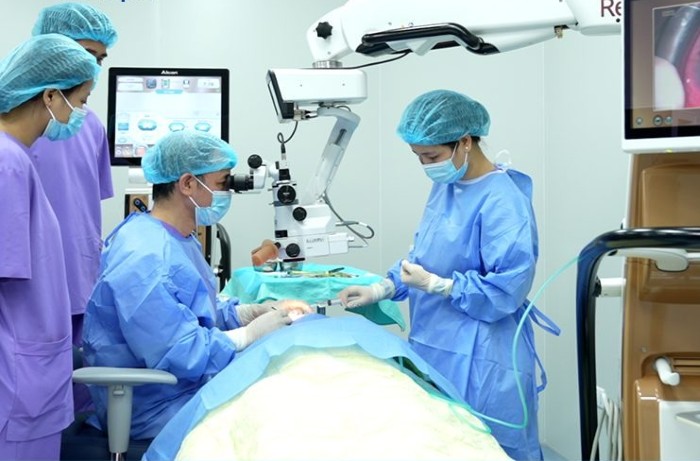 |
| The doctors in the surgery performed a cataract replacement on the patient. |
According to the patient, his eyesight temporarily deteriorated due to work stress and insufficient rest. He tried to get more rest and used eye drops daily.
After about 3 months, Mr. Hoa's glare condition did not improve and even worsened, so he decided to seek treatment at Tam Anh High-Tech Eye Center.
Associate Professor Dr. Nguyen Xuan Hiep, Director of Tam Anh High-Tech Eye Center and Vice President and General Secretary of the Vietnam Ophthalmological Society, said that the results of a thorough eye examination showed that Mr. Hoa's left eye had posterior subcapsular cataract and central cataract.
The previous eye exam did not detect any vision loss because the patient was in the early stages of the disease, and vision was not yet significantly affected. The eye exam was conducted in a dimly lit room, causing the pupils to dilate, allowing the eye to still see normally.
When exposed to bright light, the pupils constrict, limiting the amount of light reaching the retina, making the patient more sensitive to light and prone to glare.
Therefore, when patients come for an eye exam, the doctor must ask very detailed questions about even the smallest symptoms to detect any problems. In addition, in some cases, visual acuity testing is needed in both bright outdoor light and in the dark to get the most accurate visual assessment.
To accurately assess the condition, the doctor will use pupil-dilating drops and perform an eye examination using a biomicroscope to determine the morphology and extent of the cataract. Cataracts cannot be completely cured; treatment can only slow the progression of the disease.
For early-stage cataracts, as a temporary solution, patients can wear dark glasses in sunny weather; however, if their vision is poor at night, they should limit activities requiring good eyesight, such as driving.
In the long term, when the disease progresses to a later stage, especially for patients whose occupation requires them to work outdoors frequently and need good vision in all lighting conditions, surgery is the most effective and thorough treatment.
Associate Professor Hiep explained that cataracts, also known as lens opacity, are a condition where the lens becomes cloudy and loses its transparency, much like a foggy mirror where light has difficulty passing through and focusing on the retina.



In its early stages, the disease may have subtle and difficult-to-recognize symptoms. In advanced stages, it can cause vision loss, blurred vision, and even blindness.
Age-related cataracts are the most common, usually occurring in patients over 50 years old. However, many young people also develop cataracts due to causes such as eye trauma, uveitis, diabetes, congenital metabolic disorders, chronic hypocalcemia, corticosteroid abuse, or the use of multiple medications to treat metabolic diseases such as lupus erythematosus, arthritis, and gout.
People who are frequently exposed to strong light sources such as car headlights shining directly into their eyes are also at risk of developing cataracts early.
Globally, cataracts are the leading cause of blindness and the second leading cause of vision impairment, affecting people of all ages and ethnicities.
Of the 2.2 billion people worldwide with vision impairment, 1 billion suffer from preventable vision loss. Of that 1 billion with preventable vision loss, 94 million have cataracts.
There are many types of cataracts, located in areas such as the nucleus, cortex, posterior capsule, or congenital cataracts… Age-related cataracts are usually nuclear cataracts.
Meanwhile, in young people, it is often cortical or posterior capsule opacification with symptoms such as glare, difficulty seeing at night, halos, blurred vision, seeing objects in yellowish-brown colors, double vision, triple vision, etc.
In the early stages of cataracts, young people often don't notice obvious symptoms; in many cases, visual acuity measurements taken in dimly lit rooms still show 8/10, 9/10, or 10/10. However, when a doctor asks in-depth questions about symptoms and performs a thorough eye examination, they can determine the stage of cataract progression.
Associate Professor Hiep also advised patients with eye problems to seek examination at large hospitals with reputable ophthalmology departments.
Highly qualified and experienced doctors can detect eye diseases early and accurately, thereby advising on the most appropriate treatment, whether conservative treatment or necessary surgical intervention.
Everyone should wear sunglasses that protect their eyes from UV rays, maintain a healthy lifestyle, and have a diet that includes foods rich in lutein, zeaxanthin, omega-3 fatty acids, and vitamin C.
In addition, patients should not self-medicate without a doctor's prescription because the misuse of corticosteroid-containing drugs is one of the causes of cataracts, especially in young people.
According to Associate Professor Hiep, from the age of 36, people should have annual check-ups to measure intraocular pressure and screen for glaucoma risk. After the age of 40, annual eye screenings are recommended to screen for cataracts, glaucoma, and diabetic retinopathy.



Cataracts are known to be the most common eye disease in the elderly and the leading cause of blindness worldwide. The causes of cataracts can be congenital or age-related – cataracts begin to appear after the age of 50.
In addition, people with diabetes, high blood pressure, those who are frequently exposed to sunlight, and those working as welders are also at increased risk of developing cataracts earlier.
A dangerous trend is the increasing occurrence of cataracts in young people, especially those who self-medicate with corticosteroid-containing drugs to treat conjunctivitis or itchy eyes, which can cause early cataract formation.
In reality, ophthalmologists are concerned that many patients, especially in rural areas, do not seek medical attention because they only experience mild itching and instead self-medicate with corticosteroid eye drops for extended periods. This practice leads to cataracts.
Common symptoms of cataracts include blurred vision, double vision, and glare. These symptoms are most noticeable when the patient is outdoors in sunlight or at night when headlights shine directly on them, creating a hazy, cloudy feeling in their vision.
Currently, there is no cure for cataracts; treatments only slow their progression. For patients who do not yet require a lens replacement, there are two treatment options: monitoring and medication. However, the most effective solution is surgery at the appropriate time.
Source: https://baodautu.vn/thi-luc-1010-van-bi-duc-thuy-tinh-the-d219421.html





![[Image] National conference summarizing one year of operation of the overall organizational model of the political system, the three-tiered government model.](https://vphoto.vietnam.vn/thumb/1200x675/vietnam/resource/IMAGE/2026/07/01/1782882811691_ndo_br_1-jpg.webp)