


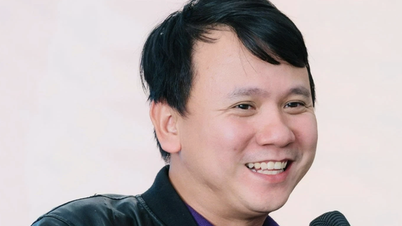
When mentioning the poet Nguyen Huu Quy, people often remember his poem "Aspiration for Truong Son". This famous poem can be considered the pinnacle of his creative work, having won the B prize (there was no A prize) in a poetry competition organized by the Military Arts and Literature Magazine.
But in addition to writing about revolutionary war and soldiers, Nguyen Huu Quy also has many other poems worth reading and remembering.
In the poem "Written from the Ancient Citadel," inspired by the sacred land of Quang Tri , the poet writes: "Night mingles with day, day mingles with night, blood mixes with blood in every handful of earth. Streams of blood flow through shattered fragments - spring grass sprouts like breasts in puberty?"
Grass is a buried dream, a song the heart has yet to sing, a longing I haven't had time to express, desires that haven't yet blossomed. Grass is you, the woman I haven't seen for a thousand nights, I long to kiss your fragrant hair, I yearn to touch the soft, delicate curves of your waist that I dream of...
In this poem, the tender grass of the ancient citadel, as described by musician Tan Huyen, has become embodied and transformed into "he" and "she," into the poignant dialogue of a couple's love. And the dream of their love could have come true if it weren't for the war. That cruel assumption, which no one with a conscience would wish for, has come true. Everything has changed unexpectedly: "Oh, tender grass of the ancient citadel - the green heartbeat under the fragile crescent moon soothes so many aching wounds. The last blade of grass gives him its breath, transferring the soul of the homeland into the journey of the night."
Blood gives birth to a river beneath the grass, the first cries of life echoing through every village. A sleepless night, a lonely night, a night of utter darkness, a night of raging currents, banks collapsing, when finally, a drop of blood bursts forth, returning home…”
The stanza, and the entire poem, is like a self-reflection of grass, but here it is the grass of the ancient citadel, the sacred grass of the sacred realm, evoking sorrow over the unspeakable sacrifices and losses of love forever left unfulfilled by the war of national defense. The dead cannot return; they can only use the grass to send their souls back with the waiting lamp, like a "drop of blood returning home."
The rustling grass at the foot of Quang Tri Ancient Citadel stands as a memorial to the heroic spirits who fell for the Vietnamese nation, a memory etched in every step of the people's hearts throughout the long years.
“The red river flows back to its mother source, reflecting the sunset over the countless reeds. The crescent moon sways the hammock, the purple flowers and grasses rock, the sound of children's cries. The sound of children crying, oh my God, the sound of children? Please, just once, let me cry with them… oh…”
"The moon forgets its crescent. The grass forgets its bitterness. Connecting two deep realms together..."
The poem "Poem from Truong Sa" was composed by poet Nguyen Huu Quy in the spirit of peacetime:
“Salt on the skin is the sea / Salt on the hair is the sky / Island soldiers can't stay fair-skinned / Love? Or not... my dear? / Islands, islands grow in clusters / Soldiers are flowers for the sea / The spring in Truong Sa is young / Like privates and corporals.”
It's quite unusual to describe the harsh climate of Truong Sa, the most remote and challenging of Vietnam's archipelago. The adjective "salty" already conveys the hardship and toil of the naval soldiers even in peacetime. Nevertheless, the spring in Truong Sa remains youthful, as the poet aptly puts it: "Like a private or corporal."
“Waves, waves crashing on all sides / Islands sinking and islands rising / If we love each other, then let's ride the waves and find each other! / Even at the ends of the earth / Our love for the homeland remains strong / The sweet folk song / Gently lulls the rocks / Where clouds and water meet / Island villages nestled on the wave peaks / Just a single slanted stroke of a letter / Can stir so much emotion!”
These short poems, with their carefully selected images and details, allow the reader to fully grasp the emotions of those at the forefront of the waves. The open sea is not only full of hardship and danger, but also overflowing with countless emotions, and it is thanks to these emotions that the soldiers stand firm, guarding the sea and sky. And spring has begun from the distant islands far out in the ocean.
“Born at the forefront of the wind / The storm flower awaits you / White petals like memories / I send them in January...”
It can be said that poetry and soldiers, soldiers and poetry, have been vividly portrayed through the authentic and moving works, full of emotion, of military poet Nguyen Huu Quy.
Source: https://baodaklak.vn/van-hoa-du-lich-van-hoc-nghe-thuat/van-hoc-nghe-thuat/202512/tho-cua-mot-nguoi-linh-5320633/




















































Comment (0)