Modern people doing traditional jobs: Carpenters from the provinces 'enter the royal court'.
Báo Thanh niên•22/11/2023
To restore the dilapidated Nguyen Dynasty imperial palace to its original state, hundreds of artisans from various fields are needed. Therefore, tasks from the past are now being undertaken by people of the present. Along with other traditional crafts, people today are preserving the ancient beauty of Hue …
For nearly two years, in order to restore the Thai Hoa Palace in the Hue Imperial Citadel, dozens of artisans from many traditional craft villages have been recruited to "join the palace" to do the work that their ancestors did hundreds of years ago...
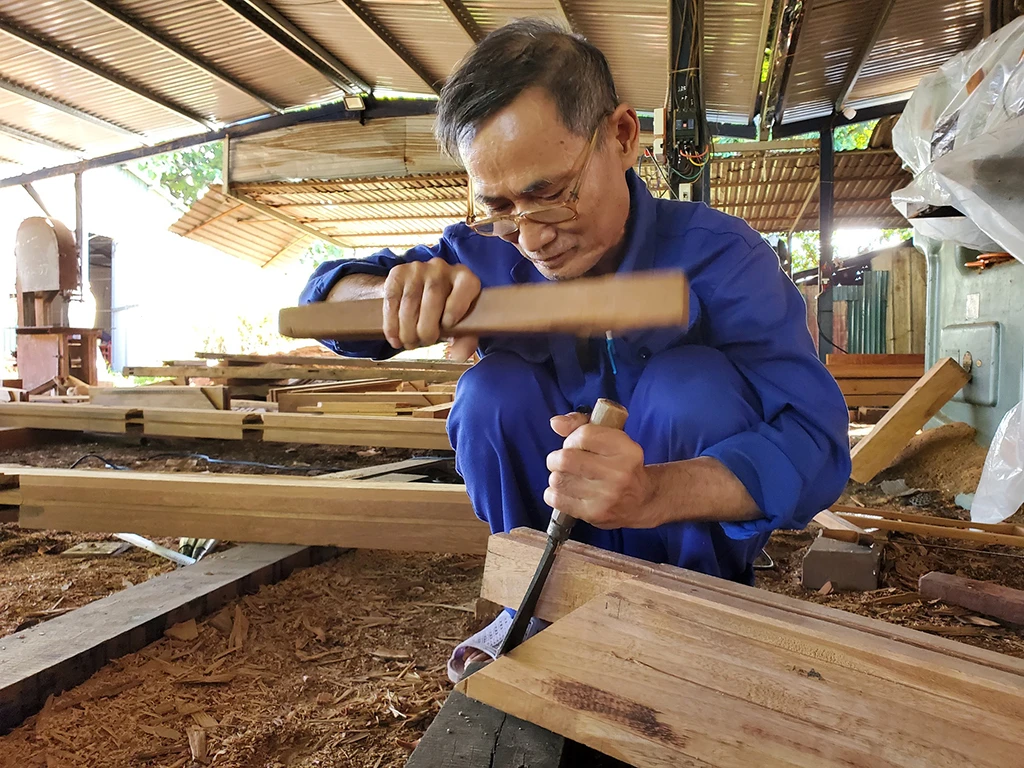
Artisan Dinh Van Chien (71 years old, residing in Duc Ly commune, Ly Nhan district, Ha Nam province) is completing new lim wood components to replace the old ones.
The restoration project of Thai Hoa Palace commenced on November 23, 2021. For nearly two years, on the right side of the restoration site, in the row of workshops, dozens of artisans have been diligently working on tasks that their ancestors performed hundreds of years ago. For the woodworking part alone, a team of skilled craftsmen from the traditional Duc Ly woodworking village in Ha Nam province has joined the project.
"PRESSURE" BEFORE SYMBOLS OF POWER
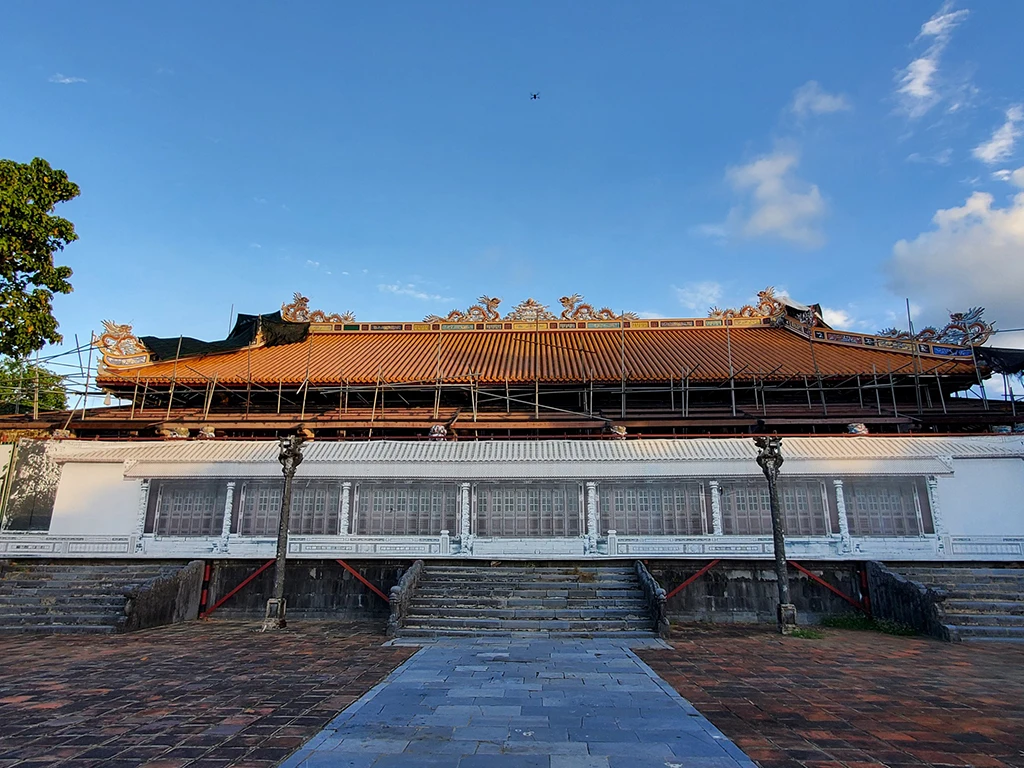
The Thai Hoa Palace, a symbol of the Nguyen Dynasty's power, has existed for over 200 years and is a representative architectural work of the ancient capital of Hue that has been preserved intact to this day. It was the place where the royal court held ceremonies such as coronations, birthday celebrations (the emperor's birthday), celebrations of the emperor's 40th or 50th birthdays, national holidays, etc., and diplomatic ceremonies were conducted.
After nearly two years of restoration, the Thai Hoa Palace is gradually nearing completion.
The restoration work was carried out with exceptional care, naturally creating immense pressure on the construction teams. This is because it is not only an architectural structure but also a repository of textual and artistic documents, including the literary works and paintings inscribed on the monument, which have been recognized by UNESCO as a Documentary Heritage site under the Memory of the World Programme for the Asia-Pacific region. The Thai Hoa Palace features a "double-tiered roof" architectural style common during the Nguyen Dynasty, consisting of a front hall and a main hall connected, covering an area of 1,440 m² , with a seven-bay, two-wing facade. The structural frame is made of wood and brick. The entire structure has 80 large lim wood columns, all painted with dragons playing in the clouds, brightly gilded and lacquered, and the roof is covered with yellow glazed tiles... The truss system of the front hall is constructed in a "stacked beam - false support" style, supporting the entire tiled roof and adding to its aesthetic value. The entire interior of the palace is painted in red and gold... The highlight of the Thai Hoa Palace is the image of the dragon - the symbol of the monarch and the main theme of the palace, appearing in many places (dragons on the roof, steps, columns, or carved on wooden components, the throne)... It can be said that the Thai Hoa Palace is where dragons fly, the pinnacle of Hue's imperial architectural art. On the roof are 9 dragons sculpted in relief and inlaid with ceramic tiles. The 80 large ironwood columns are also all painted with dragons playing in the clouds.
NEARLY 1,000 M3 OF LIM WOOD, BUT NO SCREWS USED
For the carpentry work specifically, the team of carpenters selected to join the team is from Ly Nhan district, Ha Nam province. Artisan Le Van Nhuong (54 years old, from Duc Ly commune, Ly Nhan district), who heads the carpentry team, said that nearly 50 artisans in the team have been involved in the restoration of Hue's historical relics for decades. Previously, the team restored the Gia Long and Dong Khanh tombs.
The old wooden components are disassembled for sorting, assessment, and reassembly, restoration, or replacement if too damaged.
Regarding the restoration of the Thai Hoa Palace, according to artisan Le Van Nhuong, in addition to the amount of wood deemed to be in good condition and reusable, the project had to add nearly 1,000 cubic meters of ironwood imported from South Africa. "The distinctive feature of wood carving art at the Thai Hoa Palace in particular, and Nguyen Dynasty palace architecture in general, is not the display of grandeur and ornateness, but the extremely delicate and harmonious details create a noble and classy atmosphere befitting the palace. Today, many newly built wooden houses are very large in scale and intricately carved, but apart from their opulent appearance, they cannot compare to the exquisite details of palace architecture," commented artisan Le Van Nhuong.
The artisans are carving the cornices on the roof eaves of the Thai Hoa Palace.
Having been present at the construction site for the past two years, craftsman Dinh Van Chien (71 years old, from Duc Ly commune) shared that carpentry is a traditional family craft passed down through many generations. He was a volunteer soldier in the Cambodian battlefield. After leaving the army, he returned to continue his carpentry career. Nearly 50 years dedicated to the craft, his saw strokes and chisel strokes have become incredibly skillful. Because the lines of wooden architectural art reach such a refined and high level, it requires not only high skill but also strict adherence to the principles of preservation. "The craftsman cannot freely create according to his own ideas, but must adhere to the original lines and models. Therefore, even if the wooden components are rotten or damaged, they must be measured and redrawn using tracing paper. The project uses thousands of cubic meters of wood, but all are connected using a system of wooden mortise and tenon joints, without using any metal nails, screws, or bolts," said craftsman Dinh Van Chien. After two years of arduous work and restoration, the structural framework of the Thai Hoa Palace has now been erected securely. Every day, the craftsmen continue their tireless work. The magnificent structure of the palace is gradually being restored through the hands of 21st-century artisans. (to be continued)
The restoration project of the Thai Hoa Palace, invested by the Hue Ancient Citadel Relics Conservation Center, has a total investment of over 128 billion VND. After dismantling, the main items being restored include: foundations, tiling, Thanh stone steps, brick walls, wooden frame system, roof system, wooden partition system, doors; restoration and repair of the throne, canopy, interior furnishings... and other items. According to historical documents, after ascending the throne, King Gia Long ordered the construction of the Thai Hoa Palace in 1805 in the Dai Cung Mon area. In 1833, King Minh Mang ordered the reconstruction of the palace in its current location.





![[Photo] Prime Minister Pham Minh Chinh receives the Chinese Ambassador to Vietnam](https://vphoto.vietnam.vn/thumb/1200x675/vietnam/resource/IMAGE/2026/04/05/1775397481797_ndo_br_dsc-5512-jpg.webp)























































Comment (0)