

My homeland is there.
The first island on our Vietnam Journalists Association delegation's voyage to Truong Sa was Sinh Ton Island. Everyone was excited, having spent several days at sea without touching land, and longing for the feeling of being on the mainland.
 |
The author (second from the right) with the sisters from Sinh Ton Island. |
Our group, named Sinh Ton Island, was given priority to go first. From afar, Sinh Ton Island appeared lush and peaceful amidst the sea and sky. On the harbor, soldiers in neat uniforms lined up to welcome the group, their flowing ao dai dresses visible in the distance. Without anyone saying a word, we all exclaimed, "Wow, ao dai, ao dai!"
As women, we often wear the ao dai (traditional Vietnamese dress), and we've seen many other women in it, including young, beautiful beauty queens. But when I set foot on the island, I truly never saw the ao dai so beautiful! It's not simply traditional clothing, but rather an affirmation and embodiment of "homeland there."
Survival Island has seven families, meaning there are seven women in total. Ms. Ho My Hung, along with her husband, Mr. Pham Thuc, and their two children, who have been on the island for over a year, shared: “When we packed our belongings to leave for the island, the ao dai (traditional Vietnamese dress) was the first thing I brought. People said that on the island, surrounded by sea and sky, there would be few opportunities to wear it. I said, it represents the warmth of the mainland, a source of national pride. The more exposed we are to the waves and winds, the more the ao dai needs to fly to affirm our country's sovereignty .”
On the island, far from the mainland, life for the women slowed down. There were no cars or city smog, no Wi-Fi or Facebook; instead, they had a large family of soldiers and residents who treated each other like family. Whenever there was work to be done on the island, the women were there, without hesitation. Conversely, if residents needed help with trellises for gourds or rearranging potted plants, the soldiers wholeheartedly assisted; the bond between the military and the civilians was strong and enduring.
The island experiences harsh weather year-round. During the dry season, the sun blazes and the sea breeze is dry and scorching; during the rainy season, there are storms and strong winds. But more than just a rule, every Monday morning, the women, dressed in their traditional ao dai, join the officers and soldiers in the flag-raising ceremony on the island. Ms. Hung said: "Except for storms, even in heavy rain, the whole island still holds the flag-raising ceremony; it's held in the assembly hall. Otherwise, every Monday morning, without anyone telling us to, we all stand in neat and solemn formation to salute the flag."
 |
Ao Dai (Vietnamese traditional dress) on Truong Sa Island. |
Ms. Tran Thi Thu Huyen, a neighbor, added: "On the island, on a beautiful day, we women tell each other to wear traditional Vietnamese dresses to take our children to school, go to the temple to light incense, stand under the shade of the sea almond trees, in front of the coral reefs, letting the sea breeze blow in, to feel closer to the mainland, to see the image of our homeland."
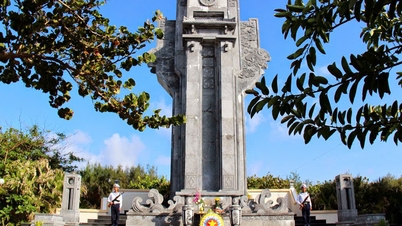
On Truong Sa Island, the flag-raising ceremony and troop review always evoke strong emotions and create unforgettable memories for delegations from the mainland. The vibrant red national flag and the national anthem, deeply ingrained in the hearts of every Vietnamese citizen, make the flag-raising ceremony amidst the waves of Truong Sa feel incredibly special. Before the sovereignty marker, interspersed among the soldiers' uniforms and solemn ranks are the flowing ao dai dresses of the island's residents and delegation members. It's an emotion difficult to describe in words—sacred and truly proud!
Journalist Phong Diep from Nhan Dan Newspaper, on her second visit to Truong Sa, shared: “Although my time on the island is short, I always wear an ao dai (traditional Vietnamese dress) to stroll around Truong Sa, visit temples, and feel the homeland in my heart. For me, this is a journey of the soul, to feel sacred things in a simple way.”
"This Tet holiday, we will wear the ao dai (traditional Vietnamese dress) that you sent us."
Da Tay A Island has a larger population, with 16 households, so the village atmosphere on the island was quite impressive to us. The houses of the residents are built close together, with trellises of gourds and loofahs in front of the gates, potted plants, and stone tables and chairs; everything is very peaceful.
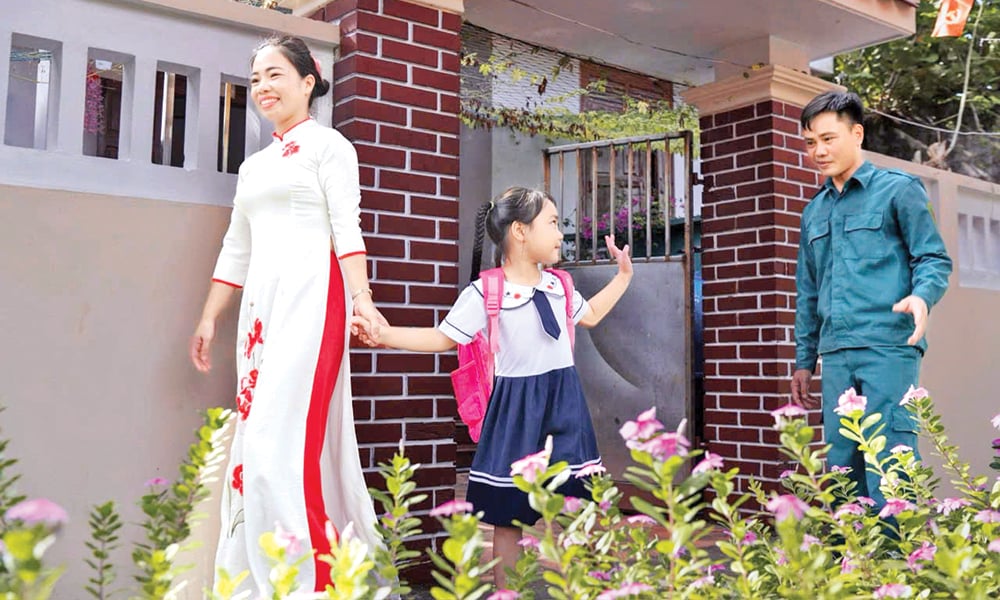 |
Women wearing traditional Vietnamese dresses take their children to school on Da Tay A Island. |
After a sweaty journey across the island, receiving a refreshing glass of herbal tea from Ms. Vo Thi Anh Chau, the head of household number 10, made the heat seem to subside. Chau, quite young, around 30 years old, recounted: "Coming to the island makes you miss home, the mainland, and your loved ones. But after staying here for a while, you get used to it. When you're on leave and return to the mainland, you miss the island, the sound of the temple bells echoing in the waves, the innocent laughter of children playing; you miss the soldiers who shared joys and sorrows with you…"
We complimented Chau on her beautiful, cool, and refreshing blue ao dai (traditional Vietnamese dress) in the summer sun, peaceful amidst the crashing waves. She said that here, the sea breeze dries clothes quickly but also causes them to fade and wear out quickly. She and her sisters wear them sparingly, only bringing them out to wear when there are honored guests, and only daring to wear them on the 15th day of the lunar month for temple visits, cultural performances, or community activities.
One thing that impressed us on the islands we visited was the sight of the young citizens of the sea. On Truong Sa Island, there's Pham Le Khanh Ngan, the youngest child of Mr. and Mrs. San and Tram, only 7 months old. On Sinh Ton Island, there's Le Thanh Tu, the child of Mr. and Mrs. Tuan and Ngoc, who has just learned to crawl. On Da Tay A Island, the youngest citizen is learning to walk, pretty, adorable, and quite comfortable in the sun, wind, and strangers. The mothers said that when their children were three months old and stronger, they crossed the waves from the mainland to the islands. And what's special is that in their luggage, the mothers all prepared traditional ao dai dresses for their children, in various sizes and colors, to wear on many occasions until they return to the mainland.
As I mentioned, I've seen the ao dai (Vietnamese traditional dress) fluttering in the harbor of Sinh Ton Island, amidst the vast, verdant expanse of the island. I've seen the ao dai fluttering in front of the sovereignty marker on Truong Sa Island, amidst the boundless sea and sky, with flocks of pigeons soaring. I've seen the ao dai gracefully flowing on Da Tay Island, amidst the tranquil sound of temple bells. What could be more beautiful, more sacred, more moving, and more inspiring than that!
And one more thing, when visiting the houses on the island, I saw pretty little ao dai dresses proudly displayed by the women and mothers, waiting for their little citizens to grow up, to wear them when they can walk and talk, to continue and leave their mark of the ao dai in Truong Sa.
“This Tet, we will wear the ao dai (traditional Vietnamese dress) you sent!” That was the message from Dang Thi Bau, a resident of Da Tay A Island, when we sent 16 sets of ao dai to the children on the island. As if by fate, on the way back to the mainland, it rained heavily, and the boat couldn't go any further. Bau came to see us off, her ao dai worn at the collar and with frayed seams on the sleeves. I asked if there was any way to send the ao dai to her, and Bau quickly wrote down her address on a piece of paper. I wrapped it in a raincoat and hurried back to the boat. Upon returning to the mainland, we fulfilled the children's wishes. They wanted a uniform set of ao dai for all 16 girls, tailored to each person's measurements, in pink, made of cool, wrinkle-free material, with a 3cm high collar and long sleeves; because, as Bau messaged: “It’s very hot on the island, so we need a collared dress to avoid getting tanned.”
It's heartbreaking, but the vast distance and immense difficulties made it so hard for us to send the clothes to the children in time for the Lunar New Year. It's like sending love, sharing, and warmth from the mainland to the island.
At this hour on the island, the sea breeze still blows steadily, salty and gentle. Ships carrying the flavors of Tet (Vietnamese New Year) from home are docking at the islands. I imagine Bau, Chau, and the other girls and women on the islands of Da Tay A, Truong Sa, Sinh Ton… wearing their traditional ao dai dresses to visit the temple on the morning of the first day of Tet, amidst the mild spring weather, alongside the soldiers standing guard in the vast sea and sky.
They are the spring of the sea. They are there, their homeland, their country, their beloved Fatherland, so that spring on land may forever be peaceful and joyful.
Source: https://baobacninhtv.vn/thoang-thay-ao-dai-o-truong-sa-postid439073.bbg
![[Photo] General Secretary and President To Lam presents the Politburo's Decision on personnel matters to 4 Party Committees directly under the Central Committee.](https://vphoto.vietnam.vn/thumb/1200x675/vietnam/resource/IMAGE/2026/04/13/1776077847172_a1-bnd-8005-950-jpg.webp)
![[Photo] Prime Minister Le Minh Hung and Prime Minister Robert Fico attend the Slovakia-Vietnam Business Forum](https://vphoto.vietnam.vn/thumb/1200x675/vietnam/resource/IMAGE/2026/04/13/1776075264359_ndo_br_dsc-6775-jpg.webp)
![[Photo] General Secretary and President To Lam holds telephone conversation with Chairman of the Liberal Democratic Party of Japan and Prime Minister of Japan Takaichi Sanae](https://vphoto.vietnam.vn/thumb/1200x675/vietnam/resource/IMAGE/2026/04/13/1776077840503_a1-bnd-7942-6402-jpg.webp)






















































Comment (0)