

For the first time, experts used quasars as "clocks" to measure the expansion of cosmic time and confirmed that Einstein was right.
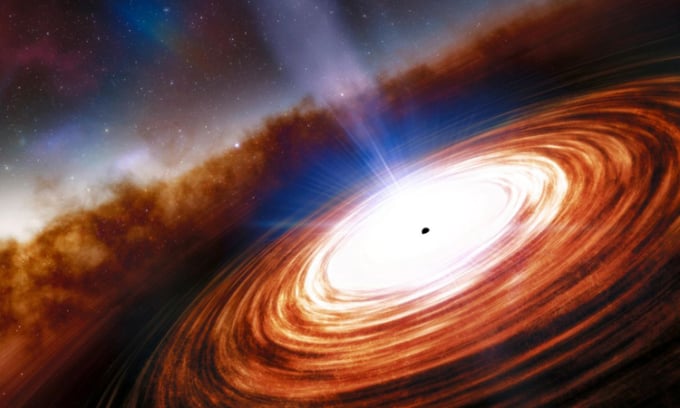
Illustration of a quasar, considered the brightest object in the universe. Image: NOIRLab/NSF/AURA/J. Da Silva
Scientists say that time in the early universe appeared to have slowed down by five times compared to today, AFP reported on July 3. This is the first time they have used quasars as a "clock" to confirm this strange phenomenon.
Einstein's theory of relativity predicts that, because the universe is expanding, we will perceive distant space as moving slowly, according to Geraint Lewis, an astrophysicist at the University of Sydney and lead author of a new study published in the journal Nature Astronomy.
The universe is considered to be about 13.8 billion years old. Researchers have previously used observations of supernovae—super-bright star explosions—as a "cosmic clock" to demonstrate that time slowed down twice as much when the universe was half its current age.
New research uses quasars, even brighter than supernovae, to gain deeper insight into the history of the universe. According to the study, more than a billion years after the Big Bang – the explosion that gave birth to the universe – time appears to have flowed only about one-fifth as fast as it does now. This phenomenon is known as cosmic time dilation.
To measure the dilation of cosmic time, Lewis and statistician Brendon Brewer at the University of Auckland analyzed data from 190 quasars, collected over two decades. Quasars form when a supermassive black hole at the center of distant galaxies "devours" surrounding matter and emits extremely intense radiation. They are considered the brightest and most powerful objects in the universe. This makes them useful "beacons" for charting the universe, according to Lewis.
However, turning quasars into "cosmic clocks" is far more difficult than turning them into supernovae. Lewis notes that many previous attempts to use quasars to measure time dilation have failed, leading to some strange conclusions. The new research puts things back in the right place and confirms that Einstein was right.
According to Lewis, their success stemmed from having more data on quasars. Recent advances in statistical knowledge of randomness also proved helpful.
To turn quasars into measurable timekeeping devices, the research team had to understand the chaotic explosions that occur when black holes devour matter. Lewis compared them to a fireworks display, where the flashes of light appear random, but in reality, different elements are brightening and dimming according to their own time scales. "We've elucidated this fireworks display, showing that quasars could also be used as standard time markers for the early universe," Lewis said.
Thu Thao (According to AFP )
Source link

![[Image] National Assembly discusses the implementation of the socio-economic development plan.](https://vphoto.vietnam.vn/thumb/1200x675/vietnam/resource/IMAGE/2026/04/20/1776696707422_ndo_br_img-20260420-185419-jpg.webp)

![[Photo] General Secretary and President To Lam meets with National Assembly delegates from ethnic minorities.](https://vphoto.vietnam.vn/thumb/1200x675/vietnam/resource/IMAGE/2026/04/20/1776696701056_a1-bnd-8331-3342-jpg.webp)

































































































Comment (0)