

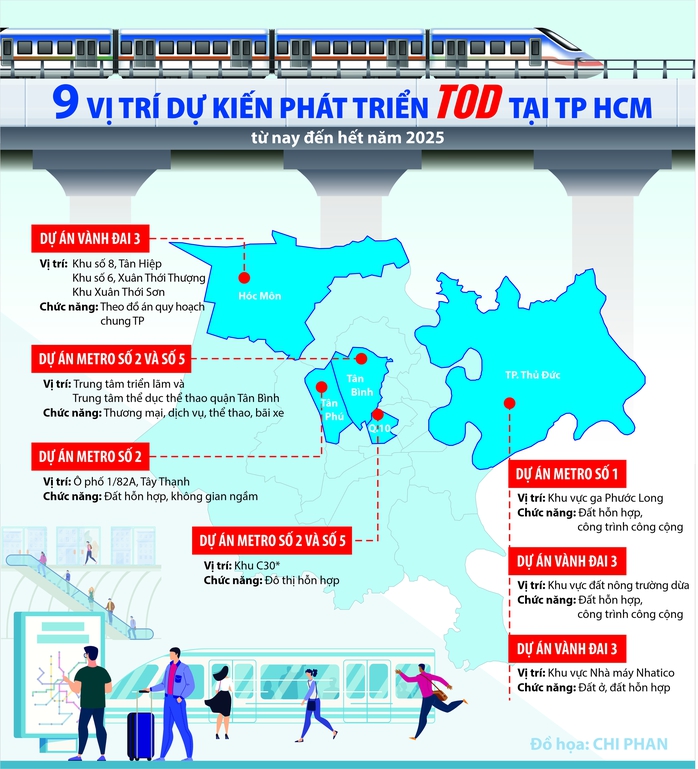
The Ho Chi Minh City People's Committee has just issued a decision on the plan to develop 11 compact urban areas based on the TOD (Transit-Oriented Development) model along metro lines and Ring Road 3, in accordance with Resolution 98/2023/QH15. Accordingly, in the 2024-2025 period, TOD development is expected to be implemented in 9 locations along 3 major ongoing transportation projects: Metro Line 1 (Ben Thanh - Suoi Tien), Metro Line 2 (Ben Thanh - Tham Luong), and Ring Road 3.
Enhancing the role of the City's Land Development Center
The largest TOD (Transit-Oriented Development) site covers over 389 hectares in Xuan Thoi Thuong commune (Hoc Mon district), connecting to Ring Road 3. The smallest site is the Tan Binh District Exhibition Center and Sports Center (5.1 hectares). This location is planned for TOD development to connect with metro lines 2 and 5. The surrounding area already has existing residential areas, schools, and a bustling market.
The remaining locations are in District 10, Tan Phu District, Thu Duc City, and Binh Chanh District; connecting to metro lines 1, 2, and 3 and Ring Road 3.
Supporting the Ho Chi Minh City government's plan to develop 11 compact urban areas along key transportation routes, Dr. Pham Viet Thuan, Director of the Institute of Resource and Environmental Economics in Ho Chi Minh City, stated that the TOD (Transit-Oriented Development) model is widely implemented in modern cities around the world, especially in China, Thailand, and Singapore. This model will help to effectively utilize and develop land suitable for urban redevelopment, creating compact urban areas and smart city clusters.
Based on planning and the current state of land areas, Ho Chi Minh City has two approaches when building TOD (Transit-Oriented Development) model cities. Firstly, the group focusing on renovating and upgrading existing areas: primarily in existing residential areas adjacent to ring roads or metro lines. Secondly, the group focusing on new investments: built on existing areas that are vacant land, sparsely populated, or where factories and enterprises are planned to relocate…
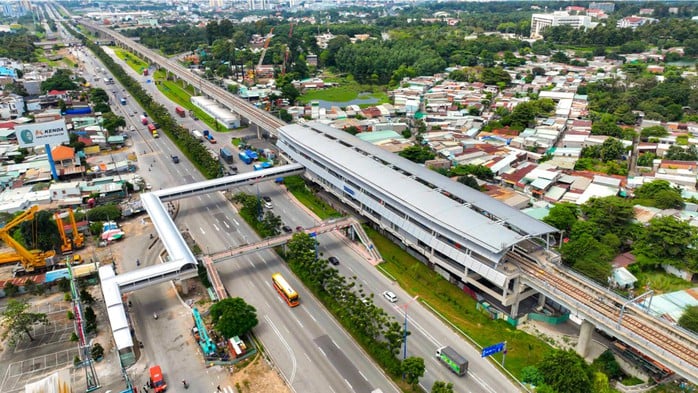
If the land along Metro Line 1 is utilized effectively, it will help create smart urban clusters in Ho Chi Minh City. (Photo: HOANG TRIEU)
Dr. Thuan suggested that the core area of the station (within a radius of 400-500 m) should focus on optimal high-density urban development. Meanwhile, the transitional area around the station (within a radius of 500-1,000 m) should also focus on high-density urban development. Regarding Ring Road 3 specifically, urban development should be concentrated in the areas adjacent to the interchanges, connecting roads to Ring Road 3, or branch lines.
To facilitate implementation, according to Dr. Thuan, Ho Chi Minh City should publish the planning boundaries of TOD (Transit-Oriented Development) sites to inform the public and develop reasonable land acquisition plans for models that meet the approved plans.
"The workload for land compensation and acquisition for TOD (Transit-Oriented Development) urban development is enormous. Based on the 2024 Land Law, to reduce the burden on the state management agency, the Department of Natural Resources and Environment, Ho Chi Minh City needs to enhance the role of the City's Land Development Center to serve the TOD plan. If the plan is implemented well and in the right direction, it will help Ho Chi Minh City create truly smart urban areas, or in other words, smart urban clusters with the most convenient transportation connections in Vietnam," Dr. Thuan commented.
Good planning attracts investors.
To unlock resources for TOD (Transit-Oriented Development), Dr. Pham Tran Hai from the Ho Chi Minh City Institute for Development Research addressed the issue of spatial organization, specifically the readjustment of land within TOD areas. Accordingly, the space around metro stations should be reorganized, and residents should be encouraged to contribute land to TOD projects as capital contributors. Depending on the area and location of the land contributed, compensation will be calculated and provided to residents in the form of land or building space. "This model is encouraged by international organizations, especially in countries facing difficulties in land acquisition," Dr. Hai stated.
Regarding policy, Dr. Hai suggested regulating the added value from land, including improvement fees (applied to existing properties in TOD areas), impact fees (for projects in TOD areas), and the transfer of spatial development rights (for land within TOD areas). To achieve this, it is necessary to improve the legal framework of these policies, specifically by readjusting land regulations in Article 219 of the 2024 Land Law regarding land use rights contribution and land adjustment; or regulations on selling spatial development rights due to increased floor area.
At a meeting between the Ho Chi Minh City Department of Transport and local authorities regarding the implementation of the TOD (Transit-Oriented Development) project in 2023, a representative from the Nha Be District People's Committee shared their experience in land acquisition and auctioning on Nguyen Huu Tho Street. While not a TOD project, Nguyen Huu Tho Street exhibits characteristics similar to one where the government allocates budget for road construction, then acquires land along the route for auction and reinvestment in transportation infrastructure. Therefore, according to the Nha Be District representative, to effectively implement TOD for metro lines 1 and 2 and Ring Road 3, planning authorities should be flexible and oriented towards general criteria, avoiding excessive detail to facilitate land auctions and attract investors without restricting their ideas.
"In the planning process, we only need to provide specific targets for green spaces, commercial areas, roads, etc. Based on this, investors can come up with their own ideas and designs for construction, which will be more effective than the state implementing it," added the representative from Nha Be district.
Some localities with Metro Line 2 passing through them, such as Tan Binh District, shared their experience that when inviting investors through bidding and auctions, they often request adjustments to increase planning targets. Therefore, when implementing the plan, targets should be raised to the maximum level, along with many attractive conditions to attract investors.
11 TOD model cities
According to the plan, from 2026 to 2028, Ho Chi Minh City will continue to implement two TOD (Transit-Oriented Development) areas in Tan Hiep commune (Hoc Mon district) along Ring Road 3 and the area around Tan Kien station (Binh Chanh district), connecting to the extended Metro Line 3 and the Ho Chi Minh City - Can Tho railway line.
With 9 TOD urban areas in phase 1, the boundaries, planning, and legal status of the land will be determined in the second and third quarters of 2025. Subsequently, the planning will be adjusted in the second and fourth quarters of 2025, and the investor selection process will be completed in early 2026.
Source: https://nld.com.vn/thu-hut-dau-tu-xay-dung-do-thi-tod-196241108210443765.htm

![[Photo] Conference announcing the Politburo's Decision on organizational and personnel matters](https://vphoto.vietnam.vn/thumb/1200x675/vietnam/resource/IMAGE/2026/04/01/1775017881825_bnd-2410-1472-jpg.webp)
![[Photo] Conference on the transfer and reception of Party organizations and Party members between the Party Committee of the Government and the Party Committees of the Central Party Agencies](https://vphoto.vietnam.vn/thumb/1200x675/vietnam/resource/IMAGE/2026/04/01/1775036784472_ndo_br_bnd-2620-jpg.webp)





















































































Comment (0)