

When I was a child, every time the summer sun began to shine, the country roads would be bustling with trucks loaded with fresh sugarcane. The heavily laden trucks moved slowly, and occasionally a few loosely tied sugarcane stalks would fall out from the back. The children would wait until the trucks were out of sight before cautiously picking them up.
The fresh sugarcane felt firm in my hand, its stalk still covered in a layer of white powder. The older children squatted by the roadside, picking through the sugarcane. The younger ones took it home for their grandmothers and mothers to cut into pieces with knives. I also ran along, gathering a few plump stalks to place on the porch, eagerly waiting for Grandma to come home and make a sweet treat that would warm my stomach: sugarcane syrup.
Back when fast food was a luxury, molasses became a favorite snack to enjoy during leisure time.
My grandmother would cut off the tops and stems of the plants she gathered, saving them for eating separately, while the roots and stems would be taken to a pushcart with a juicer near the market. She said the roots contained more sugar, and when pressed, they would have a beautiful bright yellow color and a sweet, refreshing taste. The tops, on the other hand, had less sugar, resulting in less sweetness and a tendency to turn yellowish-green.
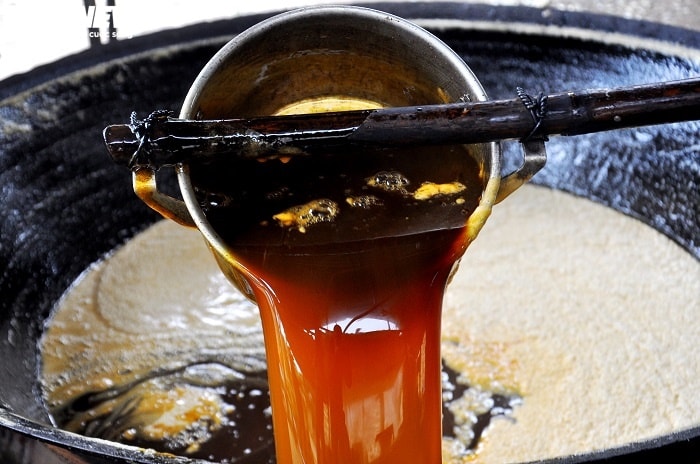
The freshly squeezed sugarcane juice was simmered by my grandmother in a cast-iron pot for about 10 hours over a low, glowing charcoal fire. She stirred it with a large spoon, placed a stool beside the stove, and continuously skimmed off the foam to keep the syrup clear, while telling stories from her time in the youth volunteer corps during the resistance war.
I leaned against my grandmother's shoulder, watching her gnarled, age-spotted hands swiftly stir the molasses. The pan of molasses bubbled and frothed, and my stomach rumbled with longing. The aroma of molasses filled the air, its sweetness infused with the gentle sunlight on the porch, filling my nostrils with its intoxicating scent.
After distillation, my grandmother uses a thin cloth to strain the syrup, removing any impurities. She then pours the finished product into glass jars for later consumption. The syrup has a golden yellow color and a distinctive, subtly sweet taste, similar to honey.
We often spread molasses on grilled rice crackers to eat as a snack while waiting for rice or as an accompaniment on days when other dishes are unavailable.
Sugarcane molasses is used to make sweet soups instead of sugar; it's refreshing and not overly sweet, making even those who don't like sweets, like my father, nod in approval. Because sugarcane molasses is high in sugar, it helps reduce hunger.
In the days when just two mashed hard-boiled eggs in a bowl of fish sauce were enough for a meal for the whole family, homemade molasses became a miraculous hunger-relief treat.
It's not just a childhood treat, but also a timekeeping device etched in our memories. Whenever we see Grandma's homemade sugarcane syrup, we know summer is coming. Summer of holidays, of exams. Summer of farewells and loss.
Even though I wasn't old enough, I always tried to act mature, and packaged snacks gradually replaced homemade sugarcane syrup. I no longer craved sweets, nor did I hop behind trucks picking sugarcane in the scorching midday sun.
It wasn't until I was old enough to long for childhood again, after experiencing the bitterness of life, that I truly appreciated the sweet flavors of my grandmother's cooking from the past.
Perhaps, as many have said, the nature of dreamers is to always be nostalgic for the old days. I keep longing to return to my childhood, yearning for the sweet, delicate taste of my grandmother's homemade molasses, a longing that fills me with restlessness.
Source: https://baodanang.vn/thuong-sao-mat-mia-que-nha-3265587.html



































































































Comment (0)