Planting large timber forests is a global trend and a crucial solution for developing a sustainable forestry economy . However, the development of large timber forests in many localities within the province still faces numerous difficulties, requiring comprehensive support mechanisms and policies, from funding to scientific and technical assistance for intensive forest management, for forest owners.
Can Khe commune (Nhu Thanh district) has over 2,000 hectares of production forest land, but currently only about 6 hectares are planted according to the large timber forest model. According to Mr. Nguyen Quang Hung, Chairman of the Commune People's Committee, although planting large timber forests brings many benefits and initially attracted many households to register when the " Development of large timber plantations and restoration of green lim forest in Nhu Thanh district, 2016-2021, with orientation to 2030" project was first implemented, many households lost interest and withdrew after a period of participation. The reason is that the planting cycle for large timber forests is long, only suitable for state-owned forest owners, forestry companies, or households with strong financial resources and large areas of forest land.
Meanwhile, the area of planted forests in Can Khe commune is fragmented and small, averaging from 0.5 to 3 hectares per household. Most households with forest land for production are those with difficult economic conditions, making it hard for them to maintain large-timber plantations for many years. In addition, people also face difficulties in meeting the criteria to benefit from support policies as stipulated. The case of Ms. Vi Thi Huyen's family, one of the acacia plantation households in Dong village, is an example. Difficult economic conditions and pressure on income and daily living expenses prevent her family from switching from small-timber to large-timber plantations. There were even times when the family had to harvest young acacia trees to sell to traders to make ends meet.

Thanh Hoa commune (Nhu Xuan district) faces a similar situation. The entire commune has 360 hectares of planted forest, with 291 households owning forest land, but none are participating in planting large timber trees. Mr. Luong Van Duong, Vice Chairman of the Commune People's Committee, stated: "Most of the forest land owned by households in the commune is fragmented and small. Therefore, most households choose to plant forests seasonally, with a cycle of 5 to 7 years. When harvesting timber, households sell to whichever unit offers the highest price, without forming any partnerships. For example, in 2024, when acacia prices increased significantly, many households, in order to cover their living expenses, were willing to harvest acacia after 4 to 5 years instead of waiting until 7 years."
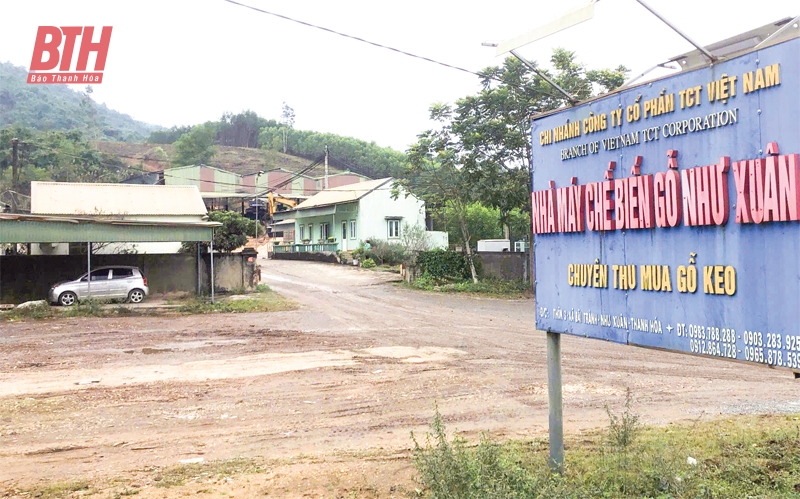
This is also one of the reasons why the development of linkages between forest growers and processing businesses in Nhu Xuan district is not yet widespread. Mr. Le Chi Lieu, manager of Nhu Xuan Wood Processing Factory, said: The factory started operating in 2012. This is the first factory operating in the field of forest product processing in Nhu Xuan district. When established, the business was structured to be linked with the local raw material area. However, in recent years, due to unhealthy competition from some spontaneous businesses, the factory's raw material area has shrunk, affecting the production and processing process. In addition, many households have a "short-sighted" mindset, selling to whichever unit offers the highest price, readily abandoning traditional buyers. This is a "barrier" preventing the linkage between people and forest product processing businesses from finding common ground. While the people worry that businesses will break their promises and not share the risks, the businesses fear that the people will not comply with the contract, selling immature acacia trees or timber elsewhere instead of selling it to the businesses.
Each year, the Nhu Xuan Wood Processing Plant needs approximately 50,000 tons of acacia wood as raw material to process into wood chips for export to markets such as Japan, Taiwan (China), and Singapore . To meet this demand, in addition to Nhu Xuan district, the plant has to import from many other places such as Thuong Xuan district and Nghia Dan district (Nghe An province).
To achieve the goal of maintaining and stably developing a large-timber forest business area of 56,000 hectares by 2025 and continuing to expand the large-timber forest model, Thanh Hoa province has directed relevant departments, agencies, and districts to implement comprehensive solutions from planning, planting, caring, harvesting, to processing. The focus is on localities promoting and encouraging forest owners to participate in planting and converting small-timber plantations to large-timber plantations, linked with obtaining FSC sustainable forest management certification. Simultaneously, emphasis is placed on forming industrial timber and large-timber raw material areas and building sustainable linkages between forest owners and processing businesses. Furthermore, funding for large-timber plantations should not be limited to the state budget but should be diversified by integrating capital from related programs and projects, as well as other legitimate sources of funding and sponsorship. It also includes mechanisms and binding sanctions for households, individuals, and forest organizations participating in large-scale timber reforestation projects; and processing enterprises participating in linkages to ensure procurement is in accordance with contracts.



Joining hands to develop large-scale timber forest planting models, the Provincial Forest Protection Department has implemented reforms in production organization, built and replicated forestry production cooperative models; and promoted sustainable linkages between forest growers and processing enterprises. At the same time, it has accelerated the issuance of forest certification, linking processing with export to meet the requirements of domestic and international markets, contributing to increasing the added value of the forestry sector. Alongside this, the Provincial Forest Protection Department continues to research and select suitable forestry tree species for each different ecological zone, with the ability to grow quickly and produce large biomass; strengthen the transfer of new technologies, create breakthrough key products in forest product processing, and develop deep processing.
Text and photos: Dinh Giang
Source: https://baothanhhoa.vn/phat-trien-rung-ben-vung-bai-2-tiem-nang-mo-nhung-con-nhieu-rao-can-234359.htm