

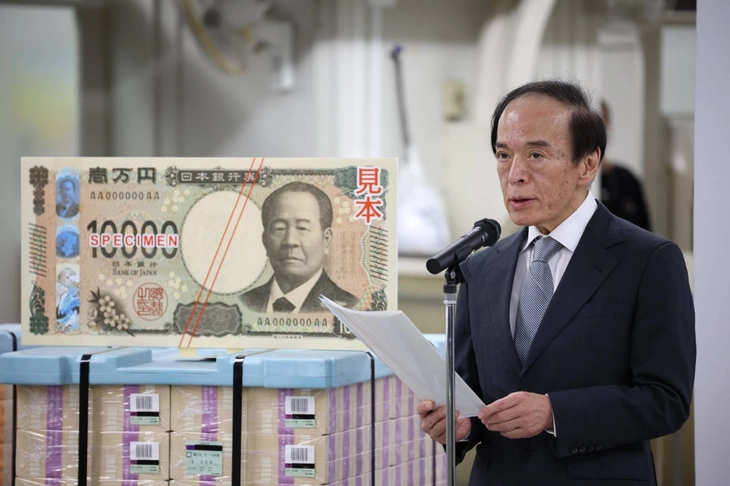
Governor of the Bank of Japan (BOJ) Kazuo Ueda announced that new banknotes will begin circulation on July 3, 2024 - Photo: JIJI
According to the Japan Times , the Bank of Japan (BOJ) began issuing new banknotes on July 3, 2024, due to a sharp increase in counterfeit money. The new banknotes use 3D technology, employing the most advanced anti-counterfeiting technology in the world today.
However, the new banknotes are not very popular, accounting for only 28.8% of the total banknotes in circulation. This figure is only half of what it was during the previous currency reform in 2004, when new banknotes accounted for over 61% of the total banknotes in circulation after just 11 months of issuance.
According to the BOJ and experts, there are several reasons why the pace of currency change is slower than in 2004.
Firstly, the total amount and value of cash in circulation have increased significantly compared to 20 years ago. The total value of cash in the system has increased from 77 trillion yen (in 2004) to approximately 117 trillion yen in 2025, while the number of banknotes has increased from 11.3 billion to approximately 17 billion – an increase of about 50% in both value and quantity.
Secondly, the trend towards cashless payments is rapidly increasing. According to Japan's Ministry of Economy , Trade and Industry, the percentage of electronic payments in Japan has risen from 16.9% in 2014 to 42.8% in 2024 – exceeding 40% for the first time. This reduces the number of cash transactions, leading to fewer opportunities to collect old banknotes.
Another significant factor is the phenomenon of people hoarding cash at home – also known as "tansu yokin" (literally: keeping money under the mattress). It is estimated that around 49 trillion yen (approximately 340 billion USD) is being held in people's homes instead of being put into circulation, slowing down the process of replacing old currency.
Furthermore, unlike the situation in 2004 – when counterfeit money was rampant and forced the government to quickly replace it – the issue of counterfeit money is no longer as urgent as before. According to the Japan Police Yearbook, the number of counterfeit bills discovered has decreased from over 25,000 in 2004 to only 681 in 2023.
Technical infrastructure is also a barrier; although ATMs now fully support the new currency, many vending machines have not yet been updated. According to the Japan Vending Machine Association, only about 50-60% of vending machines can recognize the new currency, mainly due to the high upgrade costs. Businesses are waiting for the new currency to become more widely available before investing in equipment upgrades.
Nevertheless, the BOJ affirmed that the issuance process remains stable and the slow reception is within initial forecasts. A BOJ representative stated, "There have been no major disruptions, and the issuance operation is progressing steadily."
Takanobu Kiuchi, an expert at the Nomura Institute for Comprehensive Research, believes that with the current trend towards digitalization, this series of banknotes is likely to be the last large-scale issuance by the BOJ in the past 140 years.
Source: https://tuoitre.vn/tien-giay-moi-cua-nhat-ban-bi-e-20250707135151338.htm
![[Photo] National Assembly Chairman Tran Thanh Man working with the Standing Committee of the National Assembly's Ethnic Council](https://vphoto.vietnam.vn/thumb/1200x675/vietnam/resource/IMAGE/2026/05/21/1779337435930_ndo_br_1-jpg.webp)



























![[Image] "Journey of Hope" promotes the organ and tissue donation movement in Vietnam.](https://vphoto.vietnam.vn/thumb/1200x675/vietnam/resource/IMAGE/2026/05/20/1779294400833_1-8910-jpg.webp)





































































Comment (0)