|
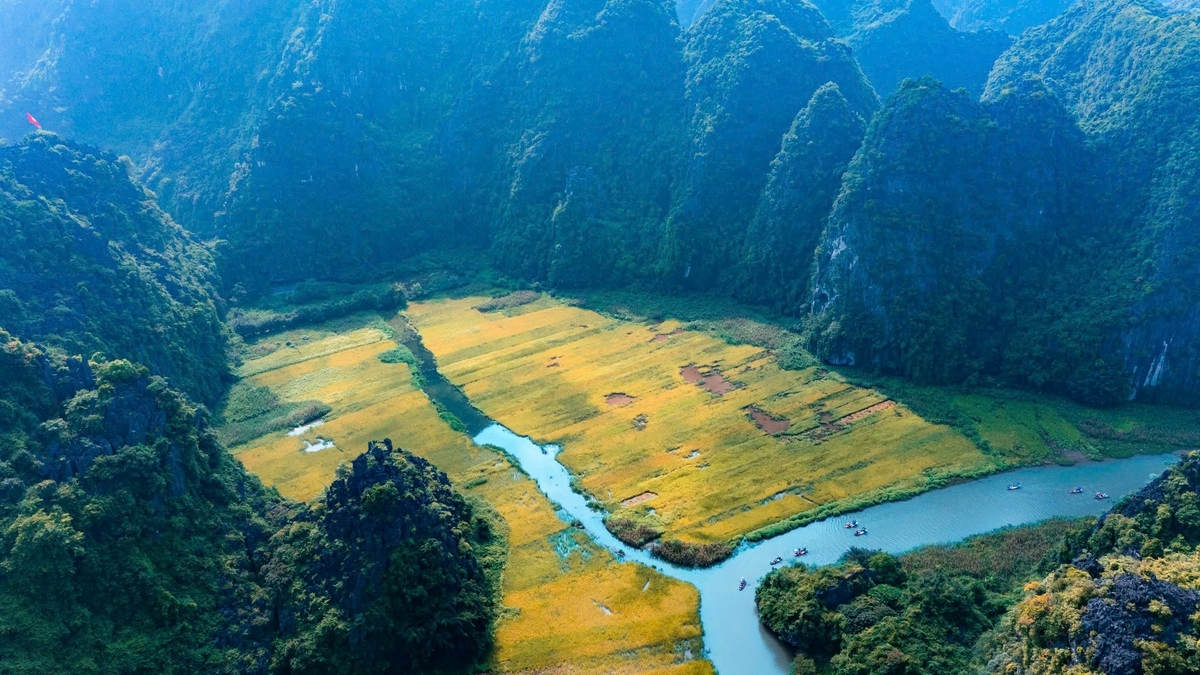
Cao Duong viewed from above. |

The gates of heaven open the way to paradise.
The road to Cao Duong is truly a fascinating test of patience and courage. To reach the "gateway to heaven," visitors must navigate a nearly 9-kilometer-long stretch of concrete with continuous hairpin bends, challenging even the most experienced drivers. However, the reward after those breathtaking curves is indescribably sweet. When the engine seems to tire, a lush, flat green valley suddenly appears halfway up the mountain.
The climate here is a gift from nature. While the northern region is experiencing scorching heat, Cao Duong remains nestled in a cool atmosphere, carrying the earthy scent of plants and the chill emanating from over 4,000 hectares of the Cham Chu primeval forest.
While engrossed in taking photos of clouds weaving through the leaves, Ms. Vo Nhu Ngoc, a tour guide from Son Binh Travel Company (Hanoi), shared: “The steep path was indeed a bit daunting, but once we reached the top, all the fatigue vanished. It's so fresh and peaceful here that I just want to take deep breaths and bring all this coolness back to the city.”
|
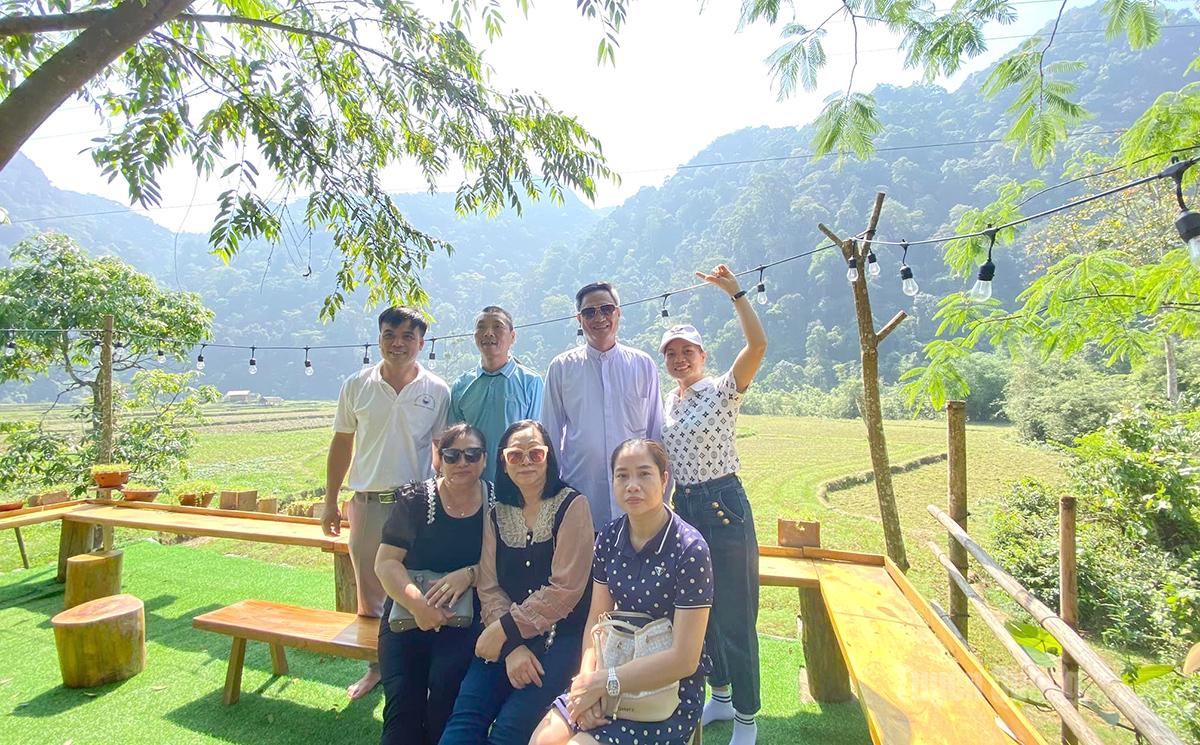
Every weekend, the number of tourists visiting Cao Duong increases. |

Sitting on the porch, sipping a hot cup of tea to start the day, Mr. Thào Chẩn Choa, the village head of Cao Đường, slowly recounted the epic story of the village's pioneering efforts. He recounted how, in the late 1970s, Mr. Giàng Tả and a few other Hmong men, while searching for precious medicinal plants, stumbled upon this valley. The migration began when eight families decided to bring their buffaloes and cattle, trekking through the forest and wading through streams to settle here. The land was fertile, and the Dao Áo Dài people also came, creating a warm and harmonious community of 80 households as it is today.
Nestled in the buffer zone of the vast forest, Cao Duong embodies a way of life in harmony with Mother Nature. This is one of the rare areas in Bach Xa commune that doesn't cultivate oranges, instead giving way to over 30 hectares of rice paddies winding along the mountain valleys. In summer, the rice is lush green, while in autumn it turns a golden yellow, like a soft silk ribbon draped across the hillsides. Beyond its dreamy scenery, this place also hides mysterious wonders such as the Roi Cave, underground streams, and the Qua Na Cave with its shimmering, ethereal stalactite formations, creating a world far removed from the mundane.
Preserving the "fire" of the forest and the pulse of green tourism.
Many years ago, Cao Duong was "bound" by hardship. Without roads or electricity, the vegetables and pigs they produced could only be used at home. But since 2019, when the power grid and concrete roads reached the mountaintop, the village has truly awakened.
Now, the winding paths in the village are being infused with a new, romantic vibrancy. The commune and the villagers have worked together to plant over 1,000 cherry blossom trees and 40 flamboyant trees scattered throughout the alleys. Before long, Cao Duong will be resplendent in color, illuminating the village with breathtakingly beautiful blossoms.
|
Tourists enjoy exploring the caves in Cao Duong. |

The transformation of Cao Duong is not noisy or hasty, but stems from the genuine love of the local people. The traditional four-room wooden houses of Mr. Duong Van Toan's family (Duong Toan homestay) and Mr. Ly Kim Thach's family (Kim Thach homestay) are now always open to welcome guests from afar. While meticulously preparing a meal to entertain guests, Mr. Ly Kim Thach simply shared: "We do tourism based on the most authentic aspects of our village."
Thanks to visitors, the sounds of the khene (bamboo flute), mouth harp, leaf trumpet, and excerpts from the Dao people's coming-of-age ceremony are revived and more vibrant. Visitors appreciate the warmth of the highland people, so everyone feels at home here. Indeed, tourists come here not only to admire the scenery, but also to experience the tear-inducing spiciness of the dipping sauce made with salt, chili, and forest leaves, to savor the smoked black pork, and to listen to the Páo dung melody soaring over the Wind Pass.
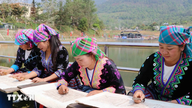


The enduring beauty of Cao Duong is thanks to a commendable sense of preservation. Comrade Doan Cai Luong, Chairman of the People's Committee of the commune, proudly spoke about the villagers' approach to tourism: "The most valuable thing is that there is an unwritten rule in the village: everyone agrees to minimize the construction of houses with corrugated iron roofs. Everyone is conscious of protecting the traditional stilt houses with palm leaf roofs, because that is the rustic essence that makes Cao Duong so attractive."
Besides preserving their traditional homes, protecting the forest is considered a "command from the heart." The village currently has 5 community groups with 15 people who regularly take turns patrolling and strictly protecting the special-use forest area. Among them are women like Ms. Hau Thi Cha, who every month nimbly treks through the forest and streams to patrol. She says: "The forest is like a mother; if we can protect the forest, we can preserve the mist and clouds, and maintain the crystal-clear water source to support tourism and ensure our livelihoods last."
With a focus on green tourism development and the expansion of the Tam Hoa plum and organic vegetable farming model, Cao Duong is steadily forging its own path. Leaving the valley as the evening shadows lengthen, the faint sound of the Hmong flute blends with the rich aroma of kitchen smoke. The gates of paradise have opened, and Cao Duong will surely be a gentle, captivating note on the journey of exploring the mountainous landscape.
According to Baotuyenquang.com.vn
Source: https://baoangiang.com.vn/tieng-goi-binh-yen-a488877.html
![[Photo] The 13th National Congress of the Youth Union conducts personnel work.](https://vphoto.vietnam.vn/thumb/1200x675/vietnam/resource/IMAGE/2026/06/24/1782299943080_ndo_br_1-6868-jpg.webp)
![[Photo] Opening Ceremony of the 13th National Congress of the Ho Chi Minh Communist Youth Union](https://vphoto.vietnam.vn/thumb/1200x675/vietnam/resource/IMAGE/2026/06/24/1782286753905_ndo_br_1-8510-jpg.webp)
![[Photo] General Secretary and President To Lam attends the Central Public Security Party Committee Conference](https://vphoto.vietnam.vn/thumb/1200x675/vietnam/resource/IMAGE/2026/06/24/1782302063612_a1-bnd-9302-9166-jpg.webp)