

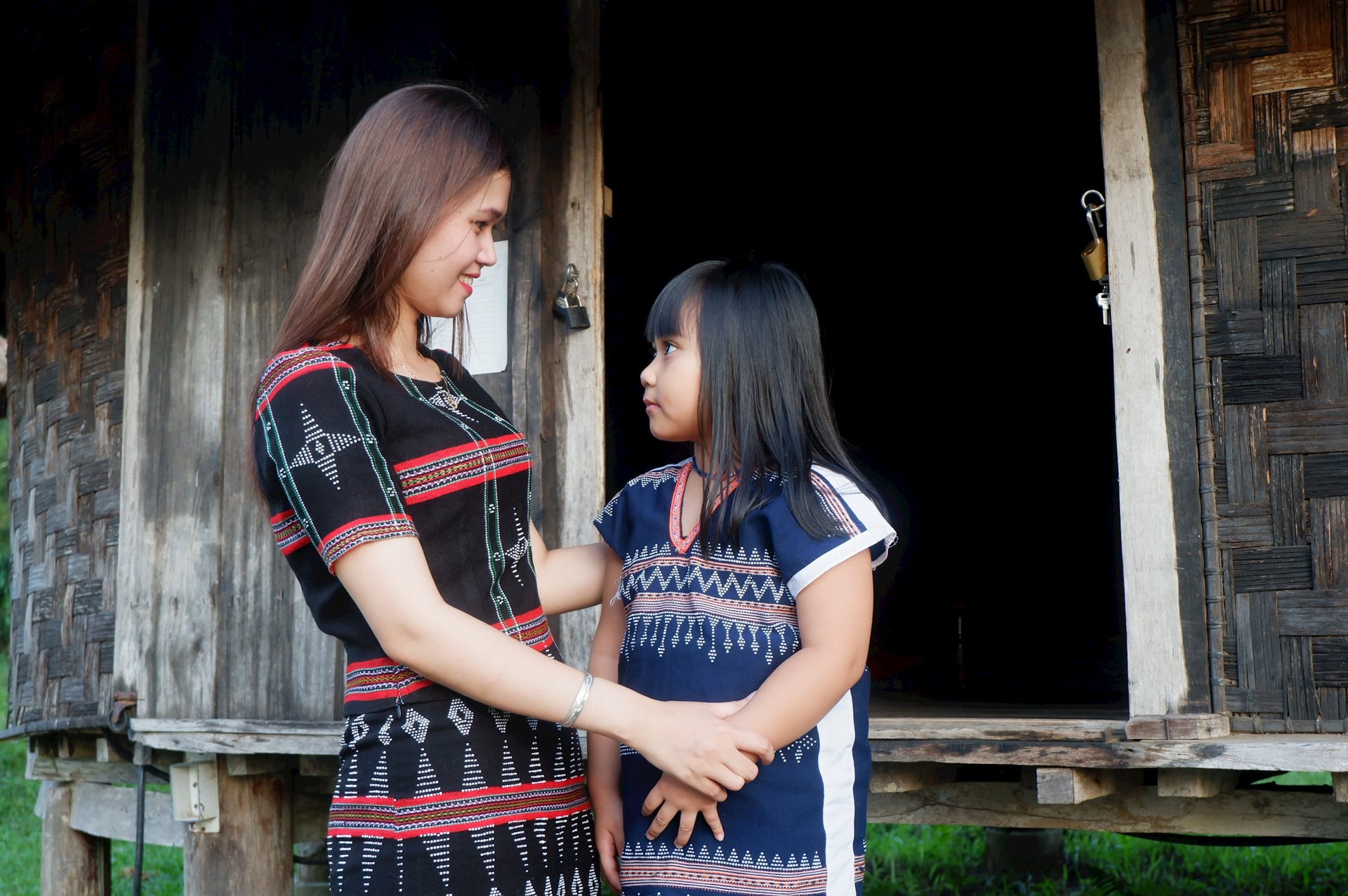
When visiting the highlands and experiencing the lives of ethnic minority communities, one easily hears ancient stories that preserve the invisible thread connecting the mountains and forests with the sea. Imagine watching the Co Tu women weaving brocade, each sparkling white bead woven into waves, swirls, betel leaves, and the sun… Or, near the Vietnam-Laos border, hearing the Gie Trieng people liken the concentric circles in their patterns to a whirlwind between the sea and the mountain valley. The Xe Dang people convey the flow of life to their origins in the kram pattern, shaped like a fish tail, evoking the idea that life originates from the vast ocean and rivers.
… like the echo of ocean waves
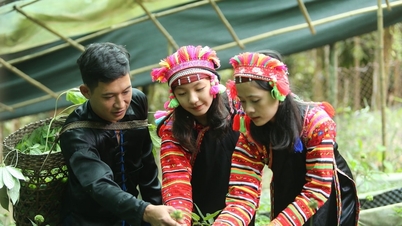
In the "visual language" of brocade colors, black commonly symbolizes the forest, yellow represents aspiration, red the sun and life, indigo plants, and white evokes purity. Depending on their skillful hands, each young woman combines colors and weaves patterns into a unique story. Some fabrics tell of the village, some mention ancestors, and some recreate an entire worldview. All are like a "river of memories," in which the sea flows silently through their fingers, permeating every thread.
In Tra My, the Co, Ca Dong, and Xe Dang people often weave sawtooth, triangular, and diamond-shaped patterns. These patterns evoke images of crashing waves, shimmering lake surfaces, or swirling red and black currents. Even in communities less connected to the sea, such as the Muong people who recently migrated from the North to Tra My, some wave patterns appear on wooden staircases, a testament to cultural exchange.
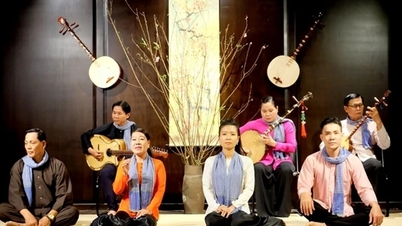
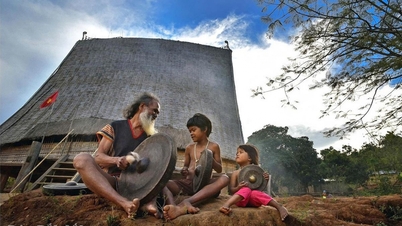
Many times, attending festivals of the highland people, when the gongs rise and the Tâng Tung Da Dá dance spins around the communal courtyard, the patterns on the skirts and blouses seem to move. I feel as if the waves are not only visible on the fabric, but also reverberate in the sound, in the footsteps, in the ancient lyrics: "Oh sea, so far away / high mountains block the way / I still dream of the day / to return and hear the waves crashing…". There are songs of the Co people in Trà My that also carry this same feeling, as if the longing for the sea has anchored itself in the consciousness of the mountains and forests.
.jpg)
…like a boat in the middle of the vast forest
Unlike the Kinh people, who often carve dragons and phoenixes on their temples and pagodas to symbolize power, the communities of the Truong Son Mountains entrust their worldview and philosophy of life to every piece of cloth, basket, and roof of the communal house... Sea waves, the moon, the sun, the rain, grains of rice - all can be transformed into patterns.
If brocade is the fabric that tells stories, then the gươl (traditional house) and longhouse are like "sails" amidst the mountain winds. The roofs of the Cơ Tu gươl curve like sails full of wind, the main and smaller pillars carved with tigers, birds, fish, and waves. Stepping into the gươl of Pơning or Arớh villages in the high mountains of Da Nang , one feels as if entering the heart of a giant ship anchored in the vast forest. I imagine the first village festival after the dawn of time, when the gongs resound, the gươl transforms into a ship carrying the souls of the people across the mountains and forests, as if reaching for the waves on the distant horizon.
Having had the opportunity to visit the Central Highlands, I felt that the Ede longhouses also carried the spirit of the sea. The staircases were carved with a pair of breasts and a crescent moon – symbolizing fertility and resembling moonlit waves on the water's surface, also reminiscent of the ebb and flow of the tides. In that space, the authority of women is intertwined with the rhythm of community life, much like the sea nurturing and protecting.
In Tra My, the village houses of the Co, Ca Dong, and Xe Dang people resemble wooden rafts crossing streams. The gables are carved with undulating waves, birds, and fish; the thick thatched roof looks like the hull of a boat, withstanding floods, rain, and wind from the source to the sea.
And memories come flooding back…
Researchers suggest that the ancestors of many Trường Sơn mountain groups originated from coastal regions, moving upstream along rivers into the mountains. Memories of the sea may be deeply ingrained in their consciousness and continue to live on in patterns, songs, and legends. Researcher Phạm Đức Dương once emphasized that Trường Sơn - Tây Nguyên culture was profoundly influenced by the Malay Archaic, with maritime traces present in language, architecture, and even myths.
But in the minds of the mountain people, the sea perhaps represents the yearning of free-spirited, open-minded, tolerant people, looking towards infinity. When weaving a spiral, the Gie Trieng people seem to recreate the rhythm of the waves. When carving the image of a fish or a boat, the Co Tu or Co people surely want to convey their dream of reaching out to rivers, streams, and the sea.
And in the firelight of the festival nights, as people sway to the dance in the valley surrounded by mountains and hills, gazing at the brocade fabrics, at the village's communal house... in the intoxicating rice wine, the heart swells and swells like ocean waves anchored against the mountains.
Perhaps, searching for the sea in the mountains isn't about seeing tangible waves, but about realizing how people preserve memories, connect the past with the present, and prevent cultural fragmentation.
The sea is waveless amidst the vast forest, yet it is subtly present in the spiral patterns and in the roofs of the communal houses that extend like sails.
It seems the sea has flowed through the underground currents of the Truong Son mountain range's consciousness since the times of sea transgression and regression…
Source: https://baodanang.vn/tim-bien-tren-nui-3305717.html







![[Photo] The colors of national unity at the 11th National Congress of the Vietnam Fatherland Front](https://vphoto.vietnam.vn/thumb/402x226/vietnam/resource/IMAGE/2026/05/17/1779001687454_ndo_br_miu-5136-jpg.webp)











































Comment (0)