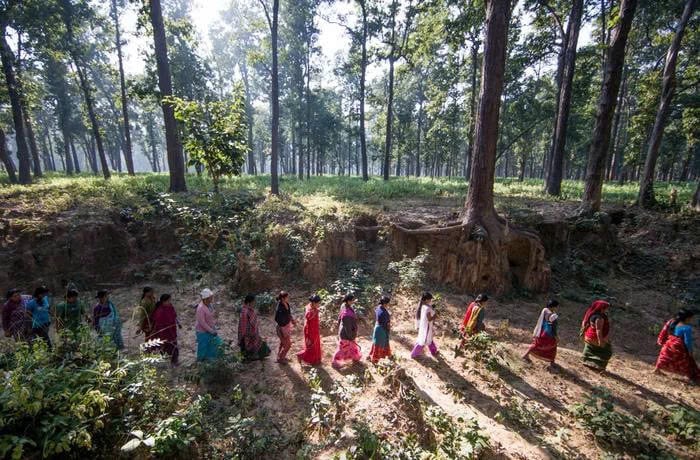
Emissions are among the lowest in the world.
The Asia-Pacific Economic Cooperation ( APEC ) forum reports that in the 2025-2026 fiscal year, the world will generate tens of millions of dollars in carbon credits from household biogas, improved water treatment plants, and small hydropower projects. Meanwhile, Nepal is also beginning to earn money from forest carbon programs.
According to The Kathmandu Post , forests cover approximately 46% of Nepal's land area, up from 29% in 1994, making the country one of the most successful community-based forest management systems studied and replicated throughout Asia.
Nepal also possesses a hydropower potential of 83,000 megawatts and has been using 100% renewable energy for many years. Nepal has very few industrial production facilities (accounting for only about 5-6% of the national GDP), and notably contributes only about 0.056% of total global greenhouse gas emissions.
For decades, agricultural communities in Nepal have played a vital role in stabilizing the economy , ensuring food security, and maintaining a low-carbon lifestyle. This has been achieved through “smart farming” models linked to indigenous knowledge and traditional conservation practices.
Nepalese farmers maintain intercropping practices, combining forestry with the use of organic fertilizers to improve soil quality and utilizing renewable energy sources such as biogas to reduce greenhouse gas emissions. These values attract the attention of the international carbon credit market, where investors and businesses increasingly appreciate sustainable agricultural production models.



Nepal is committed to achieving net-zero emissions by 2045 and views the carbon market as a crucial tool for financing forest conservation and supporting local livelihoods. Therefore, many experts believe that in the new carbon economy, "wealth" lies not only in what countries produce, but also in what they protect, reduce, and eliminate emissions from.
For Nepal, a reliable registration system is the backbone of its carbon market, helping to build trust with global partners and unlock new climate finance channels. The revenue generated can support local projects aimed at reducing emissions (such as installing clean cooking stoves in rural households, protecting community forests, and expanding renewable energy), while also creating green jobs and improving community livelihoods.
Entering the global carbon market
Last March, the Nepalese government, in collaboration with the United Nations Development Programme (UNDP), launched the National Carbon Registry (NCR). This digital platform aims to track and manage transactions in the carbon market, linking climate goals and local actions.
Each credit represents a certified unit of greenhouse gas emission reduction. This ensures that every credit is authentic, uniquely identifiable, and traceable from creation to final use, preventing fraud and duplication, according to UNDP.
In other words, the system serves as the foundation for Nepal's carbon market, enabling transparent registration, licensing, issuance, transfer, and cancellation or termination of carbon credits.
Kyoko Yokosuka, UNDP Resident Representative in Nepal, said: “A transparent system will send a strong signal to the global market that Nepal is ready to engage in credible carbon trading and mobilize financing for sustainable development.”
Nepal, the first country in Asia to finalize an Emission Reduction Credit Purchase Agreement (ERPA) worth up to $55 million with the Alliance for Emission Reduction through Enhanced Forest Finance (LEAF), is now authorized to sell up to 4 million carbon credits (equivalent to 4 million tonnes of emissions) in the three provinces of Gandaki, Bagmati, and Lumbini, supporting communities dependent on forests.



Previously, Nepal received $9.4 million from the Forest Carbon Partnership Fund (FCPF), a global partnership of governments, businesses, civil society, and indigenous peoples, administered by the World Bank, to reduce approximately 1.9 million tonnes of carbon under the REDD+ Emission Reduction Program in 13 districts within the Terai Arc landscape, Nepal's most biodiverse region.
Furthermore, recent Nepalese policies have expanded opportunities for the private sector and community-led initiatives (such as clean cooking, small-scale hydropower, and sustainable forestry) to participate in the development and trading of carbon projects.
Source: https://baodanang.vn/tin-chi-carbon-tu-be-chua-nepal-3342536.html

![[Photo] Strengthening character and expertise: Intense training for artillery soldiers.](https://vphoto.vietnam.vn/thumb/1200x675/vietnam/resource/IMAGE/2026/06/30/1782815602541_lu-368-1875-4571-jpg.webp)