

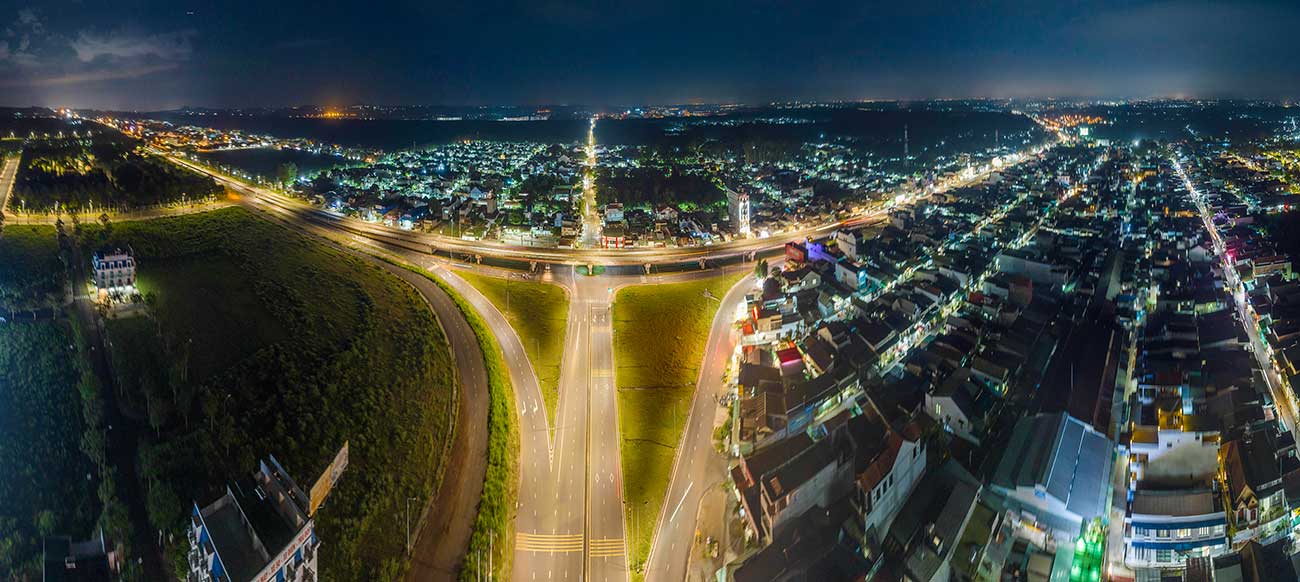
Dau Giay intersection (Thong Nhat district). Photo: Nguyen Ngoc Cuong |
C3 was stationed on this side of the Ta Lai tunnel, cooking rice and waiting for orders. It was past ten o'clock at night, and no one could sleep, still eagerly awaiting the order to depart. Moreover, the unit was only a few kilometers from the front lines, a short distance away from the line of fire. We could clearly hear the artillery fire from Tuc Trung, Gia Kiem, and Dinh Quan. Between artillery barrages, we heard the sound of a guitar. Was some platoon carrying a guitar? Someone was singing Xuan Oanh's song "Homeland of a Soldier" – "There, there are fields bathed in golden sunlight, bamboo groves, rivers, and sugarcane fields. My home has innocent-eyed, rosy-cheeked younger siblings…". Someone exclaimed excitedly, "The company commander sings so well, guys!" It was Trung singing, and he even played the guitar himself…
No new orders had been given by the battalion. Company 3 remained inactive, waiting. The campfire night gradually subsided. Some had dozed off. Others sat leaning against their backpacks, clutching their rifles, dozing off. Suddenly, they all sprang up like compressed springs at the deafening roar of the 105mm artillery shells, pounding in their ears, along with the sound of various other weapons. At 5:37 AM on March 17, 1975, the attack on the Dinh Quan sub-district by the 7th Infantry Division of the Liberation Army began. The air shook with the sound of artillery fire from both sides. An 81mm mortar shell exploded just a few hundred meters from where Company 3 was positioned. The company commander went to the platoons to remind them that the enemy was firing to block our advance. The comrades calmly waited for orders from the forward command post.
Saigon is liberated! Saigon is liberated, my fellow countrymen! Those were the joyful shouts of the people in the Dau Giay hamlet. It was a reality that still left us – the soldiers who fought in the war – stunned, as if we couldn't quite believe it. |
By the end of March 17th, the company was still lying low, awaiting orders. There was news that we hadn't completely taken control of the district. After the initial panic, the enemy had recovered, fortifying themselves in stone-walled fortifications and putting up fierce resistance. We suffered some casualties. The gunfire gradually subsided and then stopped completely. The order to march was given. The soldiers boarded vehicles and headed straight towards Định Quán. We looked out at both sides of the road and saw countless civilians fleeing in panic. Chinese and Nùng people were wearing strange, colorful clothes – something I had never seen before. Unlike in the North, where people, especially women, only wore simple black trousers and brown or white shirts, that was considered elegant. People were running in opposite directions like a procession of lanterns, not knowing where they were going. They carried babies in baskets and household items on their shoulders. Some people even carried pigs weighing 4 to 5 kilograms under their arms like babies. Some, exhausted, sat down by the roadside, using their wide-brimmed hats to shield the pigs while they themselves endured the sun.
The guerrillas, traveling in vehicle 67, shouted through a loudspeaker: "The district has been liberated. People, return home. The revolutionary government will protect the people and strictly prohibit all acts of theft and robbery." At noon, when I went to ask a family for water, I asked the homeowner:
"Did you find the Liberation Army soldiers as scary as people say?" "No," the homeowner replied. "We're not afraid. They're very gentle; they don't threaten the people at all." Then I asked, "Do you think we'll be going back to Saigon this year?" "In '68 you came back and then left again. This year..." he hesitated. "Believe me. This year we'll be going back to Saigon," I said.
That morning, we were collecting weapons from the district headquarters. The sun was blazing. The smell of burning rubber and the stench of death made us dizzy, tired, and nauseous. Around 1 PM, I was walking with a three-person team through the district headquarters' underground bunker along Highway 20 when we suddenly heard a voice calling: "Commanders of the Liberation Army, we surrender!" Soldiers from the 7th Division approached and shouted: "Put your rifle butts up first. Each of you raise both hands and come forward!" More than a dozen Saigon officers and soldiers emerged. Everyone's face was pale and distraught. The last person looked composed. Later, I learned it was Captain Chánh, the district headquarters commander. I saw a military film crew filming this scene.
The entire stretch of Highway 20 from Dau Giay to Dinh Quan - Phuong Lam was liberated. We boarded vehicles with the 7th Division to attack Lam Dong . The scouts led us along a shortcut. It was a paved road – a road used by the locals to transport timber. We reached Da Oai, a large but not deep stream where many ethnic minority girls were bathing naked. Seeing the soldiers, they acted nonchalantly as if nothing was wrong. The young soldiers were a little embarrassed. Later, we learned that this was the culture of the local people and that we had to respect it.
On March 28th, we, along with the 7th Division, took over the Lam Dong Sub-district. After a month of fighting, we arrived in Bao Loc, where the climate was cool and pleasant. Meals included various kinds of green vegetables. The supply depot provided canned meat salvaged from the sub-district's warehouse. The soldiers regained some strength. The Saigon forces here disintegrated upon hearing the roar of the liberation army's tanks. On the night of April 18th in Bao Loc town, we witnessed President Thieu's appearance on television. He bid farewell to his compatriots, condemning the Americans for abandoning the South Vietnamese army. He spoke, and at times wept: " You demand that we defeat the Viet Cong, yet you yourselves have lost... "
Through Hanoi Radio and the BBC, we learned that the battle at Xuan Loc was extremely fierce, but due to pressure from our forces from many sides, on the night of April 20th to 21st, taking advantage of the rain and darkness, the Saigon forces in Xuan Loc retreated along Highway 2 towards Vung Tau, including General Le Minh Dao. According to reports, our forces only captured the provincial governor, a colonel, and a few soldiers. The town of Xuan Loc, Long Khanh province, was completely liberated, opening a corridor for our troops to advance towards Saigon.
The company was ordered to march swiftly to Long Khánh, but had to encamp at the Dầu Giây intersection. Company commander Trung had been transferred to another company. The commander of Company 3 was Warrant Officer Phúc from Hanoi. He often gave the locals dried rice. In return, the locals gave the soldiers bananas and papayas. It turned out we were receiving a "blessing." Actually, when we were in Định Quán, Phương Lâm, and later in Dầu Giây, the locals couldn't transport bananas to Saigon to sell because the roads were blocked due to the fighting. The locals even said, "You can eat the bananas naturally, they'll spoil if you keep them for too long, it would be a waste."
Every day we would turn on the radio to watch the progress of our troops advancing on Saigon. When we collected weapons and ammunition at Trang Bom, I understood that the road to Saigon was very close. The units behind us, like ours, were also brimming with enthusiasm: "Speed, even greater speed, boldness, even greater boldness..."
Around 11:00 AM on April 30th, the air was eerily silent. What signal could this be... from the battlefield's silence? Sergeant Phat, from Ha Tay, turned on his National 3-band radio; the signal was very weak, only producing a muffled sound like someone choking. Then suddenly, we heard, albeit intermittently: " I, General Duong Van Minh, President of the Saigon government, order all soldiers... to lay down their arms... stay where you are and wait for the liberation army to arrive for the handover... "
In fact, Minh later had to declare his unconditional surrender to the liberation army on Saigon radio.
Phát and Tuấn jumped up and down, clutching their radios. Nhuận turned on the cassette radio he always carried with him, playing a bolero song: “ My love, I’m not used to living in the city anymore. Let’s take a train back to our hometown, we’ll be happier there… ”
At the Dau Giay intersection, the sky was high and clear, without a single cloud. There were no airplanes, no artillery fire. The atmosphere was peaceful and tranquil, as if war had never happened. We felt an indescribable elation. Just a few minutes ago, it felt like we had wandered into another world ...
Memoirs of Le Dang Khang
Source: https://baodongnai.com.vn/dong-nai-cuoi-tuan/202504/tin-hieu-tu-su-im-lang-9b65ccf/


![OCOP during Tet season: [Part 3] Ultra-thin rice paper takes off.](/_next/image?url=https%3A%2F%2Fvphoto.vietnam.vn%2Fthumb%2F402x226%2Fvietnam%2Fresource%2FIMAGE%2F2026%2F01%2F28%2F1769562783429_004-194121_651-081010.jpeg&w=3840&q=75)




Comment (0)