

With 44 selected poems, "Searching for Agarwood in the Mouth" demonstrates a refined, melodious language, combining carefully chosen words creatively through evocative imagery: "The smoke from the ship back then was like a dream / The vast river stretches deep green" (Many Times); "The wind blows through my hair against the mist / Flying with the dragonfly, listening to memories" (The Returning Person); or "The wine has faded in color, like autumn water / Yet I still remain intoxicated by the beauty of spring mountains." ... The collection successfully builds a consistent system of symbols such as: agarwood, agarwood, forest, wildflowers, pink grass, waves, mist... These images are repeated, creating a unique and haunting artistic space.
Notably, Ho Si Binh's poetry possesses both a solemn, ancient quality when mentioning "Su Dongpo" and "West Lake willows" in the context of humanity's concern for nature, and a breath of modern life expressing resistance and opposition to war, especially wars of aggression. In the poem "To a Friend Who Loves Reading Erich Maria Remarque," the poet offers profound insights into the works of the author of "The Western Front Remains Quiet": "The best book about war of all time / was once burned to ashes by evil forces / but who can burn wills?" ... The poem expresses a clear and decisive attitude, a warning to humanity, an indignation against any war, wherever it originates, reflecting a perspective rich in compassion and conscience.
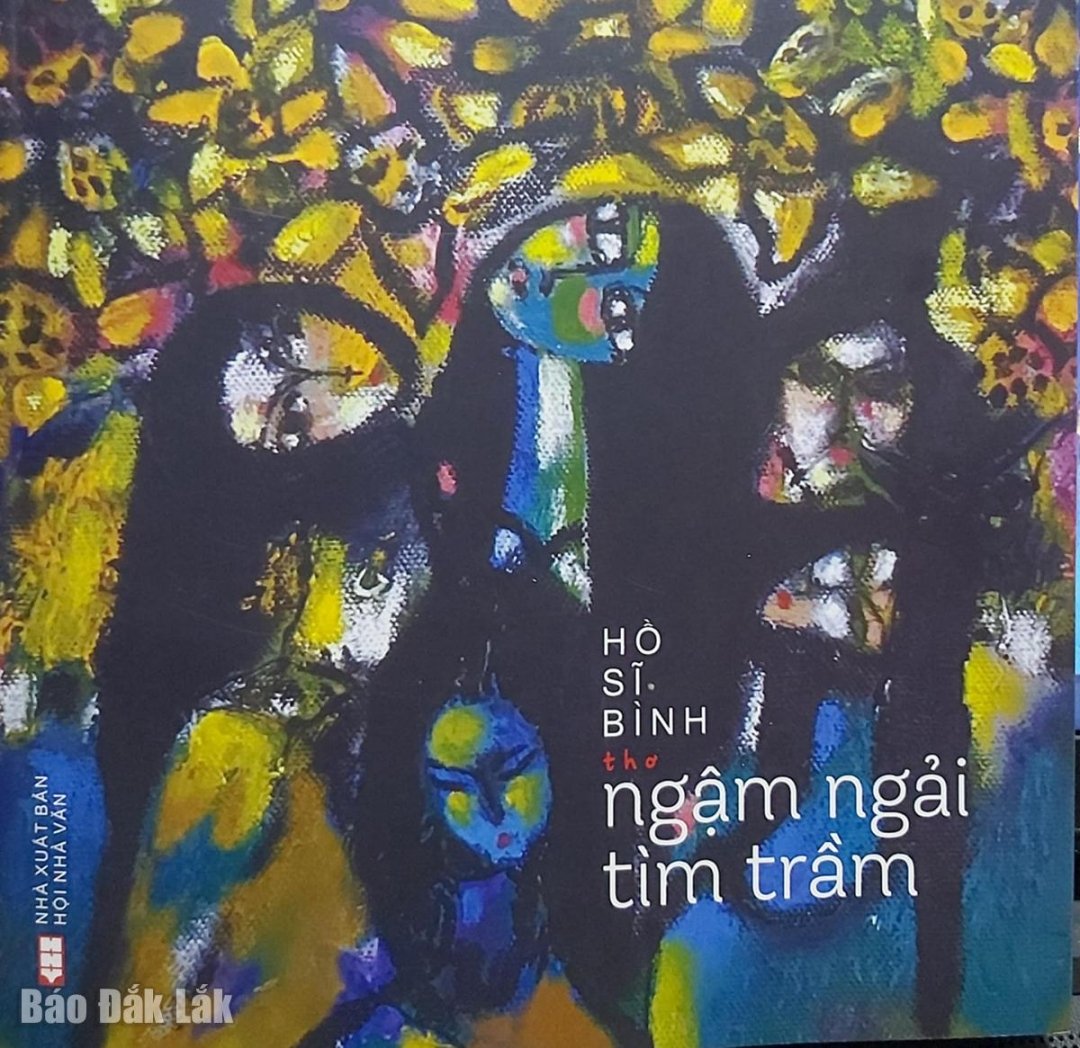 |
Throughout the collection of poems is the image of a lyrical subject on a journey to find true, precious values, like "a person who chews herbs to find agarwood," despite enduring much bitterness. "Chewing herbs to find agarwood" refers to the search for agarwood, a precious aromatic and medicinal herb that the seeker must traverse deep forests, passing through "tens of thousands of agarwood trees," "millions of winds clashing and raging," and "accumulating fragrance from their own life's wounds / concealing the pain and preserving the agarwood" to "offer to the person who chews herbs." The search is extremely arduous, sometimes requiring the sacrifice of one's life in the deep forest; therefore , "do you know / the forest's face turns gray with age / where the fairy transforms into a precious tree" (Chewing Herbs to Find Agarwood). The poem uses language full of metaphors and allegories. This is the main theme and emotional thread that creates a multi-dimensional artistic world within the collection. Besides the search for eternal beauty, "only beauty can save the world" (Dostoevsky), hidden within the poetic imagery are moments of reunion in romantic love, the search for and longing for a loving encounter, whether experienced from youth to a lifetime. And sometimes, amidst fragile hope, exhausted by the vicissitudes of life, there may not be a moment of "reunion amidst a thousand sorrows": "Whose eyes are filled with the colors of sorrow/ yet youth still knocks at the door of life/ such a charming smile/ the fragrance wafts in the early morning sun on the hill" (The Color of Flowers on the Waves).
Love also takes on many nuances in poetry: there is waiting, passionate moments, and also separation and distance. The image of the girl is a major source of inspiration throughout the collection, appearing vaguely in "floral dresses," in "blue skirts," "when stepping out from vast fields of flowers and grass." There is something both concrete and symbolic of beauty, of what the author pursued from his sacred youth, written in a predominantly melancholic, reflective, and contemplative tone, yet not sentimental, thanks to moments of innocence, romance, and an enduring belief in beauty and love, expressed flexibly in the poetry with a gentle, profound, and heavy sense of melancholy.
"Searching for Agarwood" repeatedly mentions flowers with their symbolic meanings that inspire creativity. Flowers are not merely objects of description but have become lyrical subjects, imbued with a passionate love and unspoken feelings: "The flowers have returned to my ivory hands / like love long awaited" (Evening on the Old Hill); "Where wild daisies and sunflowers bloom / the melancholic notes linger in the desolate wilderness… where the call from the abyss of error is heard" (Where the dream began too late). It is no coincidence that there are "white wildflowers swaying aimlessly," "flowers of five colors blooming profusely in all four seasons," "someone far away burdened by the cloak of the wild sunflower," "wildflowers swaying on the porch," "is there still the scent of wildflowers at night," "morning glory with its epic purple heart," "pure white cosmos flowers"... These "pitiful" wildflowers, whose names are little known / have quickly forgotten / but I remember / I cherish them" (A Word of Gratitude Rescued from Memory). The story of the wildflowers here is also the story of suffering people whose values and qualities are sometimes overlooked and carelessly disregarded by the world.
“Searching for Agarwood in the Mouth” demonstrates the maturity in the style of author Ho Si Binh. The poetry collection is not only an expression of personal emotions but also touches upon universal issues of human existence: the journey to find the essence of eternal beauty that literary creation aims for. It is a journey to discover quintessential beauty from profound life experiences, expressed through a refined poetic language and a haunting world of imagery…
Tran Trung Sang
Source: https://baodaklak.vn/van-hoa-du-lich-van-hoc-nghe-thuat/van-hoc-nghe-thuat/202507/tinh-yeu-va-cai-dep-vinh-hang-76d121b/
![[Image] National Assembly discusses the implementation of the socio-economic development plan.](https://vphoto.vietnam.vn/thumb/1200x675/vietnam/resource/IMAGE/2026/04/20/1776696707422_ndo_br_img-20260420-185419-jpg.webp)


![[Photo] General Secretary and President To Lam meets with National Assembly delegates from ethnic minorities.](https://vphoto.vietnam.vn/thumb/1200x675/vietnam/resource/IMAGE/2026/04/20/1776696701056_a1-bnd-8331-3342-jpg.webp)
















































































Comment (0)