

Singapore: The wooden building at Nanyang Technological University has an impressive green design, including photovoltaic panels that produce more electricity than is needed.
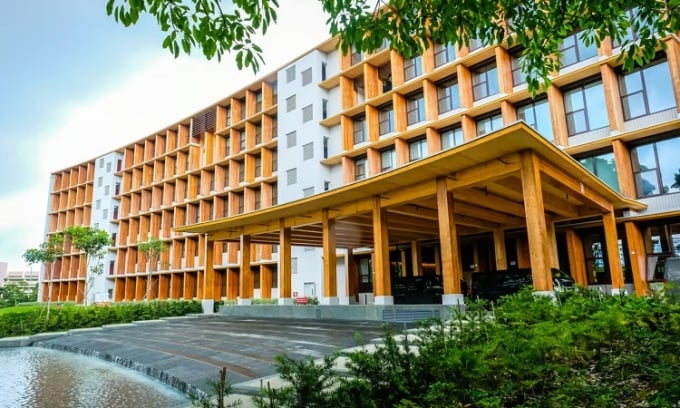
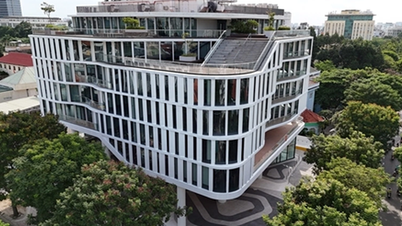
The Gaia building is constructed primarily from solid wood blocks. Photo: NTU
Gaia, Asia's largest wooden building, was designed by Toyo Ito & Associates and built in collaboration with RSP, New Atlas reported on May 19. The building is located on the campus of Nanyang Technological University (NTU) in Singapore, next to the Heatherwick Studio Learning Centre and near Wave, also designed by Ito. The building is only six stories high but measures 220 meters in length and has a floor area of 43,500 square meters. For comparison, the world's tallest wooden building, Mjøstårnet, has 18 stories.
Gaia is shaped like two slightly separate, curved rectangular blocks that intersect at several points. Structurally, the structure is primarily composed of solid wood blocks made of CLT (cross-laminated timber) and Glulam (glucanized plywood) in equal proportions. However, like many modern timber projects, the building also incorporates some concrete reinforcement. In this case, concrete is used for the staircase, toilets, and floor slabs.
The building will serve the teaching activities of Nanyang Business School with a 170-seat auditorium, 12 lecture halls, 13 seminar rooms, and classrooms. The interior design utilizes natural wood, glazed finishes, and skylights, ensuring ample natural light.
Gaia received Singapore's Green Mark Platinum (Zero Energy) award for buildings that generate more energy than they consume. The solar panels on the roof produce 516,000 kWh of electricity annually. Sunshades on the exterior help reduce solar heat. The building also features numerous open spaces, terraces, and skylights for ventilation.
According to NTU, Gaia's energy-efficient design means the building generates 2,500 tonnes less CO2 per year than a standard building of similar type and size.
An Khang (According to New Atlas )
Source link
![[Photo] General Secretary and President To Lam meets with National Assembly delegates from ethnic minorities.](https://vphoto.vietnam.vn/thumb/1200x675/vietnam/resource/IMAGE/2026/04/20/1776696701056_a1-bnd-8331-3342-jpg.webp)
![[Image] National Assembly discusses the implementation of the socio-economic development plan.](https://vphoto.vietnam.vn/thumb/1200x675/vietnam/resource/IMAGE/2026/04/20/1776696707422_ndo_br_img-20260420-185419-jpg.webp)









































































Comment (0)