House prices rise with infrastructure development.
According to experts, with the first metro lines beginning operation and a series of specific mechanisms for urban development oriented towards public transport being enacted, Vietnam is facing an opportunity to restructure its urban space in a more sustainable direction.
However, along with expectations of economic growth and increased property values around train stations, a question arises as to whether TOD can contribute to solving the housing problem in major cities, especially in the context of shrinking housing access for the population.

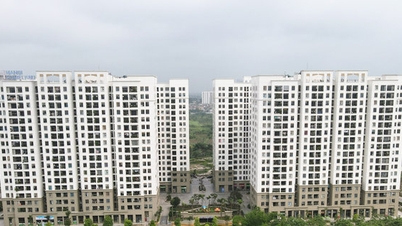
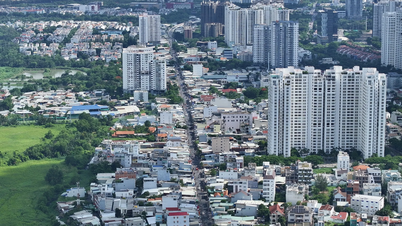
Real estate projects that are located near transportation infrastructure projects, such as metro lines, always maintain their unique appeal. Photo: Thuc Vy.
Ms. Giang Do, National Director of Consulting & Valuation at Savills Vietnam, commented that the success of TOD should not be measured by the increase in land prices around train stations, but by its ability to help various population groups access housing, jobs, and amenities in a sustainable urban environment. That is the core objective of TOD.
This perspective is particularly noteworthy given the increasing challenges to accessing affordable housing in major cities. Savills Vietnam data shows that the structure of apartment supply in Hanoi and Ho Chi Minh City has shifted significantly in recent years. Before 2020, Class C apartments accounted for over 80% of transactions in the market.
However, during the 2021-2025 period, this segment declined to below 35%, while Class A and B apartments accounted for over 95% of transactions in Hanoi. By the first quarter of 2026, Hanoi recorded no new supply of Class C apartments, while in Ho Chi Minh City, this segment only accounted for about 29% of primary supply. Simultaneously, the apartment price index in Hanoi has more than doubled compared to 2009, reflecting increasing pressure on homebuyers.


According to Ms. Giang, if the TOD (Transit-Oriented Development) process causes land prices around metro stations to continue rising sharply without appropriate regulatory mechanisms, the group that uses public transport the most, including workers and the middle class, could be pushed away from areas with the best infrastructure.
In reality, the market in Ho Chi Minh City shows that apartment prices along metro lines are always higher and have continuously increased since the time of sale, with an average increase of 35%-70% depending on location, and in some cases, projects have doubled in value between 2015 and 2023.
In Ho Chi Minh City, specifically in the Thao Dien area (formerly Thu Duc City), Masteri Thao Dien apartments, located near the metro line connecting the city center to Thu Duc, were launched in late 2014 and 2015 with prices ranging from 35-39 million VND/m2. Now, secondary market prices range from 80-141 million VND/m2; apartment prices in the Van Thanh area range from 80-150 million VND/m2, and in the Suoi Tien - New Eastern Bus Station area from 45-80 million VND/m2…
Therefore, without decisive intervention and regulation from the state, many experts believe that TOD (Transit-Oriented Development) will inadvertently become a "spark" that ignites real estate prices, making it increasingly difficult for middle- and low-income workers to own homes.
Multiple solutions are needed.
For TOD (Transit-Oriented Development) to truly become a tool to support housing goals, Ms. Giang Do believes that three groups of solutions need to be implemented simultaneously: planning, financial mechanisms, and land management.
First and foremost is the planning aspect. Instead of a model of separate functional zones, the areas around the train station should be developed as mixed-use, high-density urban areas, allowing people to live, work, and use amenities all within the same area.
Accordingly, social housing and affordable housing can be integrated directly into TOD areas, especially within a radius of 300-500 meters around the train station, equivalent to a 5-10 minute walk. This allows low- and middle-income earners to directly access the public transportation system instead of having to live in areas far from the city center.
Besides planning, the financial mechanism is a crucial factor determining the feasibility of implementation in practice. If only businesses are required to develop social housing without appropriate compensation mechanisms, TOD projects will find it very difficult to achieve financial viability. Therefore, policies attractive enough to encourage private sector participation need to be developed.



The third set of solutions relates to land management and the exploitation of public land. When auctioning or allocating land around metro stations, the State needs to include public requirements in the bidding documents, such as the proportion of social housing, public spaces, pedestrian connections, or affordable rental housing. This is a way to ensure that the benefits from infrastructure are distributed more broadly instead of being solely reflected in real estate values.
Another approach is the cooperative development model, in which the State contributes clean land, the private sector undertakes investment and construction, and a portion of the product is handed over to serve public purposes or develop social housing.
"The current challenge is no longer whether or not to implement TOD (Transit-Oriented Development), but rather how to ensure synchronized implementation across planning, finance, and land management. If done correctly, TOD could become one of the most important tools for solving urban housing problems in the next 10 to 20 years," Ms. Giang Do emphasized.
Source: https://nongnghiepmoitruong.vn/tod-va-bai-toan-nha-la-de-o-d816097.html